
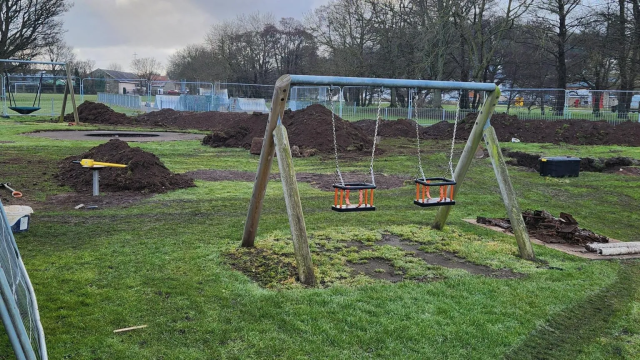
Discovery of unexploded ordnance
More than 175 unexploded bombs from World War II have been uncovered beneath a children’s playground in northern England, raising concerns about public safety. According to a BBC report, the ordnance, identified as practice bombs, still contains live charges. The discovery was made in Wooler, Northumberland, in January, and experts warn that additional explosives could still be buried underground.
Potential hazards and historical context
A press release from the Wooler Parish Council highlighted the risks associated with the find. “As these have been found with their fuse and contents still intact—and the detonator burster and smoke filling in particular can still be potentially hazardous,” the statement read.
Authorities believe that the area was formerly used as a Home Guard training site, with ordnance buried deep underground following the war’s conclusion.
Discovery halts playground construction
In December, the Wooler Parish Council secured a £150,000 (Rs 1.6 crore) grant to expand the play area in Scotts Park. However, construction was abruptly halted on the first day after workers unearthed a suspicious object, prompting an immediate alert to authorities.
‘Scale of the problem’ larger than expected
The Parish Council hired Brimstone Site Investigations to conduct an initial two-day survey. However, as excavation continued, it became clear that the situation was far more severe than anticipated.
“By the end of day two, the pit had been extended to 2 meters square, and a further 90 practice bombs had been recovered and safely removed to the designated storage area,” the council reported.
Officials express shock and frustration
County Councillor Mark Mather, reflecting on the unexpected situation, remarked, “I never thought as a parish councillor I’d be dealing with bomb disposal.” He also voiced concerns about the safety risks posed by the decades-old explosives, adding, “It’s quite something to think the children have been playing on bombs, and it’s been a really challenging situation.”
The work is expected to continue until at least mid-February, though funding for the operation remains uncertain.
Limited support from the Ministry of Defence
Councillor Mather expressed disappointment over the Ministry of Defence’s (MoD) response, stating, “The Army will not support us in any way, either looking for the ordnance or removing it, which has been extremely disappointing.”
According to the MoD, an official team has visited the site only twice since the initial discovery in January.