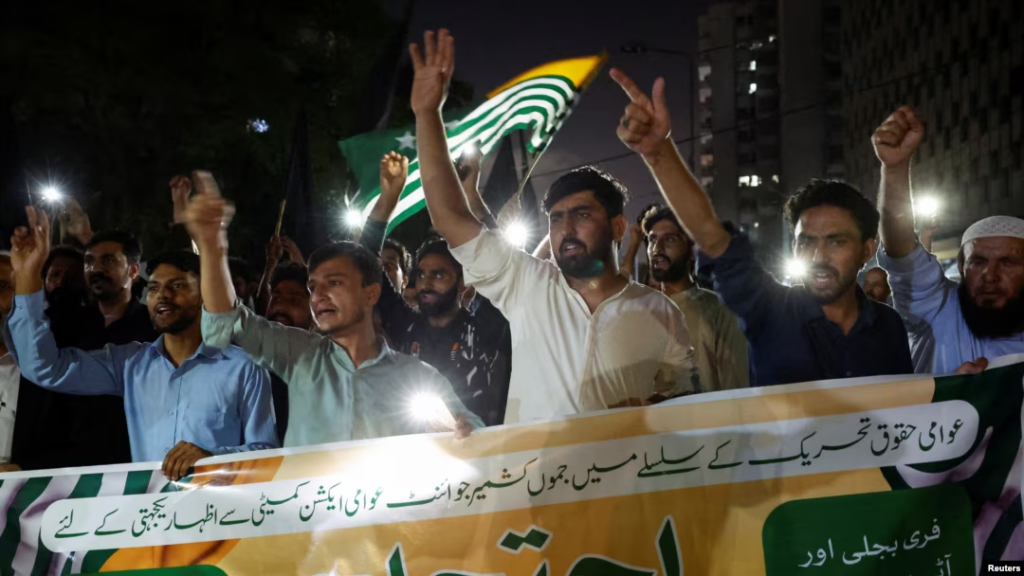
Tensions in Pakistan-occupied Kashmir (PoK) have spiralled into one of the region’s deadliest periods of unrest in recent years, with violent clashes between Pakistani security forces and protesters leaving at least 30 people dead and more than 200 injured, according to official estimates. Activists on the ground claim the toll may be significantly higher.
The unrest, centered around the growing influence of the Joint Awami Action Committee (JAAC), has exposed long-simmering frustration over economic hardship, political representation, and Islamabad’s control over the disputed territory.
The violence has also triggered international attention. More than 30 British lawmakers have urged the UK government to intervene diplomatically amid allegations of excessive force, arbitrary arrests, and communication blackouts in the region.
Why Are Protests Erupting in Pakistan-Occupied Kashmir?
The latest wave of protests began after authorities in PoK banned the Joint Awami Action Committee (JAAC). This grassroots political movement has increasingly become the voice of public dissatisfaction in the region.
The group has organized demonstrations around several key issues:
- Rising inflation
- High electricity tariffs
- Taxation policies
- Shortages of subsidised flour
- Political marginalization
- Alleged interference from Islamabad in local governance
The JAAC had planned a large-scale protest march to pressure authorities into implementing its 38-point charter of demands. Instead, the government outlawed the organization, triggering widespread demonstrations across cities, including Muzaffarabad, Rawalakot, Bhimber, and Mirpur.
For many residents, the movement represents more than an economic protest. It has evolved into a broader challenge against what protesters describe as Pakistan’s heavy-handed governance in the region.
Rawalakot Became the Flashpoint
The deadliest violence unfolded in Rawalakot, where security forces allegedly opened fire on mourners attending a funeral procession connected to the protests.
Local reports suggest:
- At least 11 people were killed in Rawalakot alone
- More than 70 were injured
- Funeral gatherings rapidly turned into anti-government demonstrations
Videos circulating online appear to show chaotic scenes as crowds fled gunfire and security personnel attempted to disperse protesters.
The incident has become a rallying point for demonstrators, with activists accusing Pakistani authorities of using disproportionate force against civilians.
Viral Videos Intensify Public Anger
Footage emerging from multiple towns in PoK has amplified tensions further.
In Bhimber, videos appear to show protesters attacking a convoy of Pakistan Rangers and army personnel headed toward the Mirpur district. In Muzaffarabad, separate visuals allegedly captured security forces firing tear gas shells at stone-pelting demonstrators.
While independent verification of all videos remains difficult, the imagery has fueled outrage both inside PoK and among the Kashmiri diaspora abroad.
What Is the Joint Awami Action Committee (JAAC)?
The JAAC is not a traditional political party. It emerged as a grassroots coalition advocating economic relief and political reforms in Pakistan-administered Kashmir.
Over the past year, the organization gained traction by mobilizing residents frustrated with soaring living costs and what they view as limited political autonomy.
One of its most controversial demands involves the abolition of 12 reserved “refugee seats” in the PoK Legislative Assembly.
Why Are the “Refugee Seats” Controversial?
These seats are reserved for families displaced during the 1947 partition and subsequent Kashmir conflict who later settled in Pakistan.
JAAC supporters argue that:
- The seats allow mainstream Pakistani political parties to influence local governance
- Representatives tied to Islamabad hold disproportionate sway over PoK politics
- The system weakens local democratic control
Critics of the movement, however, say eliminating the seats could disenfranchise communities with historical claims tied to Kashmir.
The issue has become symbolic of a larger debate: how much political independence PoK truly has from Pakistan’s central government.
Pakistan Faces Growing International Scrutiny
The unrest is no longer confined to the region itself.
Demonstrations have spread internationally, particularly among Kashmiri diaspora communities in the United Kingdom.
Outside the Pakistani Consulate in Bradford, protesters accused Islamabad of carrying out violent crackdowns against civilians in PoK. Organizers alleged that authorities used excessive force against demonstrators, especially in Rawalakot.
The backlash prompted nearly 30 British MPs, led by Bradford East MP Imran Hussain, to call for diplomatic engagement from the UK government.
The lawmakers reportedly raised concerns about:
- Civilian deaths
- Arrests of activists
- Internet and communication restrictions
- Escalating political instability
This internationalization of the issue could create additional diplomatic pressure on Pakistan, especially given the UK’s sizable Kashmiri-origin population.
India Responds Sharply to the Violence
India has also seized on the unrest to criticize Pakistan’s governance of the region.
New Delhi reiterated its longstanding position that Pakistan “illegally and forcibly” occupies the territory. Indian officials condemned what they described as Islamabad’s “brutality” against civilians and called on the international community to hold Pakistan accountable for alleged human rights violations.
The comments come against the backdrop of already strained India-Pakistan relations, where Kashmir remains the core geopolitical flashpoint.
Why This Matters Beyond Kashmir
The current unrest carries implications far beyond local protests.
Several factors make the situation particularly sensitive:
1. Economic Instability Across Pakistan
Pakistan is already struggling with:
- High inflation
- IMF-driven austerity measures
- Political instability
- Energy shortages
Economic frustration in PoK reflects broader national discontent.
2. Rising Distrust of State Institutions
The protests suggest growing skepticism toward both local authorities and Pakistan’s federal institutions.
If the movement expands, Islamabad could face pressure to negotiate rather than rely solely on security measures.
3. International Human Rights Concerns
The involvement of British MPs and diaspora activism increases the likelihood of greater international scrutiny over Pakistan’s handling of dissent in PoK.
Human rights organisations may also push for independent investigations into civilian casualties.
Information Blackouts Complicate Verification
One of the biggest challenges in understanding the full scope of the violence is the lack of independently verified information.
Activists claim the death toll exceeds 100, while official figures remain significantly lower.
Reports of:
- Internet disruptions
- Communication restrictions
- Arrests of activists
have made fact-checking increasingly difficult.
This information vacuum has allowed competing narratives from Pakistani officials, activists, and Indian authorities to dominate online discourse.
What Happens Next?
The trajectory of the protests may depend on whether Pakistani authorities choose negotiation or escalation.
If the JAAC movement continues to gain support, Islamabad could face mounting pressure to address economic grievances and political representation concerns in PoK.
But the use of force risks deepening resentment and further internationalising the issue.
For now, Pakistan-occupied Kashmir remains on edge — and the latest violence has exposed how quickly economic frustration can evolve into a larger political crisis in one of South Asia’s most disputed territories.