
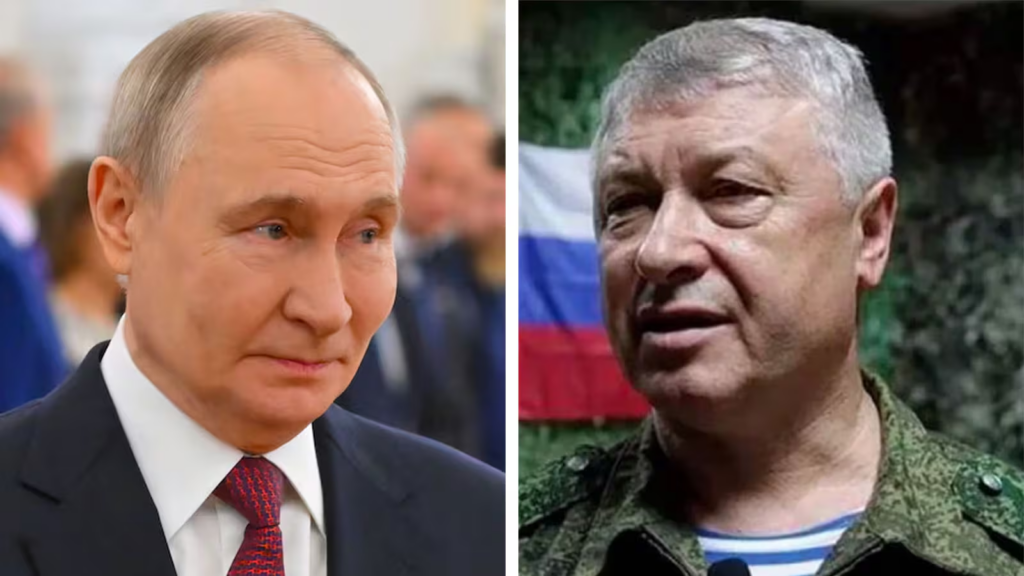
The shooting of senior Russian officer Vladimir Alexeyev has added another tense chapter to a war already fought far beyond the battlefield. The attack, carried out near his Moscow apartment building, underscores a pattern: the conflict between Russia and Ukraine increasingly spills into covert operations, sabotage, and targeted violence.
Alexeyev was not a mid-level bureaucrat. He was one of the most powerful intelligence figures in Russia, deeply embedded in military planning and international operations for more than a decade.
What happened in the Moscow shooting?
Lieutenant General Vladimir Alexeyev, first deputy head of Russia’s military intelligence agency, the GRU, was shot multiple times outside his residence.
According to reports, an attacker waited near the building entrance and confronted him as he left for work. During the struggle, Alexeyev sustained gunshot wounds to:
- the chest
- an arm
- a leg
He was hospitalized. Authorities launched a major investigation, and the Kremlin was immediately informed.
Russian officials suggested the incident was part of a broader campaign targeting military leadership during the Ukraine war.
Why this attack stands out
Russia has seen several explosions, car bombings, and assassinations since the invasion of Ukraine began. But attacks on figures as senior as Alexeyev are rare.
He sat near the top of Russia’s military intelligence hierarchy. Targeting him is less symbolic and more strategic. It signals intent to disrupt command networks rather than merely send a political message.
Who was Vladimir Alexeyev?
Alexeyev, 64, served as first deputy chief of the GRU since 2011. In practical terms, he functioned as the agency’s operational engine room.
Early life and career rise
He was born in Soviet-era Ukraine and joined the Soviet military system before the collapse of the USSR. Over decades, he advanced through intelligence operations rather than public political roles, which kept him largely unknown outside security circles.
His reputation inside Russia’s defense establishment was built on field operations rather than diplomacy.
Key roles he held
He oversaw or participated in operations tied to:
- the Russian military campaign in Syria
- planning linked to the Ukraine conflict
- coordination with paramilitary groups
- international covert activities attributed to Russian intelligence
He was awarded the Hero of Russia medal in June 2023, one of the country’s highest state honors.
Why was he important to Russia’s war strategy?
Alexeyev was not just a manager. He bridged military operations and irregular warfare.
Link to Wagner group
He reportedly managed relations between the Defense Ministry and the Wagner mercenary organization. During the early Ukraine war period, Wagner handled some of the most intense front-line fighting.
This role made him uniquely valuable because modern wars increasingly blend:
- official armed forces
- private military contractors
- intelligence operations
- cyber warfare
Alexeyev’s position sat exactly at that intersection.
International controversies and sanctions
Western governments accused Alexeyev of involvement in several major international incidents. He was sanctioned by the United States and the European Union.
Allegations tied him to:
- interference in the 2016 US presidential election
- the poisoning of former Russian agent Sergei Skripal in the UK
Russia denied these accusations, but they elevated his global profile within intelligence communities.
Did the Ukraine war influence the attack?
Russia blamed Ukraine for the shooting, calling it an attempt to sabotage negotiations and destabilize leadership. No public evidence was presented.
However, the broader pattern gives context.
Rising attacks inside Russia
Since the war began, Russia has experienced:
- assassinations of officials
- drone strikes deep inside the country
- sabotage against infrastructure
- attacks on military recruitment centers
Ukraine has acknowledged responsibility for some operations while denying others.
The war now operates on two planes:
- open battlefield fighting
- covert operations targeting leadership and logistics
The Alexeyev shooting fits squarely into the second category.
Why intelligence officials are becoming targets
Modern conflicts rely less on sheer troop numbers and more on coordination networks. Removing a senior planner can disrupt:
- battlefield decision-making
- communications
- international coordination
- paramilitary integration
In effect, targeting intelligence leadership can slow military action without engaging in full-scale confrontation.
What this means for Russia’s security posture
After the attack, the Kremlin indicated security for senior officers would increase.
This suggests a recognition that the war’s geography has expanded. The front line is no longer confined to trenches and artillery ranges. It now includes cities, transport hubs, and residential buildings.
In intelligence terms, the conflict has shifted toward a shadow war.
The broader geopolitical message
The shooting highlights a transformation in 21st-century warfare:
- wars extend beyond borders
- civilians live near operational targets
- intelligence officials face direct physical risk
- negotiations occur alongside sabotage
The Alexeyev case illustrates how high-ranking figures have become operational assets rather than distant administrators.
TL;DR
Vladimir Alexeyev, deputy head of Russia’s GRU military intelligence, was shot near his Moscow residence. A veteran of operations in Syria and Ukraine and a key liaison with paramilitary forces, he represented a critical node in Russia’s war planning network. The attack reflects a wider shift in the Russia-Ukraine conflict toward covert operations targeting leadership rather than only battlefield forces