

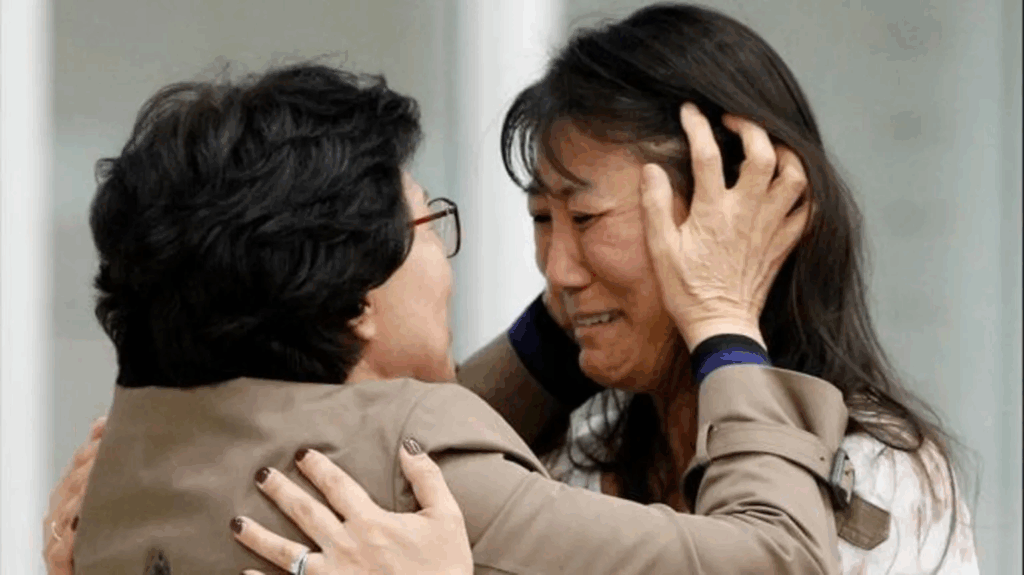
DNA match leads to emotional reunion and legal challenge over forced adoption
A South Korean woman has reunited with her daughter 44 years after the two were separated under circumstances now linked to the country’s controversial overseas adoption practices. The emotional reunion was made possible through a DNA match facilitated by 325 Kamra, a nonprofit organization that helps Korean adoptees reconnect with their biological families.
In May 1975, Han Tae-soon left her six-year-old daughter, Kyung-ha, playing near their home in Seoul while she went to the market. When she returned, her daughter had vanished without a trace.
Daughter taken by stranger and sent abroad for adoption
Decades later, it was revealed that young Kyung-ha had been approached by a woman who falsely claimed her mother no longer wanted her. The woman took her to a train station, and after a brief journey, Kyung-ha was placed in an orphanage. She was later flown to the United States and adopted by a couple in Virginia, eventually taking the name Laurie Bender.
Now a nurse living in California, Bender was connected to Han through a DNA match in 2019. After confirming their identities through multiple phone conversations, she traveled to Seoul, where the two shared a tearful and cathartic reunion.
‘I had to touch and feel the hair to confirm it’
“I’ve been a hairdresser for 30 years. I can quickly tell if it’s my daughter just by feeling her hair. I had mistakenly thought I found her before, so I had to touch and feel the hair to confirm it,” Ms. Han told the BBC.
The reunion not only brought long-awaited closure but also opened the door to new legal action. Han is now suing the South Korean government, alleging that it failed to protect her daughter from being forcibly taken and illegally adopted abroad.
First lawsuit to challenge South Korea’s adoption history
Ms. Han’s lawsuit marks the first legal challenge against South Korea’s long-criticized overseas adoption program. It follows a landmark government inquiry earlier this year that concluded successive South Korean administrations had committed human rights violations by enabling private agencies to send children overseas on what was described as an “industrial scale” for profit.
“I spent 44 years ruining my body and mind searching for [my daughter]. But in all that time, has anyone ever apologized to me? No one. Not once,” said Han, whose legal battle is now drawing national and international attention.
A broader reckoning for Korea’s adoption legacy
The case has reignited debate over South Korea’s international adoption policies, which from the 1950s onward led to the adoption of more than 200,000 Korean children overseas, primarily to the United States and Europe. Advocates say Han’s story is not an isolated one and reflects a broader pattern of negligence, coercion, and systemic abuse.
As the South Korean government faces growing scrutiny, Han’s lawsuit could set a powerful precedent for other families seeking justice for similar separations.


