
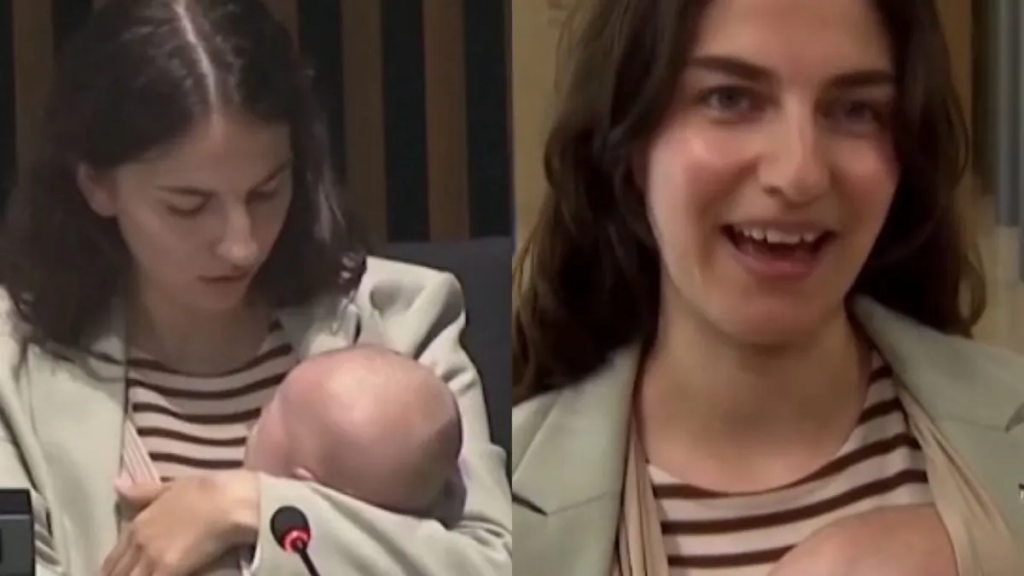
A three-month-old baby unexpectedly became one of the youngest attendees ever at a high-level European Union meeting after Sweden’s Climate Minister Romina Pourmokhtari brought her son, Adam, to a gathering of EU environment ministers in Luxembourg.
The moment quickly drew international attention, not because the infant participated in policy discussions, but because it underscored a broader message: balancing public service and parenthood should not require choosing one over the other.
Pourmokhtari said she wanted to demonstrate that modern parental leave policies can enable both parents to remain active in family life and their careers. The appearance also highlighted Sweden’s generous parental leave system, which is widely regarded as one of the world’s most family-friendly.
Why did Romina Pourmokhtari bring her baby to the EU meeting?
Romina Pourmokhtari said her decision was intentional.
The Swedish minister wanted to demonstrate that becoming a parent should not force women to step away from leadership roles or professional responsibilities. She also emphasized that this balance is only possible when fathers take an equal role in childcare.
Speaking after the meeting, Pourmokhtari credited her husband with making the arrangement possible, noting that he accompanied her on the trip and cared for their son outside the formal sessions.
Her message reflected a broader philosophy behind Sweden’s family policies: parenting responsibilities should be shared rather than falling primarily on mothers.
Was this a first for the European Union?
According to an EU Council official, yes.
The council confirmed that it was the first time in the institution’s history that a baby had accompanied a minister during an official meeting.
Although Adam did not participate in negotiations, his presence became one of the meeting’s most talked-about moments, drawing attention away from climate policy and toward work-life balance in public office.
Who is Romina Pourmokhtari?
Sweden’s youngest-ever cabinet minister
Romina Pourmokhtari made history in 2022 when she became Sweden’s youngest government minister at age 26.
Now 30, she serves as Sweden’s Minister for Climate and the Environment and has become one of Europe’s most recognizable young political leaders.
She recently returned to work after taking parental leave following the birth of her son.
How does Sweden’s parental leave system work?
Sweden consistently ranks among the world’s most generous countries for family benefits.
Parents are entitled to roughly 16 months of paid parental leave per child, which they can largely divide between themselves.
“Dad months” encourage fathers to participate
One distinctive feature of Sweden’s system is that part of the leave cannot be transferred.
Each parent receives 90 days reserved exclusively for them. If those days are not used, they expire instead of transferring to the other parent.
Often referred to as “dad months,” the policy was introduced to encourage fathers to spend more time caring for their children while promoting greater gender equality at home and in the workplace.
In Pourmokhtari’s case, her husband is currently using his parental leave while she has returned to ministerial duties.
Why are Sweden’s family policies attracting attention?
The minister argued that supporting working parents involves more than simply extending paid leave.
She called on governments to consider policies that include:
- Flexible parental leave arrangements.
- Affordable childcare.
- Shared caregiving responsibilities.
- Workplace cultures that accommodate parents.
According to Pourmokhtari, these measures reduce stress on families while helping employees remain productive throughout their careers.
She also suggested that investments in family-friendly policies can produce long-term economic benefits by reducing burnout and improving workforce participation.
Why is parental leave a political issue in Sweden?
Despite broad international praise, Sweden’s generous welfare model remains a subject of domestic political debate.
The country’s extensive parental leave benefits are funded through relatively high taxes, making them a recurring topic during election campaigns.
Supporters argue the system improves child development, promotes gender equality, and strengthens labor force participation.
Critics question whether maintaining such generous benefits remains financially sustainable over the long term.
The discussion has become increasingly prominent ahead of Sweden’s national elections scheduled for September.

How did other officials react?
The appearance of the infant was met with support rather than criticism.
Poland’s Deputy Climate Minister Krzysztof Bolesta said having a baby present posed no issue.
He described parenting as a normal part of life rather than an obstacle to public service, reflecting a growing acceptance of family-friendly workplaces across parts of Europe.
Why does this moment matter?
The image of a cabinet minister attending an international summit with her infant resonated far beyond Luxembourg.
It highlighted changing expectations around leadership, gender roles, and workplace flexibility.
For decades, senior political positions often required parents, particularly mothers, to separate family life from professional responsibilities.
Events like this suggest institutions are slowly adapting to more inclusive approaches that recognize caregiving as part of everyday life rather than an exception.
Whether other governments follow Sweden’s example remains uncertain, but the moment has reignited conversations about what modern workplaces, including the highest levels of government, should look like.
TL;DR
- Swedish Climate Minister Romina Pourmokhtari attended an EU climate meeting with her three-month-old son.
- EU officials said it was the first time a baby had attended a meeting of EU ministers.
- The visit highlighted Sweden’s parental leave policies and shared parenting model.
- Sweden offers approximately 16 months of paid parental leave, including non-transferable leave reserved for each parent.
- The minister said flexible family policies help parents avoid choosing between career and childcare.