A 15-year-old girl in Guatemala stunned her grieving family after sitting up inside her coffin during her own wake, hours after her father believed she had died. The extraordinary incident unfolded after the teenager collapsed in a car and was mistakenly presumed dead without a medical examination, according to reports.
Yuleidy Ixcotoyac was being taken to a medical centre by her father, Abraham Ixcotoyac, on the morning of October 10 when she suddenly lost consciousness. Her father said he checked her pulse and breathing but could detect neither, leading him to believe she had died.
The family subsequently arranged a wake at their home in El Jocote, Guatemala. However, what began as a gathering to mourn the teenager took an unexpected turn when relatives reportedly noticed movement inside her coffin.
Teenager Suddenly Sits Up Inside Her Coffin
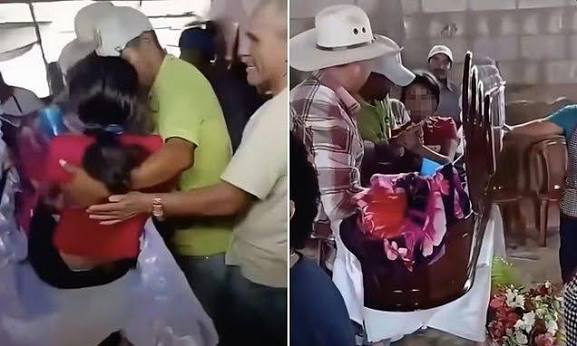
Video circulating online shows Yuleidy, dressed in pink, sitting up inside the coffin as startled family members react with cries of joy and expressions of relief. Relatives helped her out of the coffin as those gathered struggled to process what had happened.
The incident reportedly occurred several hours after her collapse. According to the account shared by her family, Yuleidy had been presumed dead for around eight hours.
Her mother said she had repeatedly felt that her daughter was still alive. Recalling the moment she noticed movement, she told local media that she had been crying over the coffin when the family opened its viewing window and saw the teenager moving.
The mother said Yuleidy began waking up before suddenly sitting upright. Her account suggests that the family’s observations prompted them to realise that the teenager was alive.
The footage quickly spread across social media, drawing widespread attention to the unusual circumstances surrounding the wake.
Father Says He Could Not Detect a Pulse
Abraham Ixcotoyac said his daughter collapsed while he was taking her for medical attention. He claimed that he checked her wrists for a pulse and examined whether she was breathing, but found no apparent signs of life.
The father, who is an evangelical pastor, said he became convinced that she had died during the journey.
However, a crucial detail distinguishes this case from a medically confirmed death: according to the report, Yuleidy had not been examined by a doctor before the family began funeral arrangements. No official death certificate had been issued.
This means the teenager’s death had been presumed by her family rather than formally established through a medical assessment.
The distinction is important because a person who collapses and becomes unresponsive may appear to have died, even when their condition requires emergency medical intervention. Checking for a pulse or breathing without proper training can also be unreliable.
The available account does not establish precisely what caused Yuleidy to lose consciousness or why she appeared unresponsive for such an extended period.
Girl Describes Sudden Pain Before Losing Consciousness
Yuleidy later recalled experiencing severe discomfort shortly before she collapsed.
She said her heart began hurting badly and felt unusually heavy before she blacked out, describing the episode as similar to fainting.
The teenager called her return to consciousness a “miracle” and expressed gratitude to God and her parents for being alive.
Her description of the symptoms raises important questions about what happened before she lost consciousness. However, the report does not provide a confirmed medical diagnosis, details of any subsequent examination, or an official explanation for her condition.
Severe chest pain followed by a loss of consciousness can indicate a medical emergency. Such symptoms may be associated with several potentially serious conditions, including heart rhythm problems, and require urgent professional assessment.
The precise cause of Yuleidy’s collapse remains unclear based on the information available in the report.
Why a Medical Examination Matters Before Death Is Declared
The incident highlights the risks of assuming that an unresponsive person has died without professional assessment.
A sudden collapse can result from a range of conditions, some of which may be reversible with prompt treatment. The absence of an easily detectable pulse or visible breathing does not reliably establish death when assessed by an untrained person.
Emergency medical services should be contacted immediately when someone becomes unresponsive or stops breathing normally. If cardiac arrest is suspected, emergency dispatchers can guide bystanders through cardiopulmonary resuscitation (CPR), while an automated external defibrillator may be used if available.
A formal medical assessment is essential before funeral arrangements proceed. In Yuleidy’s case, the report says no doctor had confirmed her death and no official death certificate had been issued before the wake.
The episode ended with the teenager alive, but the circumstances surrounding her collapse remain unexplained. Further medical information would be needed to establish what caused the incident and whether she experienced any lasting effects.
For her family, the moment she sat up in the coffin transformed a day of mourning into one of shock and relief. For observers, the case serves as a stark reminder that sudden unconsciousness must be treated as a medical emergency rather than proof of death.