
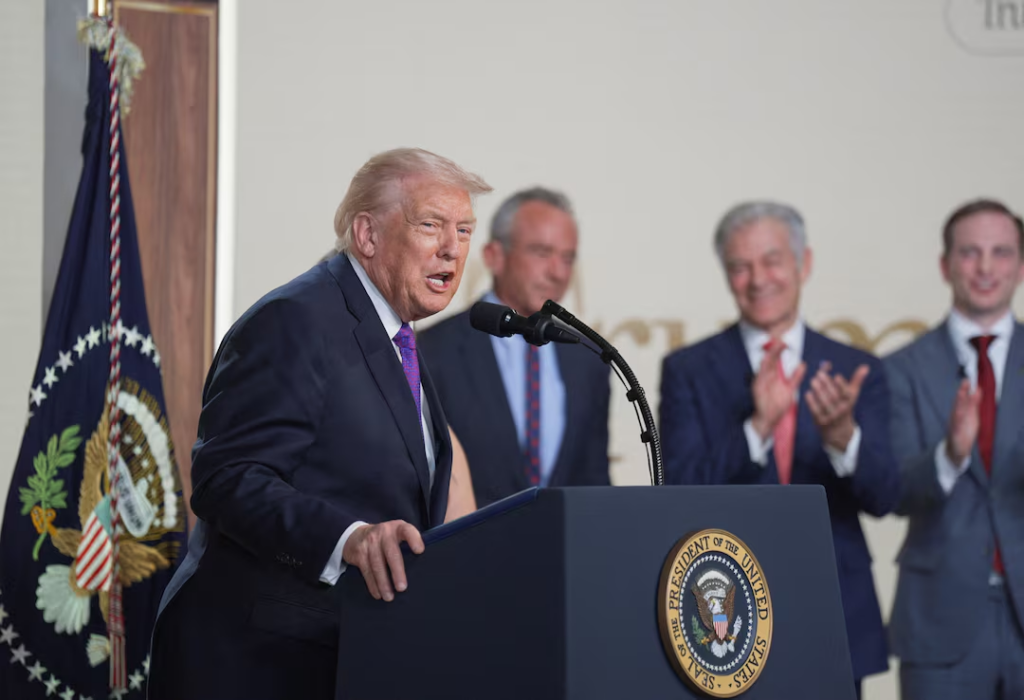
The Trump administration on Friday unveiled TrumpRx, a new government-hosted website that it says will dramatically lower the out-of-pocket cost of some of the most expensive prescription drugs in the United States. Announced at a White House event, the initiative promises steep price cuts on blockbuster medications, from GLP-1 weight-loss drugs like Ozempic to insulin, inhalers, and fertility treatments, just months ahead of the November midterm elections.
The headline-grabbing numbers are hard to miss. But beyond the spectacle, TrumpRx raises bigger questions about how drug pricing works in the U.S., what this platform actually does, and whether these savings will reach patients who need them most.
What is TrumpRx and how does it work?
At its core, TrumpRx is not an online pharmacy. According to the Associated Press, the website functions as a government-run clearinghouse that connects consumers directly to pharmaceutical manufacturers’ discount programs and direct-to-consumer platforms.
What users can expect on TrumpRx?
- A list of more than 40 medications at launch
- Posted out-of-pocket prices, not insurance-negotiated rates
- Coupons or links that can be presented at pharmacies or manufacturer sites
- Disclaimers noting prices may be lower for insured patients or those using generics
Trump emphasized that the site would be live immediately, telling Americans that savings would be available “starting today at trumprx.gov.”
Which drugs are getting price cuts under TrumpRx?
The administration highlighted several categories of high-cost medications that have fueled public frustration over healthcare expenses.
Weight-loss drugs: Ozempic and Wegovy
Trump pointed to GLP-1 drugs as emblematic of what he called “out-of-control” pricing in the U.S.
- Ozempic: From over $1,000 to $199
- Wegovy: From over $1,300 to $199
“Nobody can even believe it,” Trump said, describing the cuts as a “578 percent difference.” The drugs, made by Novo Nordisk, have surged in popularity for weight loss and diabetes management—while remaining largely unaffordable for many Americans.
Insulin: A long-standing political flash point
Trump also credited Eli Lilly with cutting the cost of a commonly used insulin medication:
- From $200 to $25
Insulin pricing has been a bipartisan issue for years, often cited as an example of systemic dysfunction in U.S. drug markets.
Inhalers and fertility drugs
Other examples included
- AstraZeneca inhaler: $458 down to $51
- Fertility treatments: Significant discounts on IVF medications
- Trump cited Gonal-F, a widely used fertility drug, as a key example
“These were the highest prices in the developed world,” Trump said, arguing that Americans have long subsidized lower costs abroad.
Why are prescription drugs so expensive in the United States?
To understand the appeal of TrumpRx, it helps to understand the underlying problem.
The U.S. pricing gap
Americans routinely pay more for prescription drugs than patients in other wealthy countries. Reasons include:
- No centralized price negotiation for many drugs
- A complex supply chain involving pharmacy benefit managers (PBMs)
- Patent protections that delay cheaper generics
- Direct-to-consumer advertising costs
Does TrumpRx actually lower costs for most Americans?
This is where the fine print matters.
Out-of-pocket vs. insured prices
TrumpRx lists out-of-pocket prices, meaning:
- Some insured patients may already pay less
- Others could see meaningful savings if they’re uninsured or underinsured
- Generics may still be cheaper for certain drugs
In other words, TrumpRx doesn’t replace insurance—it works alongside it.
Not a mandate, but a facilitator
The administration says pharmaceutical companies have agreed to participate. However:
- Prices depend on manufacturers honouring listed discounts
- Pharmacies still control final point-of-sale pricing
- Coverage varies by state and insurer
Why launch TrumpRx now?
Timing is central to this story.
Midterm elections and voter anxiety
Rising healthcare costs consistently rank among voters’ top concerns. The administration has framed TrumpRx as part of a broader effort to:
- Address inflation-related frustrations
- Demonstrate action on kitchen-table issues
- Undercut criticism that drug prices remain unchecked
“You’re going to save a fortune,” Trump said, calling the program “so good for overall health care.”
Political analysts will likely view TrumpRx as both policy and messaging, substantive enough to point to, simple enough to campaign on.
How does TrumpRx compare to past drug pricing efforts?
TrumpRx builds on, rather than replaces, earlier approaches.
Key differences
- Transparency-first: Publicly lists prices instead of negotiating behind closed doors
- Direct-to-consumer focus: Bypasses some intermediaries
- Voluntary participation: Relies on manufacturer cooperation
Previous efforts—across administrations, have included capped insulin prices for seniors, importation proposals, and Medicare negotiation reforms. TrumpRx takes a more consumer-facing approach.
What should consumers watch out for?
If you’re considering using TrumpRx, a few practical points matter.
Questions to ask before using TrumpRx
- Is the listed price lower than my insurance copay?
- Does my pharmacy accept the coupon?
- Is a generic or alternative available?
- Are there income-based assistance programs I already qualify for?
Healthcare advocates caution that while TrumpRx could help many patients, it doesn’t fix deeper structural issues in drug pricing.
Why TrumpRx matters, even if it’s imperfect
TrumpRx taps into a core truth: Americans are exhausted by opaque pricing and eye-popping drug bills. Even critics acknowledge that putting prices front and center could pressure manufacturers and competitors alike.
Whether the platform delivers lasting savings or becomes a short-lived political symbol will depend on uptake, enforcement, and follow-through.
For now, TrumpRx represents a bold, consumer-facing attempt to tackle one of the most persistent pain points in American healthcare.
TL;DR
- TrumpRx is a government-hosted website, not an online pharmacy
- It lists discounted out-of-pocket prices for over 40 drugs
- Major cuts include Ozempic, insulin, inhalers, and IVF medications
- Savings may vary based on insurance and pharmacy participation
- The rollout comes amid growing political pressure over healthcare costs