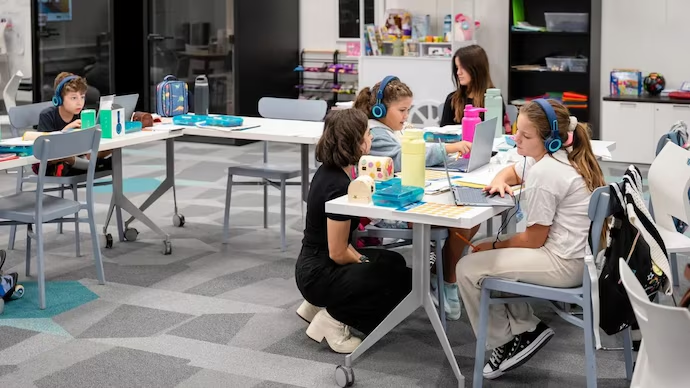
A new kind of school is set to open in Chicago this fall—one that replaces traditional teachers with artificial intelligence. Backed by bold claims and growing political attention, Alpha Schools is testing whether students can learn faster, better, and more efficiently with AI at the center of the classroom.
But as excitement builds, so does skepticism. Critics argue the model is largely unproven, raising questions about academic outcomes, student development, and privacy.
Here’s what you need to know about the rise of AI-powered schools—and why this experiment matters.
What is Alpha Schools and how does it work?
Alpha Schools is a private education network that uses artificial intelligence—not human teachers—to deliver core academic instruction.
The Chicago campus, opening in 2026, will serve about 100 students from kindergarten through eighth grade, with plans to expand. Tuition is expected to reach roughly $55,000 per year, placing it among the city’s most expensive private schools.
The “two-hour learning” model
At the heart of Alpha’s approach is a dramatically compressed academic schedule:
- Two hours of AI-led instruction daily
- Focus on core subjects:
- Math
- Reading and language arts
- Science
- Social studies
- Personalized pacing
Students move forward only after demonstrating mastery.
After the academic block, the rest of the day shifts to:
- Workshops and hands-on projects
- Life skills training
- Team-based activities
Think entrepreneurship projects, public speaking, or even running a mock business.
No teachers—just “guides”
Instead of certified teachers, Alpha employs adult “guides” who:
- Motivate students
- Provide emotional support
- Help with non-academic development
If students struggle academically, remote experts can step in virtually.
This structure fundamentally redefines what a classroom looks like—and who is responsible for learning.
Why is Alpha Schools gaining attention now?
The concept of AI in education isn’t new. But using it as the primary mode of instruction is.
A growing trend, but a big leap
- About 60% of teachers in the U.S. reported using AI tools in the 2024–25 school year
- Most schools use AI as a supplement, not a replacement
- Alpha flips that model entirely
That shift has attracted national attention—from policymakers to researchers.
Political backing adds momentum
The model has found support among proponents of school choice and innovation in education policy. High-profile endorsements and visits from federal education officials have helped elevate Alpha’s profile.
Still, political support doesn’t equal scientific validation—and that’s where the debate intensifies.
Does AI teaching actually work?
This is the central question—and the honest answer is: we don’t fully know yet.
What research says so far
- Studies show AI tools can improve short-term performance
- Gains are often seen when AI is used as a support tool
- Evidence is limited when AI replaces teachers entirely
A major review of hundreds of academic studies found that while AI can boost learning outcomes, those benefits may fade when students work independently without AI assistance.
Expert skepticism
Education researchers have raised concerns about:
- Over-reliance on technology
- Lack of long-term data
- Unclear impact on critical thinking skills
As one expert put it, this model is essentially a live experiment in education.
What are the biggest concerns?
While Alpha Schools promotes efficiency and personalization, critics point to several risks.
1. Lack of human teaching expertise
Teachers do more than deliver content. They:
- Adapt lessons in real time
- Recognize emotional and cognitive struggles
- Foster critical thinking and discussion
Replacing that with AI may create gaps that are hard to measure.
2. Data privacy and surveillance
Alpha’s system reportedly tracks:
- Eye movements
- Keyboard activity
- Response times
While the school says data is used only for learning, critics worry about:
- Student autonomy
- Long-term psychological effects
- Data security risks
3. Equity and access
With tuition around $55,000 per year, Alpha Schools primarily serves affluent families.
That raises a key question:
- Are the results comparable to public schools—or just other elite institutions?
Experts argue that comparing outcomes across vastly different student populations can be misleading.
4. Overpromised results
Alpha claims its students learn twice as fast and rank in the top 1–2% on standardized tests.
While impressive, these claims need independent verification and broader context.
Why this matters for the future of education
Even if Alpha Schools doesn’t become the norm, it signals a larger shift.
The direction education may be heading
- Increased personalization through AI
- Hybrid learning models (AI + human teachers)
- Greater focus on skills over seat time
Traditional classrooms—built around fixed schedules and standardized pacing—may evolve significantly in the next decade.
A key tension: efficiency vs. human connection
AI promises:
- Faster learning
- Scalable education
- Lower long-term costs
But education isn’t just about information transfer. It’s also about:
- Social development
- Mentorship
- Emotional growth
The challenge is balancing both.
What should parents and educators watch next?
As Alpha Schools expands, several indicators will be critical:
Key metrics to monitor
- Long-term academic performance
- Student independence without AI support
- Social and emotional development
- College readiness outcomes
Questions worth asking
- Can AI truly replace human teaching—or only enhance it?
- What happens when technology fails?
- Who owns and controls student data?
TL;DR
- Alpha Schools is launching an AI-driven school in Chicago with no traditional teachers
- Students complete core academics in just two hours daily
- The rest of the day focuses on life skills and projects
- Research on fully AI-led education is limited and mixed
- Concerns include privacy, effectiveness, and lack of human interaction
- The model could reshape education—or remain a niche experiment