More than 200,000 barrels of radioactive waste were dumped into the North Atlantic by European countries during the Cold War era. Now, decades later, an international team of scientists is heading into the deep ocean to investigate what happened to the waste — and whether radioactive material has moved into the surrounding ecosystem.
Researchers from France, Norway, Germany and Spain are studying the old dumping grounds as part of a scientific effort to understand how radioactive waste behaves after spending decades on the seafloor.
The mission is expected to involve months of research and sampling. Scientists are looking for radionuclides, radioactive forms of elements that can persist in the environment for varying lengths of time, and trying to determine how they have moved through the deep-sea ecosystem.
The research is not simply about counting old barrels. Scientists want to know whether the containers have deteriorated, whether radioactive material has escaped and whether marine organisms have absorbed any of it.
Why was radioactive waste dumped into the Atlantic?
During the Cold War, nuclear programs generated large quantities of radioactive waste, creating a difficult disposal problem for governments around the world.
At the time, ocean dumping was considered by some countries to be a practical way of isolating low-level radioactive waste from human populations.
European countries used parts of the North-East Atlantic for this purpose, sending large numbers of barrels to deep-water disposal areas.
The waste was packaged in containers and dumped at depths of several thousand meters.
The practice reflected the environmental understanding and regulations of the period. It would later become increasingly controversial as scientists gained a better understanding of deep-sea ecosystems and the long-term behavior of pollutants.
Important context: The history of nuclear-waste disposal was not identical in the United States and Europe. In the US, radioactive waste from nuclear weapons production was also stored in large underground tanks, including facilities associated with the Hanford Site near the Columbia River. Ocean dumping was a separate disposal practice and should not be presented as though the US simply followed the same Atlantic-barrel strategy.
How are scientists finding the radioactive barrels?
Finding individual barrels nearly five kilometers below the ocean surface is a major technological challenge.
The dumping zone covers roughly 14,500 square kilometers, making conventional searches impractical.
Researchers therefore began by using autonomous underwater technology and sonar to map the seabed.
During an earlier expedition, an autonomous underwater vehicle surveyed part of the disposal area and identified more than 3,500 barrels in an area representing less than 2% of the wider zone.
The discovery demonstrates the scale of the problem. Scientists are not looking for a handful of isolated containers but thousands of objects scattered across a vast section of deep ocean.
The sonar maps are also helping researchers reconstruct the distribution of the barrels and determine where detailed sampling should take place.
What do the barrels look like after decades underwater?
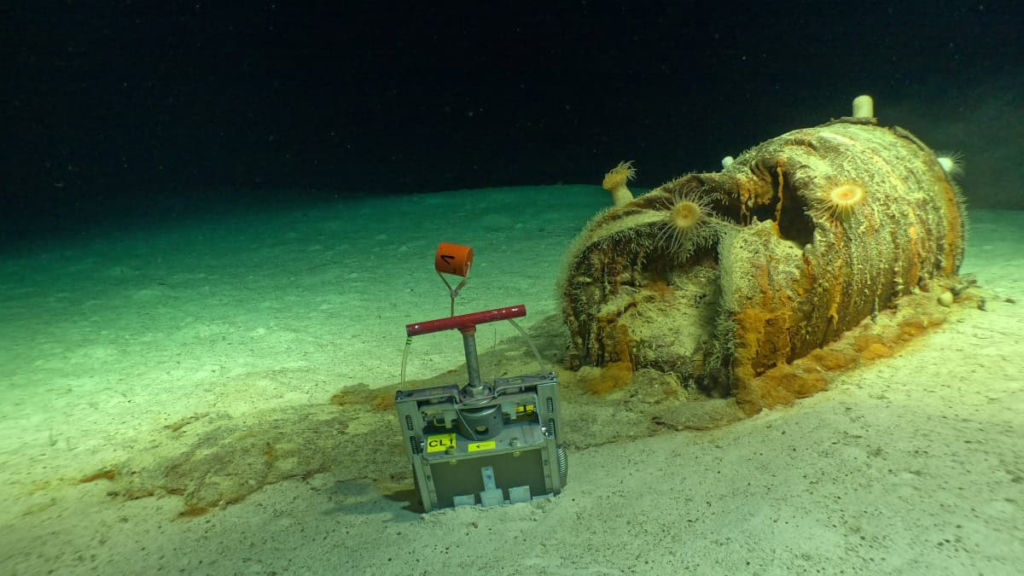
The barrels have spent roughly half a century exposed to one of the most demanding environments on Earth.
Deep-ocean conditions include intense pressure, extremely low temperatures and a chemically active marine environment. Over decades, metal containers can corrode and deteriorate.
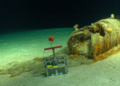
Researchers have found barrels covered by marine organisms, including crabs and sea anemones.
That observation is significant because the containers have effectively become artificial structures on the seabed.
But seeing marine life growing on a barrel does not, by itself, show that radiation is harming those organisms.
Scientists need to determine whether radioactive material is present in the organisms, surrounding sediment or seawater — and, if so, at what concentrations.
What are scientists looking for?
The research team is studying the entire environment surrounding the barrels rather than focusing solely on the containers.
Researchers have collected samples from:
- Radioactive-waste barrels
- Seafloor sediment
- Seawater
- Microorganisms
- Marine organisms
- Areas surrounding the disposal site
They are particularly interested in identifying which radionuclides are present and determining how those radioactive substances behave after decades underwater.
Different radionuclides have different chemical properties and half-lives. Some can remain associated with sediments, while others can dissolve in water or become incorporated into organisms.
This makes the question more complicated than simply asking whether radiation is present.
Scientists need to establish what is present, where it is going and whether it is entering biological systems.
Could radioactive material have entered marine organisms?
Researchers have raised the possibility that radionuclides may have transferred into living organisms around the dumping site.
That is one of the reasons biological samples are being collected.
If radionuclides are absorbed by marine organisms, scientists can investigate whether they remain concentrated in individual organisms or move through the wider food web.
However, the possibility of biological uptake should not be confused with evidence of widespread ecological damage.
Finding a radionuclide in an organism does not automatically mean that the animal has been harmed. Scientists must consider the concentration, type of radionuclide, exposure duration and biological effects.
The new research is intended to provide precisely that information.
Why is this study important after 50 years?
Radioactive waste presents a long-term environmental challenge because the material does not necessarily become harmless on the same timetable as its container.
A barrel can corrode long before every radionuclide inside it has decayed.
That creates two separate timelines:
The interaction between those two processes is central to the research.
Scientists want to understand what happens when a container that was designed to hold radioactive material for a limited period begins to deteriorate while radioactive substances remain present.
Why is the deep sea not simply an empty dumping ground?
The deep ocean was once poorly understood compared with coastal and surface environments.
Scientists now know that the deep sea contains complex ecosystems, including microorganisms, crustaceans, corals and other organisms adapted to extreme conditions.
A radioactive-waste barrel therefore does not sit in a biological vacuum.
Marine organisms can attach themselves to the containers, interact with the surrounding sediment and potentially come into contact with material released from deteriorating barrels.
This makes the Atlantic dumping site an unusual long-term case study in deep-sea radioecology — the study of how radioactive substances interact with organisms and ecosystems.
The researchers describe the work as among the first efforts to conduct a detailed radioecological investigation at such extreme depths.
What happens if radioactive material escapes from a barrel?
The environmental consequences depend heavily on the specific radionuclides involved and how they interact with the marine environment.
Once radioactive material is released, several pathways are possible.
It could:
- Remain concentrated around the barrel.
- Bind to or move through seabed sediments.
- Dissolve into surrounding seawater.
- Be taken up by microorganisms or marine animals.
- Potentially move through parts of the food web.
Scientists are therefore sampling different components of the ecosystem.
The goal is to build a picture of how radioactive substances move rather than relying on a single measurement.
Does this mean the Atlantic is facing a radioactive disaster?
There is not enough evidence to make that claim.
The discovery of thousands of barrels and the deterioration of some containers are reasons for scientific investigation, but they do not establish widespread radioactive contamination or a threat to human health.
The purpose of the research is precisely to determine the scale of any environmental impact.
The scientists also face a basic challenge: the dumping site is enormous, and only a small portion has been mapped and inspected in detail.
A few thousand barrels found in a surveyed section cannot automatically be used to determine the condition of every barrel across the entire disposal area.
That is why researchers are combining large-scale sonar mapping with close-up inspection and laboratory analysis.
What scientists still need to find out
The current expeditions can answer some questions, but the most important results will come from analyzing the samples.
Researchers need to establish:
- Which radionuclides remain in the waste.
- How many different radioactive isotopes can be detected.
- Whether the barrels are releasing radioactive material.
- How far any released material has traveled.
- Whether radionuclides are present in marine organisms.
- Whether concentrations vary between organisms and sediments.
- Whether radioactive material is moving through the local food web.
- How the situation could change over the coming decades.
These findings will help scientists distinguish between localized contamination around individual barrels and broader environmental dispersion.
Why the research matters beyond the Atlantic
The radioactive barrels are a legacy of a period when ocean disposal appeared to offer a relatively simple solution to a difficult waste-management problem.
The lesson today is more complicated.
Once radioactive waste is released into a deep-ocean environment, retrieving it becomes extraordinarily difficult. Even understanding its long-term behavior requires sophisticated submarines, autonomous vehicles, sonar systems, radiation monitoring and laboratory analysis.
That makes the Atlantic site more than a historical curiosity.
It is an opportunity to study, in real conditions, what happens to radioactive material after decades in the deep sea.
The research could also provide information relevant to the assessment of other contaminated marine environments and improve scientific understanding of how radionuclides interact with deep-ocean ecosystems.
The bottom line
More than 200,000 barrels of radioactive waste were dumped in the North-East Atlantic during the era of ocean disposal. Fifty years later, scientists are finally able to examine the site in unprecedented detail.
Modern underwater vehicles have already located thousands of barrels across a fraction of the dumping zone. Researchers have found containers colonized by marine life and are collecting sediment, water and biological samples to determine whether radionuclides have moved into the surrounding environment.
The findings should be treated carefully.
There is no basis yet for describing the site as a ticking radioactive time bomb or evidence of an impending human-health crisis. What the research has established is that a large quantity of radioactive waste remains on the deep-ocean floor, some containers have deteriorated, and scientists now have the technology to investigate what that means for the ecosystem around them.
The real story may not be about a disaster waiting to happen. It may be about a decades-old environmental decision that scientists are only now capable of measuring properly.