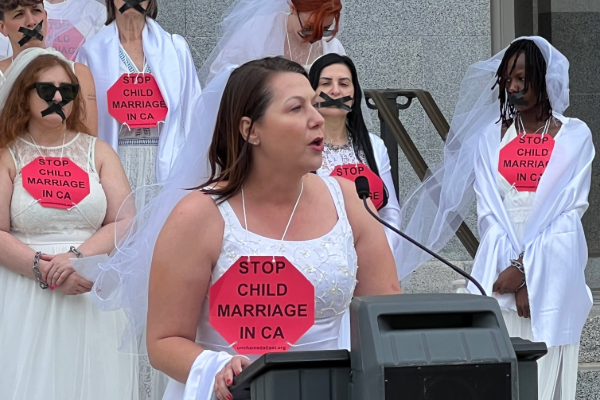
California has drawn a new legal line around marriage and childhood.
Gov. Gavin Newsom signed Assembly Bill 1267 (AB 1267) on September 30, 2026, ending the state’s previous system under which minors could marry with parental consent and court approval. Once the law takes effect on January 1, 2027, California’s minimum age for marriage and domestic partnership will be 18, with no exceptions.
The change closes a longstanding gap in California law. Before AB 1267, the state did not specify an absolute minimum marriage age. A person under 18 could seek a court order permitting the marriage and generally had to provide written parental or guardian consent. California’s courts had procedures specifically governing applications by minors to marry.
Newsom signed the legislation alongside child-marriage survivor and advocate Courtney Stodden, who married actor Doug Hutchison at age 16 in 2011 with her parents’ permission.
For Stodden and other survivors, the California law marks the end of a system they say left minors vulnerable to coercion and abuse.
What does California’s new child marriage law change?
AB 1267 makes 18 the minimum age for marriage and domestic partnership in California.
The legislation repeals the provisions that previously allowed minors to obtain permission to marry through parental consent and judicial approval. It also removes the corresponding legal provisions governing minor domestic partnerships.
Starting January 1, 2027:
- People under 18 will not be eligible to receive a marriage license in California.
- Minors will no longer be able to marry through parental consent.
- Courts will no longer be able to authorize marriages involving minors.
- The minimum age for establishing a domestic partnership will also be 18.
- The previous statutory exceptions for minor marriage will be repealed.
The law also changes how California treats marriages involving someone under 18. The legislation provides a transition rule for marriages entered into under the old system before January 1, 2027.
What were California’s old child marriage rules?
California previously had no absolute statutory minimum age for marriage.
That did not mean a child could simply walk into a county office and obtain a marriage license without oversight. Under the previous system, a minor needed a court order permitting the marriage and written consent from at least one parent or legal guardian, subject to the statutory requirements.
California’s judicial procedures included additional safeguards.
For example, Family Court Services could be required to interview the minor and the parents, prepare a report for the court and assess potential force, threat, persuasion, fraud, coercion or duress surrounding the proposed marriage. A judge could also require the parties to appear at a hearing and could consider whether the marriage was in the minor’s best interest.
The system therefore relied on parental involvement and judicial review rather than establishing 18 as an absolute threshold.
AB 1267 removes that framework.
Why did California change its law?
Supporters of the legislation focused heavily on the vulnerability of minors who may be pressured or coerced into marriage.
The California governor’s office said survivors described difficulties associated with being a minor in a marriage, including problems leaving home, finding an attorney and obtaining help from adults or institutions.
Assemblymember Gail Pellerin, who authored AB 1267, said survivors were central to the effort and described accounts involving coercion and abuse hidden behind the appearance of consent.
The issue also involves an unusual legal tension: marriage can confer certain rights and responsibilities on a minor while the person remains under the state’s general age of majority.
Advocates have argued that this can make it difficult for minors to escape abusive relationships or navigate the legal system independently.
What does Courtney Stodden have to do with the law?
The signing ceremony had a direct connection to the issue.
Courtney Stodden was 16 when she married actor Doug Hutchison, then 50, in 2011. Her parents permitted the marriage, which was legally possible under California’s rules at the time. Newsom signed AB 1267 with Stodden present.
Stodden later became an advocate for ending child marriage.
At the signing, she described California’s action as a victory but said she intended to continue advocating for changes in other states.
Her presence gave the legislation a particularly personal dimension: the same state legal framework that permitted her marriage as a teenager is now being eliminated.
What have other survivors said?
Other survivors have also described the consequences of entering marriages while still minors.
Christina Sutton, whose experience was cited during the California legislative campaign, became involved in advocacy for the bill. Sara Tasneem, another survivor, has described being married as a teenager and later becoming a mother while still very young.
Their accounts have been used by advocates to argue that formal parental or judicial approval does not necessarily demonstrate that a minor freely chose to marry.
The California Commission on the Status of Women and Girls said survivors played a central role in the campaign for AB 1267.
These are individual experiences, however, and should be distinguished from statistical evidence about child marriage nationally.
How common is child marriage in the United States?
Child marriage has declined in the United States, but it has not disappeared.
Research by Unchained At Last found that nearly 315,000 minors were legally married in the U.S. between 2000 and 2021. The organization says 86% were girls and that most were married to older men. Some minors in the dataset were as young as 10.
The figures come from marriage-certificate and marriage-license data collected from states and analyzed by Unchained At Last. They cover historical data through 2021, so they should not be interpreted as a measure of current annual marriage rates.
California itself accounted for thousands of minor marriages during the period studied by advocates.
The state’s new law changes the legal framework going forward, but historical marriages are not erased by the legislation.
How many states still allow child marriage?
California’s law changes the national picture, but it does not create a nationwide ban.
Unchained At Last’s current tracking says California becomes the 18th state to prohibit marriage before 18 without exceptions, following Oklahoma’s 2026 ban. The organization says child marriage remains legally possible in 32 states, although the circumstances and age limits vary from state to state.
The remaining states do not all have identical laws.
Some permit marriage below 18 under specified conditions, which can include:
- Parental consent
- Judicial approval
- Pregnancy
- Emancipation
- A minimum age below 18
- Exceptions based on circumstances involving the proposed spouse
As a result, simply saying that child marriage is “legal” in a state does not necessarily mean the same rules apply everywhere.
Which states still permit marriage before 18?
According to Unchained At Last’s current tracking, the 32 states where child marriage remains legally possible are:
- Alabama
- Alaska
- Arizona
- Arkansas
- Colorado
- Florida
- Georgia
- Hawaii
- Idaho
- Illinois
- Indiana
- Iowa
- Kansas
- Kentucky
- Louisiana
- Maryland
- Mississippi
- Montana
- Nebraska
- Nevada
- New Mexico
- North Carolina
- North Dakota
- Ohio
- South Carolina
- South Dakota
- Tennessee
- Texas
- Utah
- West Virginia
- Wisconsin
- Wyoming
The precise conditions differ by state, so this list should be accompanied by each state’s current statutory requirements rather than presented as though all 32 permit the same forms of minor marriage.
California was previously unusual even among states that allowed child marriage
Before AB 1267, California was one of a small number of states without an explicit statutory minimum marriage age.
Unchained At Last’s research identified California, Mississippi, New Mexico and Oklahoma as states with no statutory minimum age in its 2025 analysis. Oklahoma subsequently enacted a ban, and California has now followed.
California’s previous framework nevertheless imposed court and parental requirements for minors.
The important change is that those exceptions are now being eliminated entirely.
What happens on January 1, 2027?
January 1, 2027, is the key date for California residents.
From that date, a person under 18 cannot obtain a marriage license under California’s new rules. The same age requirement applies to domestic partnerships.
The law also addresses marriages entered into under the previous system before the new rules take effect. AB 1267’s transition provision specifically refers to marriages entered under the former statutory provisions before January 1, 2027.
That means the legislation is primarily prospective: it changes who can marry in California going forward rather than simply declaring every historical marriage involving a minor invalid.
Why the change matters beyond California
California is the most populous U.S. state, so its decision adds another major jurisdiction to the group that has adopted an absolute minimum marriage age of 18.
It also changes the legal debate in states that continue to permit exceptions.
Advocacy organizations including Unchained At Last have used California’s campaign as part of a broader push for all states to establish 18 as the minimum age without exceptions.
The remaining legal landscape is therefore increasingly divided between states that have adopted an absolute age of 18 and states that retain exceptions.
That distinction is likely to remain central to the national debate over child marriage.
What California’s law does—and does not—do
The new law establishes a straightforward rule for future marriages:
18 is the minimum age.
It does not, however, automatically resolve every issue involving people who were married as minors under the previous law.
It also does not change marriage laws in other states. A person who married under a different state’s laws may be subject to that state’s rules concerning the validity and recognition of the marriage.
For California, the immediate change is clearer: beginning January 1, 2027, the state will no longer issue marriage licenses to people under 18.
For survivors such as Stodden and others who campaigned for the legislation, that marks the end of a legal pathway they say left children vulnerable.
For the rest of the country, the map remains divided.
TL;DR
- California Gov. Gavin Newsom signed AB 1267 on September 30, 2026.
- The law establishes 18 as the minimum age for marriage and domestic partnership, with no exceptions.
- It takes effect January 1, 2027.
- Previously, California allowed minors to marry through a process involving parental or guardian consent and court approval.
- Courtney Stodden, who married at 16 in 2011, attended the signing and has continued advocating against child marriage.
- California is now the 18th state tracked by Unchained At Last as having eliminated marriage under 18 without exceptions.
- Unchained At Last currently says 32 states still permit some form of marriage involving people under 18.