California is facing a disaster scenario that sounds almost biblical: a sequence of powerful storms striking the state over several weeks, overwhelming flood defenses and causing widespread damage. Known as ARkStorm 2.0, the scenario describes what could happen if a series of atmospheric rivers repeatedly hits California. The U.S. Geological Survey and its partners developed the original ARkStorm concept to examine the consequences of an extreme storm sequence and help officials prepare for a disaster on a scale far beyond an ordinary winter storm.
The key point is that ARkStorm 2.0 is not a prediction that California will be hit by a 30-day megastorm. It is a scientific disaster scenario designed to test how the state would cope with an exceptionally severe combination of weather events.
In the modeled scenario, successive atmospheric rivers could produce enormous rainfall and mountain runoff, triggering floods, landslides and infrastructure failures across large parts of California.
What is ARkStorm 2.0?
ARkStorm is short for “Atmospheric River 1,000-year Storm.” The name is also a reference to the scale of the disaster envisioned by scientists, rather than a statement that a specific storm is scheduled to occur once every 1,000 years.
The original ARkStorm scenario was developed around 2010 by the USGS in collaboration with federal, state and academic experts.
The exercise was intended to answer a practical question: What would happen if California experienced an extreme sequence of storms comparable to some of the worst events in its geological and historical record?
ARkStorm 2.0 updates that thinking for a changing climate and examines the consequences of a prolonged series of atmospheric rivers affecting the western United States.
What makes atmospheric rivers so powerful?
Atmospheric rivers are long, relatively narrow corridors of concentrated moisture moving through the atmosphere.
They can transport enormous amounts of water vapor from tropical and subtropical regions toward higher latitudes. When these systems encounter California’s coastal mountains or the Sierra Nevada, the air is forced upward, cooling the moisture and producing heavy precipitation.
Not every atmospheric river is destructive.
In fact, these storms are an important part of California’s water system. They can replenish reservoirs, build mountain snowpack and provide a substantial share of the state’s annual precipitation.
The danger comes when several powerful systems arrive close together.
One storm can saturate the ground and raise rivers. Another arriving before the landscape has recovered can then produce much greater flooding and landslide risks.
Could California really face 30 days of storms?
The 30-day figure associated with ARkStorm 2.0 refers to the modeled sequence of weather events, not a forecast that rain would fall continuously across California for an entire month.
That distinction is crucial.
The scenario envisions multiple atmospheric rivers striking the West Coast over an extended period. Between individual storms, conditions could change, but the cumulative effect could become increasingly severe.
A useful way to think about the threat is through accumulation.
The first storm may fill rivers and reservoirs. Subsequent storms then arrive when soils are already saturated, slopes are unstable and drainage systems are under greater pressure.
This can turn a sequence of individually manageable events into a regional disaster.
How much damage could ARkStorm 2.0 cause?
The modeled consequences are potentially enormous.
Previous ARkStorm analyses have estimated that an extreme storm sequence could cause economic losses on the order of $1 trillion or more and force large-scale evacuations.
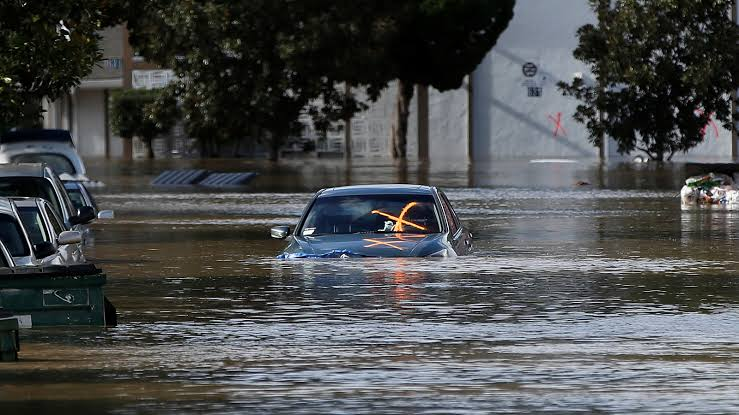
Some modeled areas could experience flood depths measured in many feet, while landslides and infrastructure failures could isolate communities.
The exact effects would depend on where the atmospheric rivers make landfall, how much precipitation they produce, existing soil moisture, snow levels, reservoir operations and the condition of flood-control infrastructure.
That is why individual figures from ARkStorm should be treated as scenario estimates rather than predictions.
Which areas could be most vulnerable?
California’s Central Valley is particularly important in any discussion of extreme flooding.
The region contains extensive agricultural land, communities, transportation networks and critical infrastructure. Much of the valley is relatively flat, meaning large volumes of water can spread across wide areas.
The state’s major metropolitan areas also face risks from intense rainfall, landslides and overwhelmed drainage systems.
Mountain communities can face another problem: rapid runoff, debris flows and landslides following intense precipitation.
Along the coast, atmospheric rivers can combine with already saturated terrain and strong winds to create additional hazards.
California has experienced extreme floods before
The ARkStorm concept is partly rooted in California’s history.
One of the most important examples is the Great Flood of 1861-62. A series of storms produced extraordinary rainfall across the state, flooding enormous areas of the Central Valley.
Historical accounts describe the valley becoming an inland lake in places, while transportation and communications were severely disrupted.
The disaster was not simply a modern climate scenario projected backward. It demonstrated that California’s climate can produce extreme precipitation events capable of overwhelming the landscape.
Scientists have also used geological evidence to identify evidence of major prehistoric flooding and storm sequences that were more severe than many events recorded during the modern era.
That historical record matters because instrumental weather observations cover only a relatively short period. Geological evidence provides scientists with a longer window into how frequently California has experienced exceptional floods.
Why climate change could make extreme storms worse
Climate change does not mean that an ARkStorm 2.0 event is certain to occur.
It does, however, change some of the physical conditions that influence extreme precipitation.
A warmer atmosphere can hold more water vapor. The commonly used atmospheric relationship is roughly 7% more moisture for every 1.8 degrees Fahrenheit, or 1 degree Celsius, of warming, when other conditions allow the additional moisture to accumulate.
That can increase the amount of water available to intense precipitation events.
Scientists have described this concept as an “expanding atmospheric sponge.” A warmer atmosphere can absorb additional moisture before releasing it through precipitation.
For California, another important factor is the changing snowpack.
Why snow matters to California flooding
The Sierra Nevada acts as a natural reservoir.
During colder winters, some precipitation falls as snow and remains stored in the mountains until warmer conditions cause it to melt gradually.
But a warmer climate can push the freezing level higher. Storms that historically would have produced snow at higher elevations can increasingly produce rain instead.
That creates a dangerous combination.
Instead of water remaining temporarily locked in mountain snowpack, rainfall can run directly into rivers and watersheds while existing snow also melts.
During an extreme storm sequence, that can substantially increase runoff.
Are California’s flood defenses ready?
The question of infrastructure is central to the ARkStorm scenario.
California relies on an extensive network of levees, reservoirs, canals, drainage systems and pumping infrastructure. These systems protect communities and agricultural areas from flooding under many conditions.
But infrastructure designed around historical conditions may face a different challenge when several extreme storms arrive in succession.
A prolonged storm sequence could test levees, drainage systems and reservoirs simultaneously.
The risk is not limited to water overtopping a single barrier. Roads can become impassable, power systems can fail, wastewater infrastructure can be overwhelmed and damaged bridges can cut communities off from emergency services.
This is why disaster planning for ARkStorm is as much an infrastructure question as a weather question.
What would happen if an ARkStorm struck California?
The effects would likely unfold in stages rather than as one giant wave of flooding.
A simplified sequence could look like this:
- An atmospheric river makes landfall and produces intense rainfall.
- Rivers and reservoirs rise as watersheds absorb increasing amounts of water.
- Soil becomes saturated, increasing the risk of landslides.
- A second or third storm arrives before the landscape has recovered.
- Snow at higher elevations may melt or fall as rain, increasing runoff.
- Levees, drainage systems and other infrastructure face mounting pressure.
- Flooding expands across low-lying communities and agricultural areas.
- Transportation, electricity, communications and emergency services can be disrupted.
The danger therefore comes from the interaction between storms and the landscape, not simply from the rainfall produced by one storm.
Is ARkStorm 2.0 caused by climate change?
Not directly.
It would be inaccurate to say climate change has “caused” ARkStorm 2.0 because ARkStorm 2.0 is a modeled disaster scenario, not an individual weather event.
A more accurate conclusion is that climate change can influence several ingredients that affect extreme precipitation and flooding.
Warmer atmospheric temperatures can increase moisture availability, while reduced snowpack and higher freezing levels can alter how precipitation moves through California’s watersheds.
Scientists are therefore studying how the probability and severity of extreme precipitation could change as temperatures rise.
When will the next ARkStorm happen?
There is no known date.
Scientists are not forecasting that ARkStorm 2.0 will strike California in a particular year. The scenario exists precisely because governments cannot know when the next exceptionally severe storm sequence will occur.
That uncertainty is part of the reason such exercises matter.
Emergency planners cannot wait for a forecast several months or years in advance before preparing flood-control systems, evacuation plans and emergency communications.
The goal is to understand what could happen before the extreme event arrives.
What can California do to prepare?
Preparation involves far more than building higher walls around rivers.
Key measures include:
- Strengthening and maintaining levees and flood-control systems.
- Improving stormwater drainage in vulnerable communities.
- Expanding floodplain mapping and evacuation planning.
- Improving reservoir operations and watershed monitoring.
- Preparing for landslides and debris flows in mountainous areas.
- Protecting roads, bridges, power infrastructure and communications networks.
- Using improved weather forecasts to provide earlier warnings.
- Restricting new development in areas with substantial flood risk.
- Conducting large-scale emergency exercises before a major disaster occurs.
California has already invested heavily in climate resilience and water infrastructure, but the scale of an ARkStorm-type disaster means preparation remains an ongoing process.
Why the ARkStorm scenario matters
The most important lesson from ARkStorm 2.0 is not that California is about to experience a biblical flood.
It is that extreme weather can become much more damaging when several hazards arrive together.
A single atmospheric river can replenish California’s water supplies. Several powerful storms arriving back-to-back can instead overwhelm watersheds, destabilize hillsides and test infrastructure beyond its design assumptions.
That difference is at the heart of the ARkStorm exercise.
California’s history shows that extraordinary floods are possible. Climate change is altering some of the conditions under which extreme precipitation occurs. And the state’s enormous population and infrastructure network mean the consequences of a major disaster could extend far beyond flooded homes.
ARkStorm 2.0 is therefore best understood as a warning from disaster planning, not a weather forecast.
The question is not whether scientists know when the next megastorm will arrive. They do not.
The question is whether California will be ready when an unusually severe sequence of atmospheric rivers eventually tests the limits of the state’s flood defenses.