
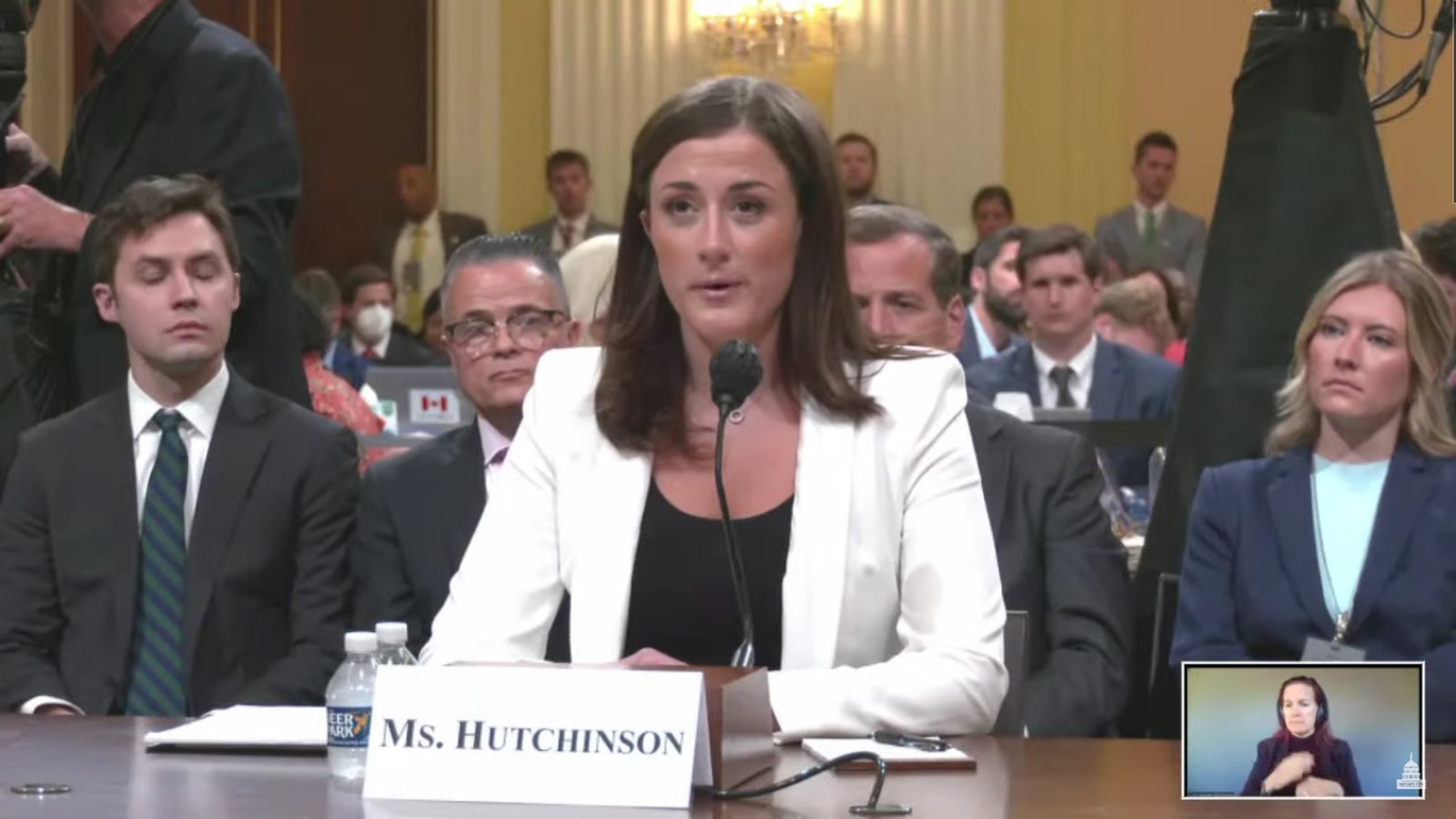

A federal grand jury in Washington refused on Tuesday, October 27, to indict Cassidy Hutchinson. The former White House aide’s 2022 testimony to the House Jan. 6 committee had angered President Trump for years.
The Cassidy Hutchinson grand jury vote produced what the Justice Department’s own manual calls a “no-bill.” Federal data show it ranks among the rarest outcomes in the criminal justice system.
No charging document has become public, and the vote count stays secret. What we know comes from a brief disclosure in court and from officials and sources who spoke to reporters.
What the grand jury decided, and how it surfaced
Grand jury proceedings are secret, so the news came out sideways. During a hearing on an unrelated matter, Civil Rights Division lawyer Neville Hedley told Magistrate Judge Zia Faruqui that a grand jury had not agreed to a proposed indictment. He did not name the defendant, CBS News reported.
Four sources briefed on the proceedings told CBS it was Hutchinson. The Washington Post first reported the decision.
A senior U.S. official confirmed the no bill to NBC News. Two people familiar with the matter told the Associated Press the same. According to NBC, the grand jury heard evidence in early October.
None of the outlets could say which charges prosecutors sought. CBS could not determine which parts of her testimony drew scrutiny. Hutchinson has maintained that she testified truthfully, NBC reported.
The courtroom disclosure followed a new rule. In March, Chief Judge James Boasberg ordered that the duty magistrate judge hear about every grand jury refusal in Washington, Fox News reported. That applies even when the person already faces charges, and the notices stay under seal.
Eleven no bills in a year of 193,000 suspects
A federal grand jury has 16 to 23 members. It “may indict only if at least 12 jurors concur,” under Rule 6 of the federal criminal rules.
Its question is narrow. The Justice Manual describes the job as deciding whether there is probable cause. The jurors have two choices: indict, or return a no bill.
That low bar explains why refusals almost never happen. The clearest federal count we found comes from the Bureau of Justice Statistics. Its report Federal Justice Statistics, 2010 tracks how U.S. attorneys closed out their matters in fiscal 2010.
That year, U.S. attorneys concluded matters involving 193,021 suspects. They took 48.4% of them to federal district court and declined 30,670.
Table 2.3 lists the reasons for those declinations. “No true bill returned” appears exactly 11 times. Against the roughly 93,000 suspects prosecuted in district court, that works out to about one in 8,500.
Two caveats apply. The figure is 16 years old. It also counts only matters that prosecutors dropped after a no bill, not cases they took to a second grand jury. Still, it is the only official breakdown we located, and it shows how far outside the norm Tuesday’s vote sits.
Prosecutors can try again, with a sign-off
A no bill is not an acquittal. NBC reported that the decision does not bar the Justice Department from seeking charges against Hutchinson again.
The department’s own rules add one hurdle. Section 9-11.120 of the manual covers what happens after a no bill. Prosecutors “should not” take it to another grand jury, or back to the same one, “without first securing the approval of the responsible United States Attorney.”
The same chapter sets a second duty. Prosecutors who know of “substantial evidence that directly negates the guilt” of a subject must present it before seeking an indictment. Nobody outside the grand jury room knows whether that happened here.
Time also matters. Most federal crimes carry a five-year limit under Section 3282 of the criminal code. Hutchinson testified in public on June 28, 2022.
For anything she said that day, the window would close in late June 2027. Without knowing the charges, treat that date as an estimate.
The department has gone back before. After a judge dismissed the first case against New York Attorney General Letitia James on technical grounds, prosecutors tried three more times to indict her, NBC reported. Grand juries refused each time.
There is a second route, too. In the third case against James Comey, prosecutors filed a criminal information. A prosecutor writes and signs that charge, and no grand jury votes on it. For a felony, it only works if the defendant waives indictment, and Comey has not.
The secondhand steering-wheel story at the center
Hutchinson worked as a special assistant to Trump’s chief of staff, Mark Meadows. The committee announced her hearing about 24 hours in advance, according to the AP. She described Trump on Jan. 6, 2021, as angry and defiant.
NBC reported that she quoted Trump as saying, “I don’t f—ing care that they have weapons.” He wanted the metal detectors at his rally removed, she testified. She also said Trump wanted to go to the Capitol.
The most disputed part was something she did not see. CBS reported that she relayed an account from then-deputy chief of staff Tony Ornato. In it, Trump lunged at the steering wheel after his lead Secret Service agent refused to drive him to the Capitol. She acknowledged at the time that she had no firsthand knowledge of the episode, according to the AP.
In March 2024, House Republicans released the committee’s interview with the Secret Service officer who drove the SUV. The public had not seen it before. He said he did not see the altercation and that Trump “never grabbed the steering wheel,” the AP reported.
The AP added that the transcript also backed up other parts of her account, including Trump’s push to go to the Capitol. So the sharpest dispute centers on a story she told the committee came secondhand. House Republican allies of the president referred the matter to the Justice Department, according to media reports cited by CBS.
Trump has called Hutchinson a “scam artist” who lied under oath, NBC reported. In 2022, he wrote on Truth Social: “What is the Justice Department going to do about this?”
A Civil Rights Division case, and a pattern in Washington
The Justice Department’s Civil Rights Division ran the case, according to NBC. Trump appointee Harmeet Dhillon heads the division. It traditionally enforces civil rights and antidiscrimination laws, which makes it an unusual home for a false-testimony inquiry.
The AP called the no bill “the latest setback” in the department’s efforts to charge people Trump sees as adversaries. NBC listed others. A grand jury also refused to indict six Democratic members of Congress over a video telling military and intelligence personnel not to obey unlawful orders. According to Fox News, that case prompted Boasberg’s March order.
Attorney General Todd Blanche defended the record in April. He told NBC the failed prosecutions showed “that we’re working hard.” He added: “It could be that the grand jury just made the wrong decision.”
The vote comes a week before the November 3 midterms. Other Justice Department inquiries, such as the reported investigation of Corey Lewandowski, remain in the news.
For now, Hutchinson faces no charge. Under the Justice Manual, any second attempt needs a U.S. attorney’s approval before it goes back to a grand jury.