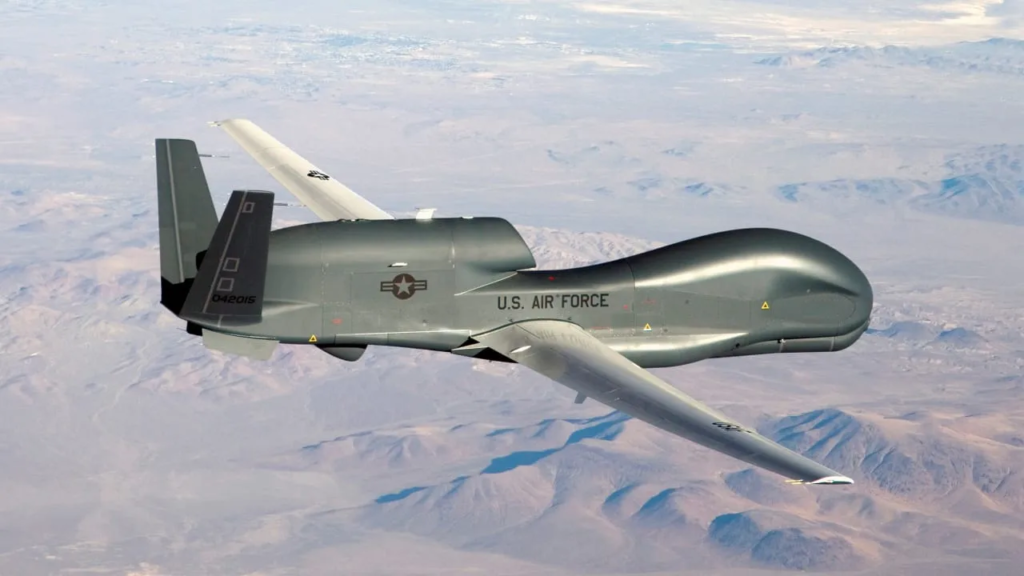
The US military is expanding its use of attack drones across the Middle East with the creation of Task Force Falcon Strike, a new multinational initiative designed to integrate unmanned systems operated across the air, land and maritime domains.
US Central Command, or CENTCOM, says the task force will work with regional partners to develop and deploy new unmanned capabilities. The announcement comes as the US military faces growing scrutiny over reported losses of MQ-9 Reaper drones during recent operations against Iran.
Falcon Strike builds on Task Force Scorpion Strike, a dedicated US one-way attack drone unit established about nine months earlier. The new initiative is intended to move beyond a primarily US-operated model and bring allied militaries into the development and use of unmanned attack systems.
What is Task Force Falcon Strike?
Task Force Falcon Strike is a new multinational force being developed by CENTCOM to coordinate unmanned attack capabilities among the United States and regional partners.
Unlike a conventional military formation built around a specific aircraft or weapons platform, the task force is designed around a capability: integrating unmanned systems across multiple domains.
That could include:
- One-way attack drones operating in the air
- Unmanned surface vessels operating at sea
- Unmanned systems supporting operations on land
- Command-and-control networks connecting different platforms
- Capabilities supplied or developed by US and regional forces
CENTCOM commander Adm. Brad Cooper said the initiative would build on the innovation already taking place among the command’s regional allies and partners.
The broader objective is to create what CENTCOM describes as a unified, multi-domain, multinational deterrent.
How is Falcon Strike different from Scorpion Strike?
Falcon Strike is effectively an expansion of the model established by Task Force Scorpion Strike.
CENTCOM launched Scorpion Strike as its first dedicated one-way attack drone squadron in the region. The unit was intended to give US forces a specialized capability for deploying relatively inexpensive unmanned systems designed to strike targets and not necessarily return to base.
Scorpion Strike has since reached several operational milestones.
One of the most notable came in December 2025, when an aerial attack drone was reportedly launched from a US Navy warship. The development demonstrated how unmanned strike systems could be deployed from platforms traditionally associated with crewed aircraft, missiles and naval weapons.
Scorpion Strike also used one-way unmanned aerial systems during Operation Epic Fury and employed unmanned attack vessels during strikes against Iranian port facilities in July, according to the supplied reporting.
Falcon Strike takes that concept a step further by seeking to integrate regional partners into the effort.
Why is the US expanding attack drones in the Middle East?
The shift reflects a broader transformation in modern warfare.
Large military platforms such as fighter jets, bombers and high-end surveillance aircraft remain essential, but they can be expensive to operate and potentially vulnerable in heavily contested airspace.
One-way attack drones offer a different equation.
Many are smaller and less expensive than traditional aircraft. Their loss can therefore be more acceptable in some circumstances, particularly when a relatively inexpensive unmanned system can threaten or destroy a much more valuable target.
For military planners, the attraction is not simply cost. Unmanned systems can also provide commanders with additional options for surveillance, targeting, electronic warfare and strike missions without placing a pilot directly in danger.
The challenge is finding the right balance between inexpensive expendable systems and more sophisticated platforms such as the MQ-9 Reaper.
What are MQ-9 Reaper drones and why do their losses matter?
The MQ-9 Reaper is a large, remotely piloted aircraft primarily associated with intelligence, surveillance and reconnaissance missions, although it can also carry precision weapons.
It is fundamentally different from a one-way attack drone.
The Reaper is designed to fly long missions, gather intelligence and, when required, strike targets before returning to base. A one-way attack drone, by contrast, is generally designed to reach its target and detonate or otherwise complete its mission without returning.
That distinction becomes particularly important in contested airspace.
According to reporting cited in the supplied material, the US military lost at least 45 MQ-9 Reapers during operations linked to the conflict with Iran. The Washington Post reportedly cited three US officials for the figure.
If accurate, the losses would represent roughly one-quarter of the US Reaper fleet and would underscore the challenges of operating large unmanned aircraft against an opponent capable of detecting and engaging them.
The reported value of the destroyed aircraft exceeds $1.3 billion.
Does Falcon Strike replace the MQ-9 Reaper?
No.
CENTCOM has not described Falcon Strike as a replacement for the MQ-9 Reaper, nor has it explicitly linked the task force’s creation to the reported Reaper losses.
The distinction matters because the systems perform different jobs.
A Reaper can remain airborne for extended periods, collect intelligence and conduct multiple missions. An expendable attack drone is generally intended for a single strike.
That means the two capabilities can complement rather than replace each other.
A military force could use sophisticated aircraft to identify and track targets while deploying smaller unmanned systems for specific strike or saturation missions. The exact combination would depend on the mission, threat environment and capabilities available to the force.
How could regional partners contribute to Falcon Strike?
CENTCOM has already begun discussions with potential regional partners and is moving toward formally inviting them to participate.
The command has not publicly identified all prospective participants or specified which systems each country might contribute.
That leaves several possibilities.
Regional militaries could contribute:
- Locally developed attack drones
- Existing unmanned aircraft
- Maritime unmanned systems
- Operators and technical personnel
- Intelligence and surveillance capabilities
- Testing and training facilities
- Command-and-control expertise
The appeal for Washington is that regional partners have increasingly developed their own unmanned warfare capabilities.
Bringing those systems into a common framework could create a larger and more diverse pool of drones than the United States could provide alone.
What does multinational drone warfare mean?
The most important aspect of Falcon Strike may not be any individual drone.
It is the attempt to build a network in which multiple countries can operate or contribute unmanned systems within a coordinated military framework.
That model could make future operations more flexible.
Instead of relying entirely on a limited number of expensive US platforms, commanders could potentially draw on a mix of systems suited to different missions and environments.
It also creates redundancy. If one platform becomes vulnerable to an adversary’s air defenses or electronic warfare, another type of unmanned system could potentially perform part of the mission.
But multinational integration is difficult.
Different countries use different communications systems, software, weapons, command structures and rules of engagement. Sharing sensitive data can also create security concerns.
Falcon Strike will therefore face a technical challenge as much as a military one.
Why are one-way attack drones becoming more important?
The battlefield economics of drones are changing how militaries think about airpower.
A high-end aircraft may cost millions of dollars and require extensive maintenance, trained personnel and sophisticated infrastructure. A smaller unmanned system can potentially be produced and deployed at a fraction of that cost.
That does not make cheap drones universally superior.
Small systems generally have limitations in range, payload, endurance and survivability. Larger aircraft can carry more sensors and weapons and remain airborne for much longer.
The emerging approach is therefore less about choosing one system and more about creating layers of unmanned capabilities.
Falcon Strike appears designed around that concept.
What do the reported Reaper losses reveal about modern warfare?
The reported loss of at least 45 MQ-9s highlights a fundamental problem for remotely piloted aircraft: removing the pilot from the aircraft does not make the platform invulnerable.
Large drones can still be detected, tracked and attacked.
Their vulnerability becomes particularly significant in an environment where an adversary has capable air-defense systems, electronic warfare tools or other methods of targeting unmanned aircraft.
The lesson for military planners is not necessarily that large drones have become obsolete.
Instead, it suggests that future operations may require a broader mix of platforms, including smaller and potentially expendable systems that can operate in environments where expensive aircraft face greater risks.
What happens next with Falcon Strike?
The immediate next step will be CENTCOM’s work with regional partners.
The command has begun consultations and plans to formally invite countries to participate. How many ultimately join, what systems they provide and how deeply those systems can be integrated will determine whether Falcon Strike becomes a symbolic initiative or a genuinely operational multinational force.
The task force also faces questions over interoperability, command authority, intelligence sharing and rules governing the use of unmanned weapons.
If those challenges can be overcome, Falcon Strike could become an important model for how the US and its regional allies conduct unmanned operations.
The initiative also signals that the Pentagon’s drone strategy is moving beyond individual aircraft. The future battlefield may increasingly depend on networks of autonomous and remotely controlled systems operating together across air, land and sea.
For CENTCOM, Falcon Strike is an attempt to build that network before the next major crisis puts it to the test.
Key takeaways
- CENTCOM has announced Task Force Falcon Strike, a new multinational unmanned warfare initiative.
- The task force will integrate systems operating across air, land and maritime environments.
- Regional military partners are expected to participate alongside US forces.
- Falcon Strike builds on Task Force Scorpion Strike, launched about nine months earlier.
- Scorpion Strike previously demonstrated the use of one-way attack drones and unmanned maritime systems.
- Reports cited in the supplied material say the US lost at least 45 MQ-9 Reapers during operations linked to the conflict with Iran.
- CENTCOM has not explicitly said Falcon Strike was created because of those losses.
- The initiative reflects a broader US effort to develop more diverse, scalable, and multinational unmanned capabilities.