
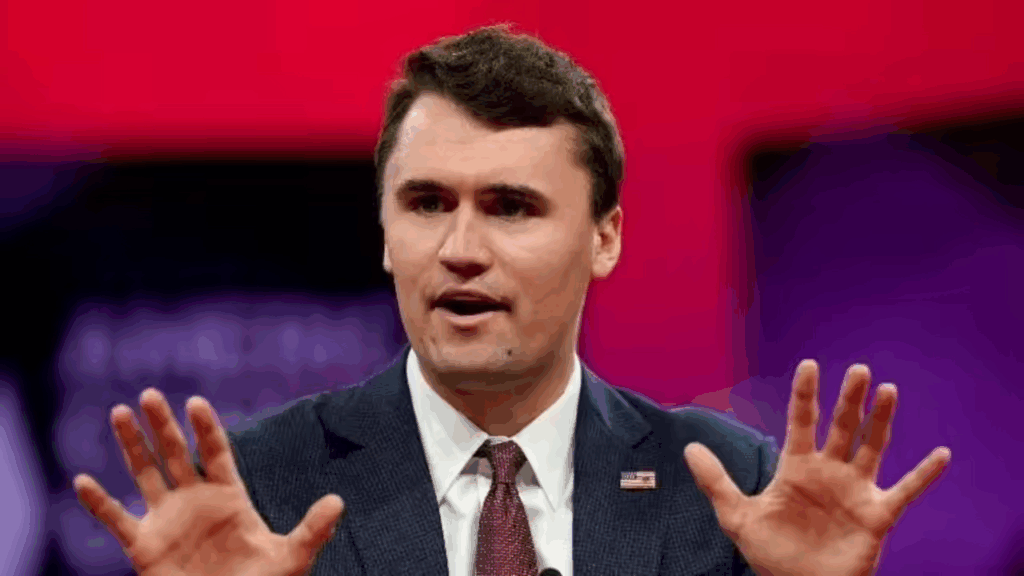
The “security signals conspiracy theory” surrounding Charlie Kirk’s assassination has exploded across social media in the weeks since his fatal shooting at Utah Valley University. But now, the man who led Kirk’s protection detail is pushing back, directly and unequivocally.
Brian Harpole, Kirk’s former head of security, says the online speculation built around slowed-down clips, frame-by-frame animations, and TikTok detective work has it all wrong. During an interview this week with podcaster Shawn Ryan, Harpole said none of the gestures made by guards behind Kirk before the shooting were coded warnings or coordinated signals.
And according to him, those theories aren’t just incorrect—they’re distracting from the reality of what happened that day.
What Sparked the “Security Signals” Conspiracy Theory?
The speculation began almost immediately after Kirk was shot on September 10 while speaking in front of about 3,000 attendees. Video angles from the outdoor event circulated widely, and a few seconds caught fire online:
- One member of Kirk’s detail adjusted his cap while holding a phone.
- Another moved his arms while scanning the crowd.
Those everyday motions spiraled into a theory that Kirk’s own security team knew a gunman was in position but failed—intentionally or otherwise—to stop him.
On platforms like TikTok, X, and Reddit, users ran with the idea that the gestures were covert signals exchanged moments before the attack, implying internal involvement or foreknowledge.
Did the Security Team Use Signals That Day? Harpole Says Absolutely Not
Harpole says the premise itself is flawed. His team doesn’t rely on hand signals, ever.
“If we needed to relay a message, we’d say it on comms,” he explained. “If we notice something, we’re not going to use a hand signal.”
He added that legitimate tactical signals look nothing like everyday body language. They’re designed precisely so they can’t be confused with normal movements.
“We’d never use something that could be mistaken for a guy scratching his a**,” he said.
Why the Theory Doesn’t Hold Up, According to Harpole
1. No One Reacted Like a Signal Was Given
Harpole said that if any guard had issued a warning signal, even hypothetically, the rest of the team would have turned immediately toward him for direction. That didn’t happen.
His point: communication protocols rely on confirmation, not silent mime-like gestures that could easily be missed or misinterpreted.
2. Everyday Movements Were Miscast as Something More
The most viral clip featured guard Frank Turek adjusting his hat seconds before the gunshot.
Harpole finds it baffling that such a normal action drew suspicion:
“There were a line of people in the front, and everyone was doing all kinds of things. Everybody’s subject to that.”
This aligns with a broader pattern online—viewers watch chaotic footage and isolate moments that, when separated from context, appear suspicious.
3. The Wrong People Are Getting Blamed
Some conspiracy threads targeted Kirk’s wife, Erika, suggesting she played a role in his death.
Harpole rejected that outright:
“She’s a victim; that’s her husband. How people without any proof are saying she’s responsible—that’s what makes me lose faith.”
He warned that reckless speculation isn’t just hurtful—it also derails factual investigations.
Here, consider adding an infographic illustrating “How conspiracy theories typically evolve after high-profile tragedies.”
A Reminder of What Actually Happened That Day
Kirk was shot in the neck soon after starting his Q&A session. His team rushed him to Timpanogos Regional Hospital, where he was pronounced dead.
Authorities arrested Tyler Robinson, 22, days later. He is charged with Kirk’s murder. This is publicly reported information but should be fact-checked against official police statements or a court docket before publication.
For accuracy, plan to cite:
- Utah County Sheriff’s Office press releases
- Court records are accessible through Utah’s state judiciary portal
- Reporting from AP, Reuters, or local outlets like The Salt Lake Tribune
Why This Conspiracy Theory Matters—and Why Harpole Is Speaking Now
The spread of misinformation after a high-profile killing is depressingly common. But Harpole says this one hit especially hard because:
- It targets innocent people.
- It distracts from the investigation and the real perpetrator.
- It creates a false narrative around how protective teams operate.
And it reflects a larger trend: people increasingly interpret normal human movement as evidence of secret plots.
A short visual addition here could be useful: “Timeline of online mentions and keyword spikes for ‘security signals’ after September 10.”
Should We Expect More Answers?
The criminal case against Robinson will likely reveal more about the motive and planning. But Harpole’s comments underline a key point: speculation isn’t evidence.
His interview marks the first time someone directly involved in Kirk’s security detail has addressed the rumors head-on. And for him, the goal is simple—steer the conversation back to facts.
As Harpole put it, conspiracy theories “make it impossible to find the truth.”
TL;DR
- Viral clips of Kirk’s security guards adjusting clothing and scanning the crowd fueled claims they used “security signals.”
- Brian Harpole, who led the detail, says his team never uses hand gestures for communication.
- He dismissed the theories as misunderstandings of normal movements.
- He condemned online attacks on Kirk’s wife, calling them baseless and cruel.
- Police arrested 22-year-old Tyler Robinson for Kirk’s murder.