
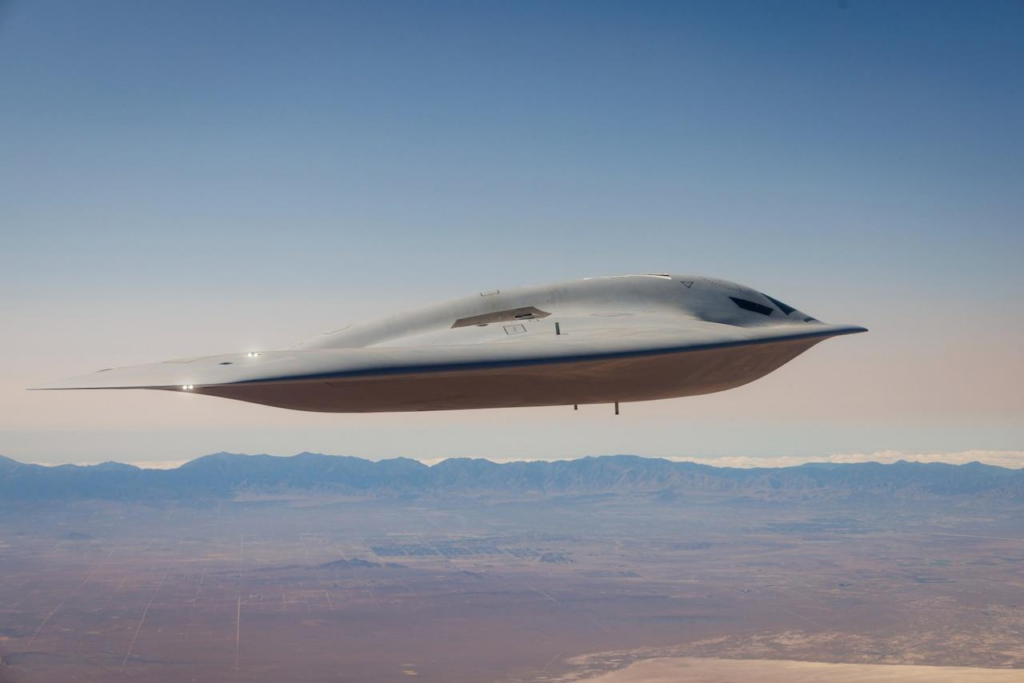
The B-21 Raider—America’s next-generation stealth bombers—has barely stepped out of the shadows, and already it’s the subject of global scrutiny. A recent claim by Chinese researchers suggests they may have identified a potential flaw in its design.
But in the chessboard world of military aviation, not every “weakness” is what it seems. Sometimes it’s a hypothesis wrapped in simulation, wrapped in geopolitics.
Here’s what’s actually going on.
What are the B-21 Raider bombers and why does it matter?
The B-21 Raider is being developed by Northrop Grumman as the future backbone of the US Air Force’s long-range strike capability.
A next-generation stealth platform
Designed to replace both the B-2 Spirit and the B-1B Lancer, the B-21 is built for a different era of warfare:
- Deep penetration into heavily defended airspace
- Long-range nuclear and conventional strike missions
- Integration with next-gen digital and AI-driven systems
It’s also expected to play a key role in the US nuclear triad, making it strategically critical.
What makes it technologically unique
Unlike older bombers, the B-21 leans heavily into software:
- Open architecture design: Enables rapid upgrades without redesigning hardware
- Stealth evolution: Designed to evade a wider range of radar frequencies
- Digital engineering: Developed using advanced simulations from day one
Think of it less like a traditional aircraft and more like a flying system that can be continuously updated—closer to a smartphone than a static machine.
What flaw did Chinese scientists claim to find?
The claim comes from researchers linked to the China Aerodynamics Research and Development Centre, who used simulation tools to model the bomber’s likely performance.
How the simulation was conducted
Using publicly available data—images, known dimensions, and general design principles—they created a virtual model of the aircraft.
The key tool reportedly used: PADJ-X simulation software.
Their analysis focused on:
- Airflow behavior around the flying-wing structure
- Stability across different flight conditions
- Aerodynamic efficiency under stress
The alleged weakness
The researchers suggested that the B-21’s flying-wing design may present:
- Potential stability challenges in certain flight regimes
- Opportunities for aerodynamic optimization
- Design trade-offs that could affect performance
Importantly, they did not claim a catastrophic flaw—more a “room for improvement” scenario.
How credible are these claims?
Here’s where things get interesting. The claim sits at the intersection of science, speculation, and strategic messaging.
The limits of open-source simulations
The B-21 program is highly classified. That means:
- Exact dimensions, materials, and systems are unknown
- Internal flight control software is undisclosed
- Real-world performance data is unavailable
So any simulation is, at best, an educated guess.
It’s like trying to reverse-engineer a locked smartphone by looking at its reflection in a mirror—you might get the shape right, but not the circuitry.
Flying-wing designs are not new
The supposed “flaw” revolves around the flying-wing configuration—but this design has existed for decades.
The B-2 Spirit already uses it successfully.
Yes, flying wings can have stability challenges. But modern aircraft solve this with:
- Advanced flight control systems
- Real-time software corrections
- Precision engineering
In other words, what looks like a weakness on paper is often handled invisibly by onboard systems.
This kind of analysis is routine
Military powers constantly study each other’s equipment.
- The US analyzes Chinese stealth jets
- China analyzes US bombers
- Both sides run simulations based on limited data
This is less a “breakthrough discovery” and more standard practice in defense research.
Why this matters in the bigger US-China rivalry
Even if the findings are speculative, they serve a purpose.
Strategic signaling
Publishing such claims can:
- Showcase domestic technological capability
- Signal confidence in aerospace research
- Subtly challenge US military superiority
Information warfare layer
In modern conflicts, perception matters almost as much as capability.
A claim like this can:
- Influence public and political narratives
- Raise questions about expensive defense programs
- Feed into broader geopolitical competition
What makes the B-21 difficult to evaluate from the outside?
The B-21 is designed to be mysterious by design.
Classified by necessity
Most critical aspects remain hidden:
- Radar cross-section data
- Engine configuration
- Electronic warfare capabilities
Without these, any external analysis is incomplete.
Software is the real “secret sauce”
The aircraft’s edge may lie less in its shape and more in its code:
- Adaptive mission systems
- AI-assisted decision-making
- Continuous upgrades to counter new threats
That’s something simulations based on external design simply cannot capture.
Should the US be concerned about such findings?
Short answer: not immediately—but not dismissively either.
Why it’s not an immediate red flag
- No access to classified data
- No real-world testing validation
- Known design trade-offs already accounted for
Why it still matters
- Highlights how advanced simulation tools are becoming
- Shows how quickly adversaries can analyze new systems
- Underscores the importance of staying ahead in both hardware and software
TL;DR
- Chinese researchers claim a potential aerodynamic flaw in the B-21 Raider
- The finding is based on simulations using public data, not classified information
- The issue relates to flying-wing stability—something already managed in modern aircraft
- Experts view this as routine analysis, not a confirmed vulnerability
- The bigger story is about technological competition and perception in US-China rivalry