
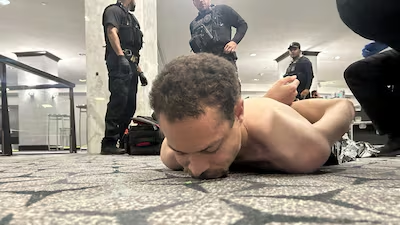
In the hours after a shooting scare at the Washington Hilton during the White House Correspondents’ Dinner weekend, investigators began piecing together a portrait of the suspect—one shaped as much by his online presence as by the events of that night. Authorities allege that Cole Tomas Allen, a California-based engineer and game developer, opened fire near the venue before being subdued by law enforcement.
The incident has raised urgent questions about political extremism, online rhetoric, and security vulnerabilities at high-profile events attended by journalists, lawmakers, and officials, including figures tied to Donald Trump’s administration.
What happened at the Washington Hilton?
According to officials, Allen had booked a room at the Washington Hilton, a move that allowed him to bypass some of the stricter security protocols imposed on event attendees entering the main ballroom.
Authorities say he later approached a magnetometer checkpoint and opened fire before being quickly subdued. No major casualties have been reported, but the breach itself has triggered serious concern.
Why does this matter?
The White House Correspondents’ Dinner is one of Washington’s most tightly secured annual events. The fact that an armed individual allegedly accessed the premises highlights the following:
- Potential gaps in hotel-based security screening
- The complexity of securing multi-use venues
- The risks posed by individuals with insider-like access (e.g., registered guests)
Who is Cole Tomas Allen?
Allen’s background stands in stark contrast to the nature of the alleged attack. He is reported to have a strong academic and technical profile.
Educational background
- Bachelor’s degree in mechanical engineering from the California Institute of Technology
- Master’s degree in computer science from California State University, Dominguez Hills
- Undergraduate graduation: 2017
- Master’s completion: 2025
Professional profile
Allen reportedly worked as:
- An independent game developer
- An educator in technology-related fields
His trajectory reflects a technically skilled individual with exposure to both engineering and software development—making his alleged actions particularly difficult to reconcile with his professional identity.
What do Allen’s social media posts reveal?
Investigators are closely examining posts attributed to Allen on platforms like Bluesky and X, where he allegedly used the handle “Coldforce.”
These posts suggest a pattern of escalating political anger, particularly toward the Trump administration.
Key themes in his posts
- Strong criticism of Donald Trump
- Opposition to U.S. foreign policy, especially support for Ukraine
- Personal attacks on public officials, including JD Vance
- Religious framing of political disagreement
One post reportedly described Trump as “a sociopathic mob boss,” while another criticized administration officials through a moral and religious lens.
Why this matters
Online rhetoric doesn’t always translate into real-world violence—but in cases like this, it can provide:
- Insight into motive
- Evidence of premeditation
- Warning signs that may have been overlooked
What did Allen’s manifesto say?
Authorities say Allen sent a written document, described as a manifesto, to family members shortly before the incident.
Key excerpts and ideas
- He used the alias “Coldforce,” matching his online identity
- He framed his beliefs through a moral and religious lens
- He justified action by arguing that inaction equals complicity
One notable passage:
“Turning the other cheek when someone else is oppressed is not Christian behavior; it is complicity in the oppressor’s crimes.”
The document also included apologies to individuals whose trust he claimed to have “abused.”
Interpretation
The manifesto suggests:
- A perceived moral justification for violence
- A shift from political dissent to ideological absolutism
- A blending of religion and political grievance
Experts often point to this combination as a common feature in lone-actor radicalization.
What did Allen say about security at the venue?
Perhaps most alarming are statements attributed to Allen criticizing the security setup itself.
In the document, he allegedly wrote that he was able to enter with weapons unnoticed and described the environment as marked by “arrogance.”
Why is this significant
If verified, these claims could:
- Trigger a review of security protocols at major events
- Influence how hotels coordinate with federal agencies
- Lead to stricter screening for registered guests
How has Allen’s family responded?
As of now, public information about the family’s response remains limited. However, authorities confirmed that Allen shared his writings with family members before the attack.
This raises difficult questions:
- Were there warning signs?
- Did family members attempt to intervene?
- What responsibilities do individuals have when confronted with alarming behaviour?
These questions often surface in similar cases but rarely have simple answers.
What charges could Allen face?
Prosecutors say Allen is expected to face multiple serious federal charges, including the following:
- Use of a firearm during a crime of violence
- Assaulting a federal officer with a dangerous weapon
If convicted, these charges carry significant prison time.
What happens next?
The case is still under investigation. Authorities will likely:
- Analyse digital evidence (social media, emails, devices)
- Review the manifesto and communications
- Interview witnesses and associates
Why is this incident bigger than one individual
While the case centers on Cole Tomas Allen, it reflects broader issues shaping the U.S. today:
1. Political polarisation
The intensity of Allen’s rhetoric mirrors a wider trend of deeply entrenched political divisions.
2. Online radicalisation
Digital platforms can amplify extreme views and create echo chambers that reinforce them.
3. Security challenges
Balancing openness with safety at public and semi-public events remains a persistent challenge.
TL;DR
- Cole Tomas Allen was detained after allegedly opening fire near the White House Correspondents’ Dinner venue.
- He had a strong academic background in engineering and computer science.
- Social media posts show sharp criticism of the Trump administration and U.S. policies.
- A manifesto sent to family members outlined ideological motivations.
- The incident has raised concerns about security gaps and online radicalisation.
- Federal charges are expected, and the investigation is ongoing.