
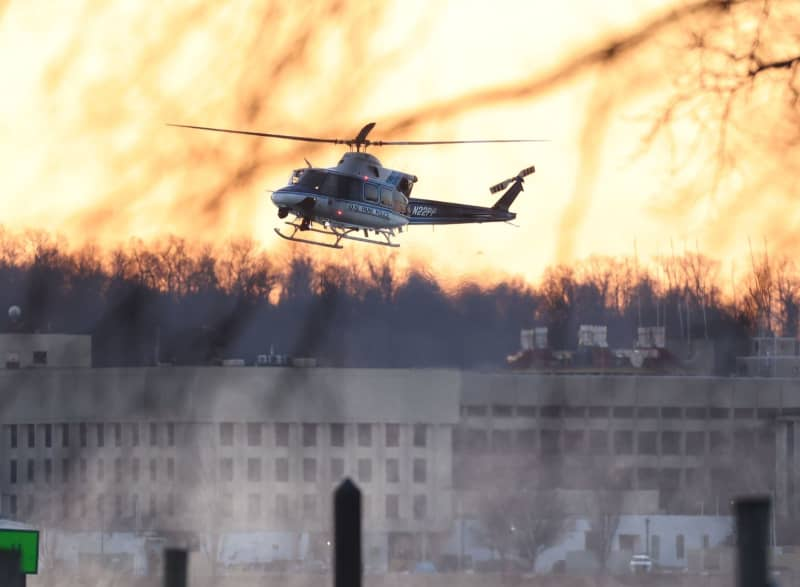
Elite military unit served crucial role in government continuity plans
A devastating collision between a Black Hawk helicopter and a passenger jet in Washington has unexpectedly shed light on one of the military’s most secretive missions: ensuring government survival during national emergencies. The incident, which claimed 67 lives, has drawn attention to the specialized military units tasked with protecting America’s leadership during crisis situations.
Training mission turns tragic
The fatal crash occurred Wednesday when a Black Hawk helicopter from Fort Belvoir’s 12th Aviation Battalion, conducting night training along the Potomac River’s Route 4, collided with a commercial aircraft. The accident resulted in the deaths of three military personnel and 64 civilians.
Defense Secretary Pete Hegseth confirmed the helicopter’s sensitive mission during a White House briefing: “They were on a routine, annual re-training of night flights on a standard corridor for a continuity of government mission.”
Behind the shadows: The continuity of government program
The 12th Aviation Battalion, while typically known for VIP transport around Washington, plays a crucial role in the nation’s “continuity of government” operations. This program, designed to maintain governmental function during catastrophic events, remains largely classified.
“Some of their mission is to support the Department of Defense if something really bad happens in this area, and we need to move our senior leaders,” explained Jonathan Koziol, chief of staff of the Army’s Aviation Directorate.
The program’s significance was dramatically demonstrated during the September 11, 2001 attacks. Bradley Bowman, a former Army aviation officer with the 12th Aviation Battalion, disclosed: “The battalion helped transport some senior leaders out of Washington, DC to ‘hide sites.'”
Bowman himself flew then-Deputy Secretary of Defense Paul Wolfowitz back to the Pentagon that evening, improvising a landing on the closed I-395 highway after finding the Pentagon’s helipad destroyed.
Current operations and facilities
According to Garrett Graff, author of a 2017 book on the subject, the Raven Rock Mountain Complex, or “Site R,” remains one of three main government backup facilities. “It’s 100 percent operational today. There’s a team of maybe 100 personnel inside Raven Rock right now, ready to pick up the pieces of the U.S. government,” Graff noted.
The facility, located near Camp David, serves as the primary contingency site for Pentagon leadership, maintaining constant readiness for potential national emergencies.