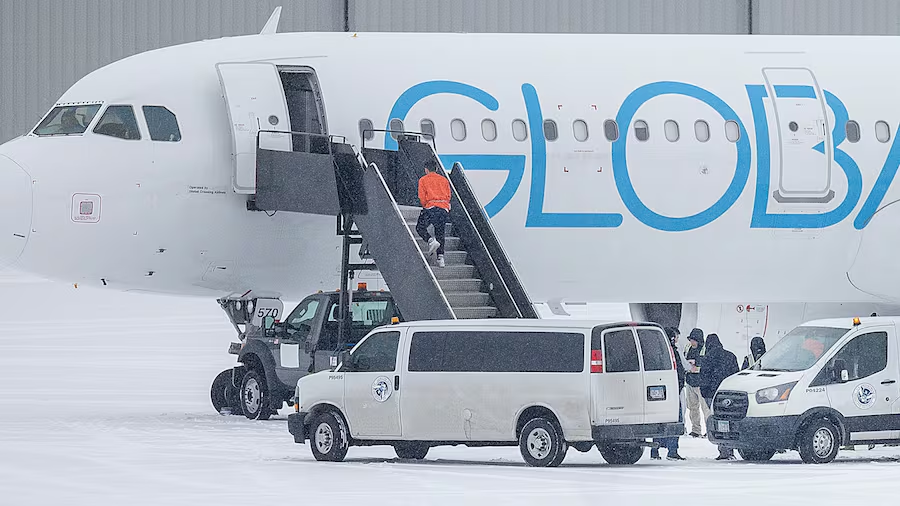
A new phase of the Donald Trump administration’s immigration crackdown is sending some migrants from the United States to African countries they have never lived in, including a group of Cuban immigrants who were deported to the Central African Republic. The cases have highlighted one of the most controversial elements of the administration’s immigration strategy: “third-country” removals, in which people are sent to a country other than their country of nationality. Among those affected is Yasmany Moreno, a Cuban immigrant who had lived and worked in Florida for years. He says he did not know he was being sent to Africa until hours into the flight.
Moreno and dozens of other deportees are now in Bangui, the capital of the Central African Republic, where they say they have little information about their legal status or what comes next. Their accounts have intensified concerns from immigration attorneys and human-rights groups about transparency, due process, and conditions facing people removed under these agreements.
What are third-country deportations?
A third-country deportation occurs when the United States removes a person to a country that is neither the person’s country of citizenship nor necessarily a place where they have previously lived.
The Trump administration has expanded this approach through agreements with governments in Africa and elsewhere.
The strategy can be used when the United States says it cannot immediately return an individual to their home country because of legal restrictions, diplomatic complications or concerns surrounding removal.
The administration argues that sending people to willing partner countries gives immigration authorities another way to carry out removal orders.
Human rights organisations, however, say the policy can place deportees in countries where they have no family, community ties or familiarity with the language and legal system. Amnesty International says more than 100 people had been sent by the United States to African third countries over the previous year as of August 2026.
Why were Cubans from Florida sent to the Central African Republic?
The Cubans were among migrants removed from the United States under the third-country strategy.
One of them, Yasmany Moreno, had lived in Florida for about a decade. He had worked between Tampa and Miami and operated a small trucking company.
According to his account, Moreno was moved among US detention facilities before being placed on a flight from Texas on July 30. He said he initially believed he was being transferred to another US detention centre.
He told the Tampa Bay Times that an immigration officer informed him several hours into the flight that the destination was Africa.
Moreno said he was shocked because he had expected another domestic transfer.
By the time he and the other passengers understood where they were going, they were already en route to Bangui.
Who are the Cuban deportees?
The group includes Cuban immigrants with very different immigration histories.
Moreno arrived in the United States in 2016 after travelling from Cuba by raft. He was admitted under the immigration framework that existed after the Obama administration had ended the “wet foot, dry foot” policy in 2017.
He later applied for permanent residency but was denied after his temporary immigration status expired.
Another deportee, Arístides Fernández, came to the United States through the southern border in 2021 and had an I-220A document, according to the reporting.
Fernández was arrested after an immigration court hearing in Miami in January 2026 and spent months in detention before being removed to Africa.
A third Cuban, Daniel Fuentes, lived in Miami and entered the United States through a process involving the CBP One app during the Biden administration. Fuentes, who is transgender, said the situation in Bangui has created additional safety concerns.
Their different immigration histories illustrate that the group is not made up of people who all entered the country through the same pathway.
What happened after they arrived in Africa?
The deportees arrived in Bangui after a flight lasting roughly 21 hours, according to accounts from those involved.
Moreno and the other migrants were being housed at a hotel in the capital.
They said they did not have their passports and were uncertain about how long they could remain in the country or what would happen after their initial accommodation.
Moreno told reporters that the group feared they could eventually be moved to another country.
The uncertainty is one of the central criticisms of third-country deportation arrangements: removal from US custody does not necessarily mean the individual immediately enters a stable life in the receiving country.
Why is the Central African Republic controversial as a destination?
The Central African Republic is a country affected by political instability, armed conflict, crime and limited public infrastructure.
The US State Department currently assigns the country its highest travel warning, Level 4, advising Americans not to travel there because of risks including unrest, crime, kidnapping, landmines, health threats and terrorism. The State Department also says the US government has limited capacity to provide emergency assistance there.
That warning is directed at US citizens rather than deportees, and it should not be treated as a direct legal assessment of whether migrants can safely remain in the country.
But advocates say the advisory underscores the challenges facing people who are unfamiliar with the country and may lack money, documents, legal assistance or local support networks.
What happens to people once ICE removes them?
The Trump administration says its responsibility ends once a person is no longer in Immigration and Customs Enforcement custody.
That position has become a major point of contention.
The Department of Homeland Security has defended the use of third-country removals as part of the administration’s broader effort to increase deportations.
Critics argue that the government cannot treat a transfer as the end of its responsibility when the receiving country provides little clarity about the person’s status or ability to seek protection.
That disagreement is now at the heart of the broader legal and humanitarian debate surrounding third-country removals.
Why are human rights groups criticising the policy?
Amnesty International has accused the United States of using a system that can expose deportees to serious rights violations.
The organisation says people have been sent to African countries despite having limited or no ties there and, in some documented cases, have faced detention, restricted access to lawyers and uncertainty about their legal status.
One of the group’s central concerns is refoulement, the principle that people should not be returned to a country where they face a serious risk of persecution, torture, or other grave harm.
Advocates argue that third-country arrangements can create additional risks if deportees are later transferred again or sent back to their country of origin without adequate safeguards.
The US government disputes the broader characterisation that the policy is unlawful, and the legal status of individual removals depends on the facts of each case.
Is the Central African Republic the only African country accepting deportees?
No.
The United States has reached or pursued third-country removal arrangements with multiple African governments.
Amnesty International lists countries including Cameroon, the Democratic Republic of Congo, Equatorial Guinea, Eswatini, Ghana, Liberia, Rwanda, South Sudan and Uganda among African countries that have received or agreed to receive third-country nationals from the United States.
Liberia has also recently agreed to accept as many as 1,200 third-country deportees over a year under an arrangement with Washington.
The first group sent there included people from Latin American countries, including Venezuela and Cuba.
That shows the policy is broader than the Cuban cases in Bangui.
Why are Cubans being caught up in the policy?
Cuban nationals occupy an unusual position within the US immigration system because the United States and Cuba have a long and complicated migration history.
For decades, special immigration policies affected how Cuban migrants were treated compared with many other nationalities.
Some Cubans who entered the United States under earlier policies built long-term lives in Florida before their immigration status later became uncertain.
The Trump administration’s expanded removal efforts have therefore brought people into detention who may have lived in the United States for years.
The cases of Moreno and others show how dramatically a person’s circumstances can change once ICE takes custody and a third-country removal is pursued.
What does this mean for due process?
Due process is one of the most contested issues surrounding third-country removals.
Immigration law gives the US government broad authority to remove certain noncitizens, but people can have different forms of legal protection depending on their circumstances.
Some migrants may have pending proceedings, withholding of removal or other protections that complicate deportation to their home countries.
The central question for critics is whether those protections remain meaningful when the government sends someone to a third country instead.
Amnesty International says some people have been removed while their cases were still being reviewed and has raised concerns about access to lawyers and meaningful opportunities to challenge removal decisions.
The administration maintains that it is using lawful removal mechanisms and agreements with countries willing to accept deportees.
What about people with medical or safety concerns?
The personal accounts emerging from Bangui have also highlighted the vulnerability of some deportees.
Moreno said he has diabetes and asthma and became sick after the long flight.
Fuentes, who is transgender, said security personnel warned her that it could be unsafe to leave the building where the group was staying.
These accounts are individual allegations and should not be generalized to every person removed under the program.
But they illustrate why advocates are concerned about sending vulnerable people to destinations where they may have no support system and may face language, medical or security barriers.
Why are deportees calling themselves “forgotten”?
The uncertainty surrounding life after removal is central to the experiences described by the Cubans in Bangui.
Moreno said he felt he had been forgotten and did not know what would happen after the group’s temporary accommodation ended.
Fernández described the situation as being in limbo because he did not know where he could go or what rights he had in the Central African Republic.
Those descriptions point to a broader issue with third-country removals: deportation is a physical act, but it does not automatically resolve the person’s immigration status, housing, legal position or ability to remain safely in the destination country.
Are third-country deportations new?
No, but their scale under the Trump administration has increased significantly.
The United States has used third-country arrangements before, including agreements involving countries willing to accept migrants the US could not readily return elsewhere.
What has changed is the breadth and prominence of the policy in the current administration’s effort to increase deportations.
The strategy has expanded beyond a narrow group of nationals and now involves agreements with multiple African governments.
That expansion has attracted growing scrutiny from courts, lawmakers, immigration advocates and international human rights organisations.
What happens next for the Cubans in Bangui?
The immediate question is what legal and practical status the deportees will have in the Central African Republic.
They need clarity about how long they can remain, whether they can work, whether they can seek asylum, whether they can obtain travel documents, and whether they could be transferred somewhere else.
Those answers depend partly on arrangements between Washington and Bangui and partly on Central African law.
The uncertainty is particularly significant for people who have spent years building lives in the United States and have no established connections in Africa.
The bigger picture
The Cuban cases illustrate the human consequences of a policy that can look very different on paper and in practice.
For the US government, third-country removals provide another mechanism for carrying out immigration enforcement.
For the migrants being removed, the experience can mean leaving behind families, jobs and communities and arriving somewhere they have never lived.
The policy is likely to remain contested because the debate is not simply about whether the United States can remove someone from its territory.
It is also about what protections follow that person after the plane leaves US airspace.
The bottom line
Cubans living in Florida are among a growing number of migrants being sent by the Trump administration to African countries under third-country removal arrangements.
Yasmany Moreno, Arístides Fernández and Daniel Fuentes are among those who have described being deported to the Central African Republic despite having no meaningful connection to the country. Their accounts describe uncertainty over documents, housing, legal status and personal safety.
The US government argues that the removals are part of its lawful immigration enforcement strategy. Human-rights organizations dispute that characterisation and have raised concerns about due process, detention, access to legal assistance and the possibility of people being sent onward to danger.
The Central African Republic itself is under a US State Department Level 4 “Do not travel” advisory because of risks including unrest, crime, kidnapping, terrorism and health threats.
The cases therefore raise a question that extends beyond the migrants currently in Bangui: when a country removes a person to a third country, what legal and humanitarian responsibilities remain after deportation is complete?
That question is likely to become increasingly important as the United States expands its network of third-country removal agreements across Africa.