
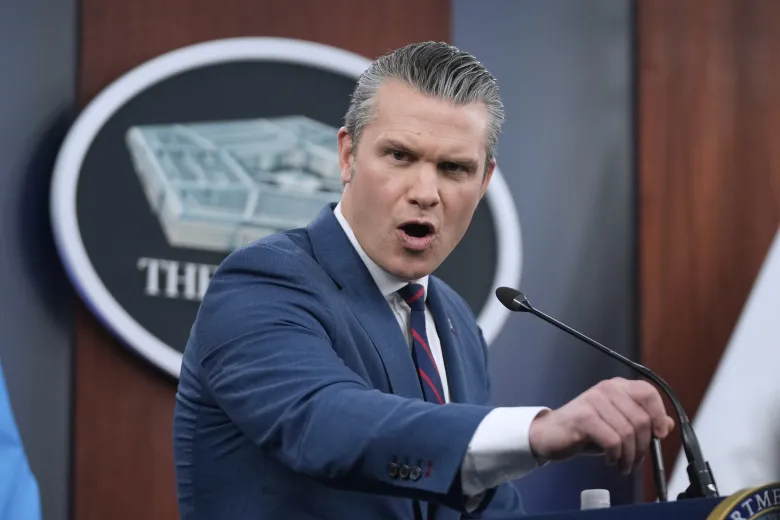
A claim by U.S. Defense Secretary Pete Hegseth that grieving military families urged him to “finish the job” in Iran is facing scrutiny after at least one family member publicly disputed the account.
The moment has become a flashpoint in shaping, amplifying, and challenging wartime narratives, especially when emotions and policy intersect.
What did Pete Hegseth claim?
Speaking after meeting families of six U.S. service members killed in a recent military incident, Hegseth described a unified message from the relatives.
His version of events
At a Pentagon press briefing, Hegseth said:
- Families expressed “unbreakable resolve.”
- They urged leadership to “honour their sacrifice.”
- Multiple families told him to “finish this” and not stop until the mission is complete
The framing suggests a broad, emotionally charged endorsement of continued military action in Iran.
Why the statement matters
Such claims carry weight. When leaders invoke the voices of grieving families, it can:
- Shape public opinion
- Influence political support for ongoing military operations
- Add moral justification to strategic decisions
That makes accuracy critical.
What did the soldier’s father say?
The narrative began to fracture when Charles Simmons, whose son was among those killed, spoke to the media.
A direct contradiction
In an interview with NBC News, Simmons said:
- He did not tell Hegseth to “finish the job.”
- The continuation of the war was not part of their conversation
- His discussion focused on his son’s life, service, and personal reflections
When asked directly whether he encouraged continued fighting, Simmons was unequivocal:
“No, I didn’t say anything along those lines.”
A more nuanced perspective
Rather than advocating escalation, Simmons expressed uncertainty:
- He acknowledged the complexity of wartime decisions
- He said he lacks enough information to draw firm conclusions
- He raised a broader question: “Who wants war?”
His remarks reflect a more cautious, conflicted stance rather than a clear call for intensification.
What do we actually know?
At this stage, the facts are limited and incomplete.
Confirmed
- Hegseth met families of fallen service members
- He publicly claimed they supported continuing the mission
- At least one family member has denied making such a statement
Not confirmed
- Whether other families expressed similar sentiments
- Whether Hegseth’s comments reflect a general impression rather than direct quotes
- The full context of all private conversations during the meeting
This leaves room for interpretation and misinterpretation.
Why discrepancies like this happen
Moments like these often sit at the intersection of emotion, memory, and messaging.
Emotional environments shape perception
Meetings between officials and grieving families are intense and deeply personal. What is said, heard, or remembered may vary:
- Officials may interpret tone and God as support
- Families may focus on personal loss rather than policy discussions
Political messaging pressures
Public officials operate under pressure to communicate resolve and unity. That can lead to:
- Broad generalizations from limited interactions
- Selective emphasis on statements that align with policy goals
The risk of overgeneralization
Even if one or more families expressed support for continuing the mission, presenting it as a unanimous sentiment can be misleading.
Why this fact check matters
This is not just about one quote. It touches on a larger issue: how narratives are constructed during wartime.
The power of symbolic voices
Families of fallen soldiers carry moral authority. Their words can:
- Humanize policy decisions
- Influence public sentiment
- Be used, intentionally or not, to support specific agendas
Trust and credibility
When discrepancies emerge:
- Public trust in official statements can erode
- Media scrutiny intensifies
- Competing narratives gain traction
In an environment already saturated with conflicting claims, credibility becomes a fragile currency.
The broader context: war, messaging, and public opinion
The U.S. involvement in the Iran conflict is unfolding under intense global attention. Statements from leaders like Donald Trump and senior defense officials are closely parsed for signals of intent.
Competing pressures on leadership
- Demonstrate strength and resolve
- Maintain public and political support
- Honor military sacrifice without appearing to exploit it
Balancing these is inherently difficult, and missteps can quickly become controversies.
So, did families tell Hegseth to “finish the job”?
The bottom line
- There is no verified evidence that multiple families made this statement.
- At least one family member has explicitly denied it.
- Hegseth’s claim remains uncorroborated and contested.
Until more families speak publicly or additional evidence emerges, the assertion should be treated with caution.
TL;DR
- Pete Hegseth said families of fallen soldiers urged him to “finish the job” in Iran
- One father, Charles Simmons, has publicly denied making such a statement
- No independent verification confirms that multiple families shared this view
- The claim remains disputed and highlights the risks of broad generalizations in wartime messaging