
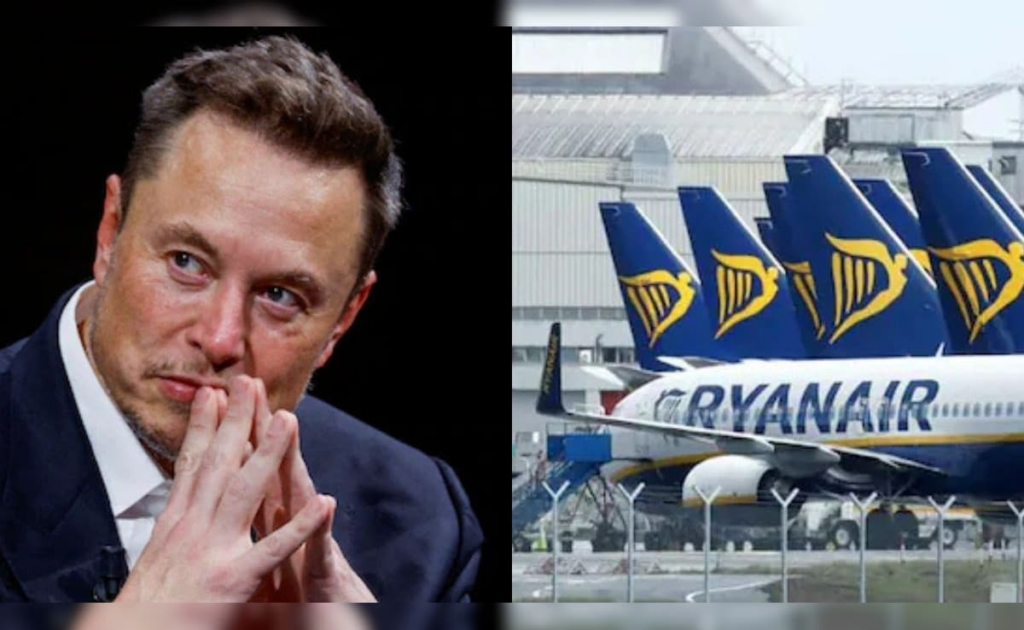
What began as a technical disagreement over in-flight internet has morphed into a full-blown social media spectacle, complete with insults, jokes about hostile takeovers, and a tongue-in-cheek ticket sale. The online clash between Elon Musk and Ryanair, led by its famously blunt CEO Michael O’Leary, is the latest example of how digital spats can spill into real-world business moves—and brand strategy.
At its core, the argument was about connectivity in the skies. But as often happens online, the conversation quickly veered off course.
What sparked the Elon Musk–Ryanair feud?
The exchange began with Musk promoting Starlink, his satellite-based broadband service operated by SpaceX. Musk has repeatedly argued that Starlink could revolutionize in-flight internet, offering faster and more reliable Wi-Fi at cruising altitude.
Ryanair wasn’t buying it
Michael O’Leary dismissed the idea outright. His argument was practical and very on-brand for Europe’s largest budget airline:
- Installing Starlink equipment would add weight, increasing fuel costs
- Those costs would ultimately be passed on to passengers
- Most Ryanair customers, he said, don’t want to pay extra for in-flight Wi-Fi
For an airline built on ultra-low fares and optional add-ons, the math simply didn’t work.
When the debate turned personal
What could have remained a dry business disagreement quickly escalated on social media.
“Idiot” vs “I’ll buy your airline”
O’Leary took to X and publicly criticized Musk, calling him an “idiot.” The post gained rapid traction, amplified by Ryanair’s large and highly engaged online following.
Musk fired back in his trademark style. He joked that he might buy Ryanair, fire O’Leary, and put “someone named Ryan” in charge instead. The remark went viral, racking up millions of views and turning a niche aviation debate into internet entertainment.
At that point, the argument had clearly left the runway.
How Ryanair turned insults into a sales pitch
Rather than backing away, Ryanair did what it does best: leaned into controversy.
The “Great Idiots Sale”
The airline announced a limited-time ticket promotion dubbed the “Great Idiots Sale.” In a cheeky post on X, Ryanair said the sale was dedicated to Musk and “other idiots on the platform.”
The result:
- Deeply discounted fares
- A surge of online engagement
- Free global publicity
By reframing the insult as humor, Ryanair transformed a personal jab into a marketing hook, reinforcing its irreverent brand voice.
Musk doubles down on Starlink
Musk didn’t retreat either. He responded with further criticism, arguing that O’Leary didn’t understand how planes work and reiterating that better internet would meaningfully improve the flying experience.
The back-and-forth kept social media buzzing:
- Some users applauded Ryanair’s humor and quick thinking
- Others sided with Musk, arguing that airlines underestimate passenger demand for connectivity
- Critics on both sides accused the pair of turning a serious discussion into a spectacle
Either way, attention was guaranteed.
Is Musk actually going to buy Ryanair?
Short answer: almost certainly not.
Why a takeover is highly unlikely
Even setting aside the joke-like tone of Musk’s comment, there are major regulatory barriers:
- European aviation rules require airlines to be majority-owned and controlled by European entities
- Ryanair, headquartered in Ireland, must comply with EU ownership limits
- A takeover by a non-European billionaire would face intense legal and political scrutiny
A bid from Musk would be less a business move and more a legal quagmire.
What this episode says about modern brand warfare
Beyond the jokes and memes, the Musk–Ryanair spat highlights a deeper shift in how companies compete for attention.
Social media as a battleground
Key takeaways:
- Executives now act as brand amplifiers, not just decision-makers
- Online conflict can generate more reach than traditional advertising
- Humor and self-awareness can neutralize criticism—and even monetize it
Ryanair, in particular, has built a reputation for embracing chaos online. This episode fits neatly into that strategy.
Does in-flight Wi-Fi actually matter to passengers?
The underlying debate is still unresolved.
Two competing visions of air travel
Musk’s view:
- Connectivity is becoming a basic expectation
- Faster Wi-Fi improves productivity and passenger satisfaction
Ryanair’s view:
- Most passengers prioritize price over perks
- Optional extras should stay optional
Both arguments have merit—and the answer likely varies by airline type, route length, and customer demographic.
TL;DR
- Elon Musk and Ryanair clashed online over the value of in-flight Wi-Fi
- Michael O’Leary called Musk an “idiot”; Musk joked about buying Ryanair
- Ryanair turned the insult into a “Great Idiots Sale” promotion
- The spat generated massive online engagement and free publicity
- A Musk takeover of Ryanair is extremely unlikely due to EU rules