
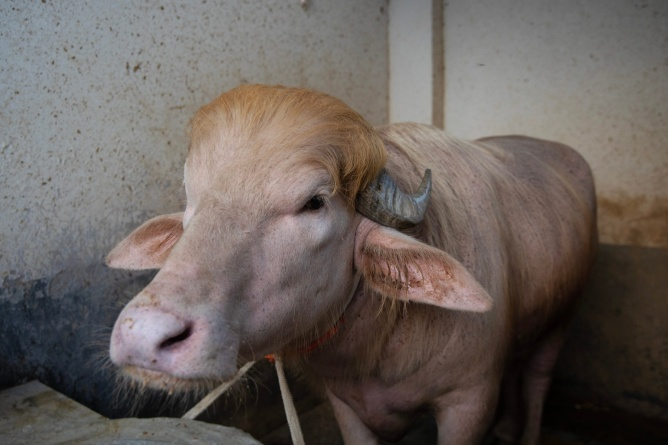
Geopolitics took a detour through a cattle farm this week after Iranian officials joined the internet’s latest surreal spectacle: an albino buffalo in Bangladesh that social media users say resembles US President Donald Trump.
The animal, nicknamed “Donald Trump” online because of its golden-white coat and distinctive tuft of hair, became the subject of mockery and meme warfare after Iran’s diplomatic mission in Russia amplified the viral story on social media.
The post from Iran’s Russia-linked diplomatic account read:
“Poor thing! Bangladeshi buffalo upset by comparisons to Donald Trump.”
In a world already overflowing with AI propaganda, diplomatic feuds, and nuclear brinkmanship, the internet somehow still found room for a buffalo with a presidential hairstyle.
Why the buffalo went viral in Bangladesh
The buffalo gained attention ahead of Eid al-Adha celebrations in Bangladesh, where large cattle markets traditionally attract major public interest.
Located in Narayanganj near Dhaka, the animal reportedly weighs around 700 kilograms and quickly became a local attraction because of:
- Its unusual albino coloring
- Pinkish facial tone
- Thick golden tuft of hair
- Calm behavior around visitors
Social media users began comparing the animal’s appearance to Trump’s signature hairstyle and facial profile, triggering a flood of memes, edited images, and viral posts.
One visitor reportedly told Bangladeshi outlet Prothom Alo that the buffalo’s “facial structure and even hairstyle” resembled the American president.
The internet, predictably, treated this observation like it had just discovered a new species of political satire.
Iran’s trolling reflects deeper US-Iran tensions
The Iranian post was not random internet participation. It arrived against the backdrop of escalating tensions between Iran and the United States.
Relations between the two countries have deteriorated sharply in recent months following military escalation, nuclear tensions, and growing regional instability.
By mocking Trump through a viral animal meme, Iranian-linked accounts appeared to be blending internet humor with geopolitical messaging, a tactic increasingly common in modern state-backed online communication.
Governments today do not just communicate through speeches and sanctions anymore. Sometimes they post buffalo memes.
And increasingly, those memes are strategic.
The buffalo reportedly stopped eating after the attention
Part of the story’s virality came from claims that the animal became distressed by the constant crowds and comparisons.
Russian state broadcaster RT claimed the buffalo had “lost its appetite” after visitors continuously arrived to see the Trump resemblance for themselves.
The animal’s caretaker, Ziauddin Mridha, reportedly said crowds had been gathering daily at the farm to take photographs and videos with the buffalo.
Whether the buffalo was genuinely stressed or simply overwhelmed by becoming South Asia’s strangest celebrity remains unclear. But the story gained momentum precisely because it blended:
- Politics
- internet absurdity
- animal virality
- international trolling
That combination is basically rocket fuel for social media algorithms.
The buffalo was eventually sold for Eid sacrifice
Despite its online fame, the buffalo’s story ended in a very traditional way.
According to reports, the animal was sold ahead of Eid al-Adha for Qurbani sacrifice, an important religious practice observed during the festival.
The buffalo reportedly sold for:
- 550 Bangladeshi taka per kilogram
- Roughly 385,000 taka total
The buyer was identified as Mohammad Shoron from the Jinjira area near Dhaka.
That detail added another layer to the online reaction, with some users expressing sadness that the internet-famous animal would ultimately be sacrificed.
Others responded with dark humor, because the internet rarely misses an opportunity to combine geopolitics with existential livestock commentary.
Another buffalo reportedly got named after Netanyahu
The “Trump buffalo” was not the only politically branded animal reportedly drawing attention in Bangladesh.
According to local reports, another buffalo nicknamed after Israeli Prime Minister Benjamin Netanyahu also became a local attraction.
Unlike the calmer “Trump” buffalo, the “Netanyahu” buffalo was reportedly described as:
- More energetic
- Less predictable
- More aggressive in behavior
The symbolism was almost too perfectly internet-ready to remain confined to local cattle markets.
Why political memes now spread faster than diplomacy
The story may sound trivial, but it highlights something important about modern information warfare and digital culture.
Political narratives increasingly spread through:
- Memes
- Viral clips
- Humor accounts
- Animal videos
- Edited social posts
Sometimes these formats reach larger audiences than official government statements.
Countries including:
- Russia
- Iran
- China
- United States
have increasingly embraced meme-driven communication ecosystems, either directly or indirectly.
The goal is not always persuasion. Often it is amplification, ridicule, emotional reaction, or simply dominating online attention cycles.
A viral buffalo may seem ridiculous. But in the attention economy, ridiculousness is often the point.
Why the story exploded online
Several elements made the story almost perfectly engineered for virality:
- A recognizable political figure
- An uncanny visual resemblance
- International tensions
- Animal content
- Diplomatic trolling
- Eid market culture
- Meme-friendly imagery
It also tapped into the internet’s long-running fascination with accidental celebrity animals.
From “Grumpy Cat” to celebrity pigeons to capybaras becoming emotional support icons, the web has repeatedly demonstrated that animals with oddly human characteristics tend to dominate timelines with terrifying efficiency.
A buffalo that allegedly resembles Donald Trump was practically destined for internet immortality.
The bigger picture: politics is becoming increasingly performative online
What makes this episode interesting is not the buffalo itself. It is how governments, media outlets, and audiences interacted around it.
Diplomatic communication is increasingly happening alongside meme culture rather than separately from it.
Political trolling once lived mainly in fringe internet communities. Now official state-linked accounts participate openly.
The line between propaganda, humor, and entertainment has become blurry enough to resemble a badly compressed JPEG.
And in that strange new ecosystem, even a livestock market outside Dhaka can briefly become part of an international political narrative.