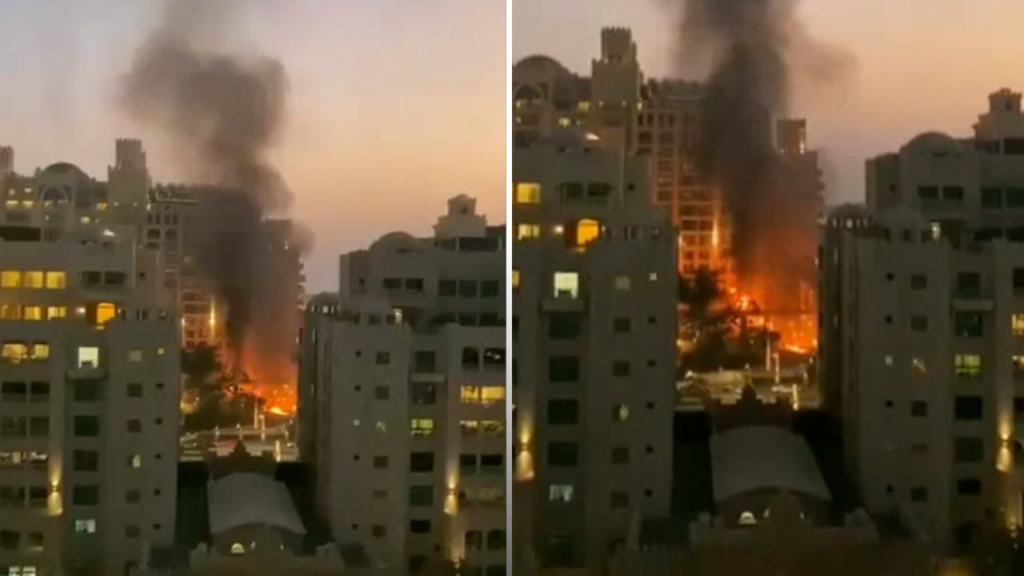
A new warning from Iran’s military has raised the stakes in an already volatile regional conflict. Officials say that hotels and civilian facilities housing U.S. troops may now be treated as legitimate military targets—a shift that could significantly blur the line between civilian and combat zones.
The statement comes amid escalating tensions involving the United States and Israel, following weeks of strikes and counterstrikes across the Middle East.
What Did Iran Say About Targeting Hotels?
Iran’s armed forces spokesperson, Abolfazl Shekarchi, delivered the warning on state television in stark terms:
If U.S. forces are operating from hotels, those locations are no longer civilian in Iran’s view.
The message is clear: location determines legitimacy. If military personnel are present, Iran argues, the site becomes a lawful target.
Why is this a major escalation
Traditionally, international conflict distinguishes sharply between:
- Civilian infrastructure (protected)
- Military targets (legitimate for attack)
Iran’s position challenges that distinction—particularly in urban, civilian-heavy environments like hotels.
This raises immediate concerns about:
- Civilian safety
- Collateral damage
- Legal interpretations under international humanitarian law
How Did the Conflict Escalate to This Point?
The current war traces back to a major flashpoint: joint strikes by the U.S. and Israel on Iran.
What triggered the conflict?
- Strikes reportedly began on February 28
- Iran’s leadership was targeted, including Ali Khamenei
- Iran responded with missile and drone attacks across the region
Since then, the conflict has expanded geographically, affecting multiple countries and strategic sites.
Where the conflict is spreading
Iran claims U.S. personnel are now dispersed across:
- Gulf Cooperation Council (GCC) countries
- Syria
- Lebanon
- Djibouti
This wider footprint increases the risk that civilian areas become entangled in military operations.
Why Does Iran Accuse the US of Using “Human Shields”?
Abbas Araghchi has accused U.S. forces of deliberately relocating into civilian spaces to avoid being targeted.
Iran’s claim
According to Iranian officials:
- U.S. troops have left traditional military bases
- They are now operating from hotels and office buildings
- This places civilians at risk during retaliatory strikes
Araghchi described this as the use of “human shields”, a term with serious legal implications under international law.
Why this accusation matters
If proven, using civilian infrastructure for military purposes can:
- Violate international humanitarian law
- Shift legal responsibility in case of civilian casualties
- Justify retaliatory targeting—at least from Iran’s perspective
However, such claims require independent verification and are often contested in wartime narratives.
Are Hotels Really Being Used by Military Forces?
Reports from outlets like The New York Times suggest that repeated Iranian strikes have made some U.S. military bases in the region difficult to operate.
What’s being reported:
- Certain bases have become “largely uninhabitable”
- Troops may have been temporarily relocated
- Alternative facilities include hotels and office spaces
Why does this happen in conflict zones
Military forces sometimes disperse personnel to:
- Avoid concentrated attacks
- Maintain operational continuity
- Reduce the vulnerability of large bases
But doing so introduces new risks—especially if those locations are civilian.
Iran’s Warnings to Gulf Countries
Iran has reportedly issued direct warnings to hotels in countries like:
- United Arab Emirates
- Bahrain
The message: do not host U.S. troops.
What this means for the region
This puts Gulf nations in a difficult position:
- Many are U.S. allies
- Their economies rely heavily on tourism and hospitality
- They now face potential security risks for civilian infrastructure
Possible consequences
- Increased security at hotels
- Reduced international travel demand
- Diplomatic pressure from both sides
What Are the Risks for Civilians?
This development significantly raises the danger for ordinary people.
Key concerns:
- Blurring of civilian and military spaces
- Higher risk of miscalculation or mistaken targeting
- Potential for mass-casualty incidents in urban areas
Even if strikes are intended to target military personnel, the presence of civilians in hotels makes precision nearly impossible.
Legal and Ethical Questions
Iran’s stance introduces complex legal debates.
Core questions:
- Does the presence of soldiers automatically convert a civilian site into a military target?
- What level of evidence is required before striking such locations?
- Who bears responsibility for civilian casualties?
Under international humanitarian law:
- Combatants must distinguish between civilian and military targets
- Attacks must be proportionate
- Civilian harm must be minimised
Whether Iran’s proposed targeting meets these standards would depend on specific circumstances and an independent assessment.
TL;DR
- Iran warns hotels housing U.S. troops may be treated as military targets
- The conflict escalated after U.S.-Israel strikes on Iran
- Iran accuses the U.S. of using civilians as “human shields”
- Reports suggest troops may be operating from hotels due to damaged bases
- Gulf countries now face increased security and diplomatic pressure
- Civilian risk in the region has significantly increased
Final Take
Iran’s warning marks a dangerous shift in modern warfare—one where the boundaries between civilian and military spaces are increasingly unclear.
If hotels and commercial buildings become perceived extensions of the battlefield, the consequences could extend far beyond military targets—pulling everyday civilians into the line of fire.
In conflicts like this, perception can be as powerful as reality. And right now, the perception is that nowhere is entirely safe.