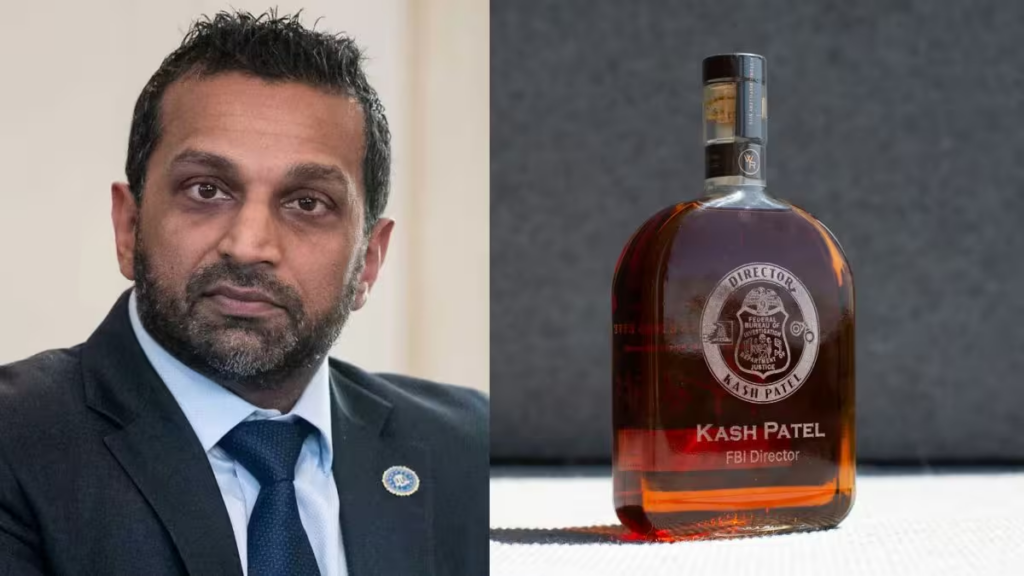
The controversy surrounding Kash Patel is no longer just about allegations of heavy drinking. It is now about optics, leadership culture, government ethics, and the image of the nation’s top law enforcement agency.
A new report from The Atlantic claims Patel has been regularly handing out personalized bottles of Kentucky bourbon to FBI employees, government officials, and civilians he encounters during official duties. The engraved bottles, featuring “Kash Patel, FBI Director,” an FBI shield, and Patel’s preferred stylization “Ka$h”, have reportedly become a recognizable part of his leadership style.
The timing matters. Patel is already suing The Atlantic and journalist Sarah Fitzpatrick for $250 million over earlier reporting that accused him of erratic behavior and excessive alcohol use.
Now, the bourbon story is deepening questions about whether the FBI is facing a leadership image problem at a moment when public trust in federal institutions is already strained.
TL;DR
- The Atlantic reports that Kash Patel has been gifting personalized bourbon bottles during official engagements.
- Multiple current and former FBI employees confirmed receiving the bottles.
- One missing bottle allegedly triggered threats of polygraphs and possible prosecution.
- The reports come amid separate allegations that Patel has struggled with excessive drinking.
- Patel denies the allegations and is suing The Atlantic for defamation.
- Critics argue the controversy raises broader concerns about ethics, professionalism, and leadership culture inside the FBI.
What Is the Kash Patel Bourbon Controversy?
According to The Atlantic, Patel has been distributing engraved bottles of Woodford Reserve bourbon as gifts during his tenure as FBI director.
Eight current and former FBI and Justice Department employees reportedly confirmed receiving the bottles. The publication also said it purchased one at an online auction after a seller claimed it had been gifted by Patel during an event in Las Vegas.
The FBI reportedly told the outlet that Patel paid for the liquor personally and that the practice complied with ethics guidelines. But the agency did not provide examples of prior FBI directors engaging in similar gifting practices.
That distinction is important because symbolism carries weight in federal law enforcement. FBI directors historically cultivate a restrained public image designed to project impartiality, discipline, and institutional seriousness.
Critics say personalized bourbon bottles branded with “Ka$h” send a very different message.
Why the Bourbon Story Matters Beyond the Bottles
On its own, gifting alcohol is not necessarily scandalous. The larger issue is context.
The Atlantic’s earlier reporting alleged Patel had episodes involving unexplained absences, excessive drinking, and erratic behavior while serving as FBI director. One reported incident claimed security personnel struggled to wake him. Another alleged official considered using breaching equipment to reach him behind a locked door.
One FBI official quoted in the report described fears about the director being unreachable during a domestic terror emergency.
Patel has strongly denied those allegations.
But the bourbon reports reinforce a narrative critics were already discussing: whether alcohol has become too closely associated with Patel’s leadership image.
A story about leadership culture
Inside law enforcement agencies, culture often flows from the top down.
Former FBI supervisory intelligence analyst George Hill told The Atlantic:
“Handing out bottles of liquor at the premier law enforcement agency, it makes me frightened for the country.”
That criticism reflects a broader concern among former officials: that symbolic gestures from leadership influence standards across the organization.
The Missing Bourbon Bottle Incident Explained
The most explosive claim in the report involves an incident at the FBI’s Quantico facility.
According to The Atlantic, Patel allegedly brought a full case of personalized bourbon bottles to a training seminar involving the UFC. When one bottle disappeared, Patel reportedly became furious and threatened polygraph tests and potential prosecution.
Retired FBI agent Kurt Siuzdak said multiple agents later sought legal assistance over the matter.
If accurate, the incident could prove more politically damaging than the gifting itself.
Why? Because critics may frame it as an example of disproportionate use of authority over something viewed internally as trivial.
How the FBI Has Responded
The FBI has not denied that Patel distributed the bottles.
Instead, the bureau reportedly defended the practice as part of an FBI tradition dating back more than a decade. However, several current and former officials interviewed by The Atlantic said they had never seen similar behavior from previous directors.
That gap matters because institutional traditions are usually easy to verify inside federal agencies.
The bureau also reportedly emphasized that Patel purchased the liquor himself, though reports indicate some bottles were transported on Justice Department aircraft during official travel.
One bottle was allegedly left behind in an Italian locker room during a trip where Patel was photographed drinking beer with the U.S. men’s Olympic hockey team in Milan.
The optics reportedly frustrated allies of Donald Trump, who is famously abstinent from alcohol.
Gavin Newsom and Political Critics Jump In
The controversy has also become political ammunition.
Gavin Newsom mocked Patel in a post on X, accusing him of focusing on “handing out bottles of his liquor” while allegedly spending taxpayer money irresponsibly.
That response highlights how quickly controversies involving FBI leadership can move beyond internal agency concerns and become national political narratives.
The FBI occupies a unique position in American public life. Any perception that its leadership is unserious, partisan, or erratic can become a flashpoint in broader political debates about trust in institutions.
Why Patel’s Lawsuit Against The Atlantic Is Significant
Patel’s $250 million lawsuit against The Atlantic may ultimately become as important as the allegations themselves.
Defamation lawsuits involving public officials face a very high legal standard in the United States because of the Supreme Court’s “actual malice” doctrine established in New York Times Co. v. Sullivan.
To succeed, Patel would likely need to prove that The Atlantic knowingly published false information or acted with reckless disregard for the truth.
At the same time, reports that the FBI opened a criminal leak investigation involving journalist Sarah Fitzpatrick have alarmed press freedom advocates.
The Atlantic editor in chief Jeffrey Goldberg called the reported investigation “an outrageous attack on the free press.”
Media law experts will likely watch this closely because it touches two politically sensitive issues at once:
- Government pressure on journalists
- Legal retaliation against investigative reporting
What Happens Next?
Several unanswered questions could determine how long this story remains in the headlines.
Key questions still unresolved
- Were government resources improperly used to transport the bourbon?
- Did the gifting practice violate internal ethics expectations?
- Can Patel prove defamation in court?
- Will additional FBI employees publicly corroborate or dispute the reports?
- Could congressional oversight committees get involved?
The answers matter because this controversy is increasingly becoming about institutional credibility rather than one official’s personal habits.
For Patel’s supporters, the reports may look like politically motivated attacks from a hostile media outlet.
For critics, the bourbon bottles have become a symbol of what they see as a breakdown in professionalism at the FBI’s highest levels.
Either way, the story has clearly moved beyond novelty headlines about engraved whiskey bottles.
It is now a test of leadership, media accountability, and public trust in one of America’s most powerful agencies.