
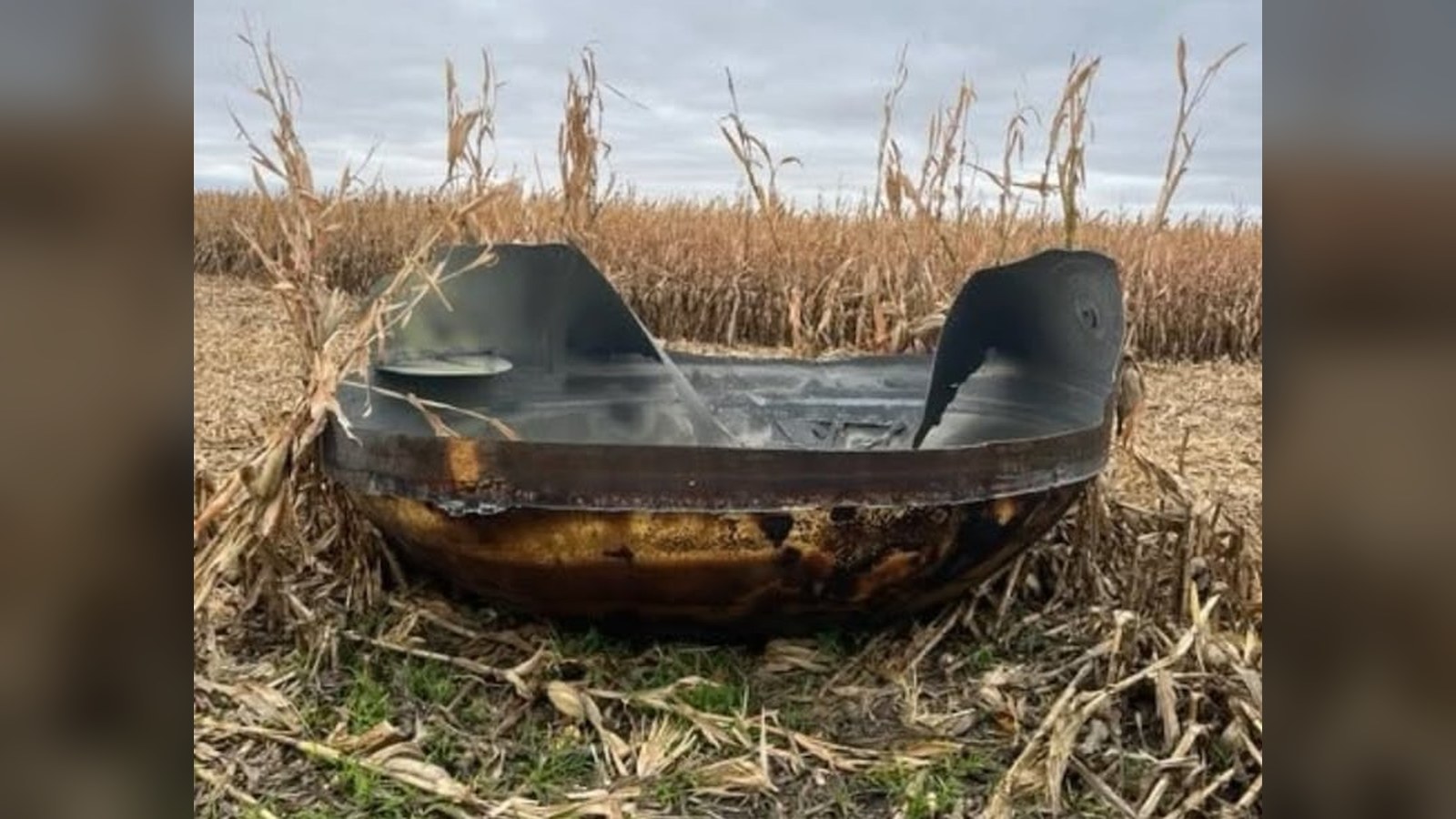
The charred, 11-foot metal dome a farmer found in a western Minnesota cornfield last week matches the upper stage of a Chinese rocket, according to an analysis by Ars Technica. Its October 19 report ties the object to a Zhuque-2E that launched on September 15 and fell back the same day. No official agency has confirmed that origin yet.
The case matters beyond one Stevens County farm. Under international law, the country that launches an object is liable for damage it causes on the ground. If the identification holds, this would be a large piece of Chinese hardware that came down on US farmland after its deorbit burn apparently went wrong.
A farmer found it while harvesting corn
The Stevens County Sheriff’s Office got a call at about 3:30 p.m. on Wednesday, October 14, reporting “foreign debris” in a field in Scott Township, just west of Morris. A farmer had come across the object while combining corn, Ars Technica reported.
Deputies confirmed “a large, metallic object, approximately 11-feet in diameter, presumably a space object,” the sheriff’s office said in a Facebook post quoted by MPR News and Valley News Live. The office’s photo shows a domed shell lying upside down among dried cornstalks, with scorch marks visible on it.
The office notified the Minnesota Department of Public Safety’s duty officer, and federal agencies came to the site. Officials said the object posed no danger to the public, and nobody was hurt.
What the sheriff has said on record
Sheriff Jason Dingman told the Minnesota Star Tribune that the object left the field on the evening of Thursday, October 15. It now sits in a secure location. He would not name the federal agencies involved because the investigation remains open.
He also said local officials knew little more than the public. “We’re not getting fed much information either and what info we do get is pretty cryptic,” Dingman told the paper. “So I think somebody way up the food chain above my head knows what this thing is but they are not even telling us.”
He did rule out the theories circulating online. “There’s a lot of stuff out there [saying] that it’s the top of a silo or the end of a propane tank. I can tell you it’s not that,” he said. He added that whatever event produced the object was over, so there was no risk of more pieces falling.
Officials told KARE 11 that serial numbers are visible on the object, NewsNation reported. Those markings, not its shape, are what would settle who built it. Neither the sheriff nor any federal agency has published them.
The case for a Chinese Zhuque-2E rocket
The strongest evidence so far comes from Stephen Clark at Ars Technica, who matched the object to a launch that drew little US attention at the time. LandSpace, a private Chinese company, launched a methane-fueled Zhuque-2E from the Dongfeng launch zone in northwestern China on September 15. The rocket carried 10 satellites for Qianfan, the Chinese network often compared to SpaceX’s Starlink.
Four details line up, according to Clark’s reporting:
- Size: the rocket’s upper stage is 3.35 meters, or 11 feet, wide, the same diameter deputies measured.
- Flight path: after releasing its satellites about half an hour after liftoff, the rocket flew south over Antarctica, then north over the Americas.
- Timing: the whole flight lasted 75 to 80 minutes, and the stage came down without finishing a single orbit.
- Witnesses: social media posts that night showed fiery debris streaking north over Kansas toward Minnesota, visible from Wisconsin too.
Our own check of the clock fits as well. The launch went up at 06:26 UTC, according to the Zhuque-2 flight log. Add 75 to 80 minutes and the reentry falls at roughly 2:45 a.m. Central time on Tuesday, September 15, an hour when few people would have been watching a cornfield.
That timing would also explain how the object sat unnoticed. If the link is right, it came down in standing corn about four weeks before harvest. Nobody saw it until a combine reached it. NewsNation reported that the farmer estimated it had been there about six weeks, a rough guess that is not far off.
Why a planned disposal ended up in a field
If this is the Zhuque-2E stage, its fall was not random. After deploying its satellites, the stage fired its engine to slow down and drop out of orbit. Deorbiting spent stages is responsible practice, because it keeps dead hardware from cluttering space.
Operators normally aim those burns at a remote stretch of ocean. Clark wrote that a stage landing in the Midwest suggests the burn was botched. LandSpace has not publicly acknowledged the debris, Ars reported.
It would not be the company’s first upper-stage problem this year. A Zhuque-2E stage from a June flight broke apart in low Earth orbit after its mission, scattering dozens of fragments, according to Ars. Most of those pieces should fall back within a few months.
Most falling hardware never reaches the ground. NASA’s Orbital Debris Program Office says most debris “does not survive the severe heating” of reentry. What does survive usually lands in an ocean or a sparsely populated area. An 11-foot shell surviving intact is unusual, and Clark noted it is larger than most objects that make it down.
BreezyScroll has covered the growing debris problem before, from a 1988 US spy satellite that broke apart in September to the debris strike that delayed China’s Shenzhou-20 crew.
Who pays if a rocket stage lands on your farm
This piece of rocket landed on corn rather than a house. “We’re just lucky it hit a cornfield and not someone’s roof,” Dingman told the Star Tribune.
Had it caused damage, the question of who pays has a clear answer. The UN’s Liability Convention, in force since 1972, makes a launching state “absolutely liable” for damage its space objects cause on the Earth’s surface. Fault does not matter. Because the rocket flew from Chinese territory, that responsibility would sit with China rather than with LandSpace alone.
In this case there are no reported injuries or property damage, so the practical questions are ownership and disposal. The sheriff’s office said it is working with state and federal agencies “to identify and notify the owner of the debris.” For LandSpace, which first reached orbit with a methane-fueled Zhuque-2 in 2023, that would mean being formally told one of its stages landed in Minnesota.
The serial numbers will decide it
Ars Technica’s case is strong but circumstantial. It rests on size, timing and witness reports, not on a physical match. The serial numbers KARE 11 reported are the piece that can turn a likely answer into a confirmed one.
Dingman said the sheriff’s office will post updates on its Facebook page when it can. The next real development will be a federal agency, or LandSpace itself, matching those serial numbers to a specific stage.