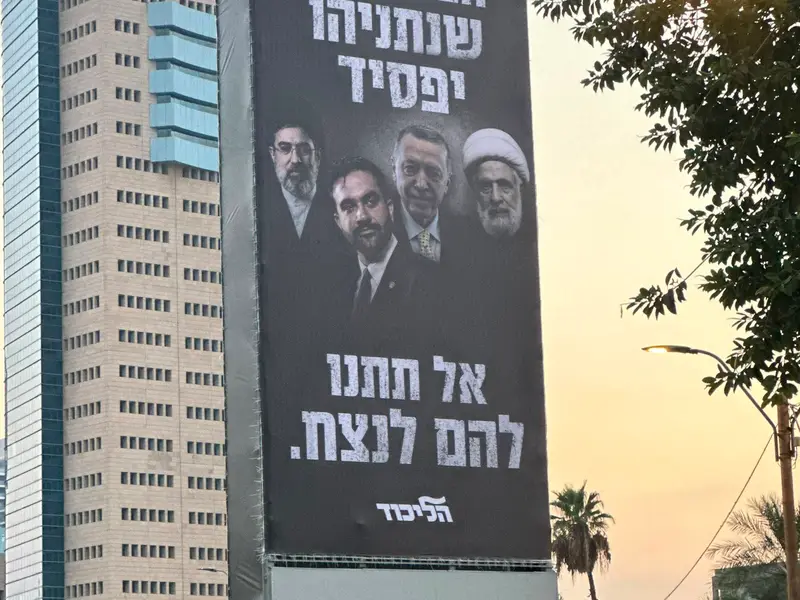
Israeli Prime Minister Benjamin Netanyahu’s Likud party has turned New York City Mayor Zohran Mamdani into a central figure in its latest election campaign, placing his image alongside the leaders of Iran, Turkey and Hezbollah in a provocative billboard in Tel Aviv.
The billboard shows Mamdani alongside Iranian Supreme Leader Mojtaba Khamenei, Turkish President Recep Tayyip Erdogan and Hezbollah Secretary-General Naim Qassem. Above the images is the message: “They want Netanyahu to lose, don’t let them win.”
Netanyahu himself amplified the message, reposting a photograph of the billboard on social media with the caption: “Don’t let them win.” The advertisement comes as Israel’s October 27 general election approaches.
What does Likud’s billboard show?
The billboard groups four figures with very different political backgrounds but presents them as part of the same opposition to Netanyahu.
They are:
- Zohran Mamdani, the mayor of New York City
- Mojtaba Khamenei, Iran’s Supreme Leader
- Recep Tayyip Erdogan, Turkey’s president
- Naim Qassem, Hezbollah’s secretary-general
The accompanying slogan tells Israeli voters that the four figures want Netanyahu to lose and urges them not to “let them win.”
The billboard is displayed in Tel Aviv overlooking the Ayalon Highway, rather than in Jerusalem as some social media posts initially claimed.
Why is Zohran Mamdani featured alongside Israel’s rivals?
Mamdani’s inclusion is the most striking element of the campaign because he is not a foreign leader or the head of an armed organization.
The New York mayor has become an outspoken critic of Netanyahu’s policies toward Palestinians and has said he would seek to enforce an International Criminal Court arrest warrant against Netanyahu if the Israeli prime minister visited New York for the United Nations General Assembly.
Likud’s decision to place Mamdani beside leaders associated with countries and organizations hostile to Israel therefore sends a broader political message: that opposition to Netanyahu’s government can be portrayed as part of the same camp as Israel’s geopolitical adversaries.
The billboard does not establish that Mamdani is allied with any of the other people shown. Rather, it is a campaign message designed to associate them in the minds of Israeli voters.
Why does the billboard matter ahead of Israel’s election?
Israel is heading toward a closely watched parliamentary election on October 27, 2026.
The campaign is already becoming a contest over Netanyahu’s record on security, the war, relations with the United States and Israel’s wider position in the Middle East.
The billboard reflects Likud’s attempt to frame the election through national security rather than simply domestic policy.
By placing Netanyahu’s perceived opponents next to figures associated with Iran and Hezbollah, the campaign presents a choice between Netanyahu and what it portrays as a dangerous alternative.
The strategy is particularly significant because the election is taking place amid continuing tensions involving Israel, Iran, Hezbollah and Turkey.
How have Netanyahu’s political rivals responded?
The billboard has also become a target for political satire.
Yashar!, the party led by former Israel Defense Forces Chief of Staff Gadi Eisenkot, produced its own altered version of the message.
Instead of the original slogan, the parody reportedly read: “They want the IDF to collapse, don’t let Netanyahu win.”
The response turns Likud’s own campaign technique against Netanyahu, suggesting that his opponents see the original billboard as an attempt to reduce a complex election to a binary security narrative.
Yashar! describes itself as seeking a different form of leadership centered on professionalism, national unity and strengthening Israel’s democratic institutions.
Why is Erdogan included?
Erdogan’s presence on the billboard reflects the increasingly strained relationship between Israel and Turkey.
Turkey has sharply criticized Israeli military operations and Netanyahu’s government, while Erdogan has repeatedly taken a strong position on the Palestinian issue.
For Likud, placing Erdogan alongside Khamenei and Qassem reinforces the argument that Netanyahu’s foreign and security policies are being challenged by leaders Israel views as hostile or adversarial.
The billboard therefore uses recognizable foreign figures as symbols of the geopolitical environment surrounding the Israeli election.
What does the campaign say about Likud’s strategy?
The advertisement shows how international politics can become a domestic election weapon.
Rather than focusing exclusively on taxes, housing, public services or the economy, Likud is presenting the election as a referendum on Netanyahu’s ability to confront Israel’s enemies and protect the country.
That approach is familiar in Israeli politics, where security issues can carry enormous electoral weight.
But putting Mamdani into the same visual category as Iran’s leadership and Hezbollah is also deliberately provocative. It transforms a U.S. city mayor’s political disagreements with Netanyahu into part of a much larger narrative about Israel’s enemies.
What happens next?
Israel’s election campaign is expected to intensify as October approaches.
The Likud billboard is unlikely to be the last example of campaign advertising built around Netanyahu’s security credentials or his opponents’ relationships with Israel’s adversaries.
Recent polling also suggests a competitive race. An N12 poll reported that Eisenkot’s Yashar! was ahead of Likud in projected Knesset seats, with Yashar! on 23 and Likud on 22, while the broader anti-Netanyahu bloc held an advantage in that survey. Polls can shift substantially before election day, however.
For now, the billboard offers a clear glimpse of how Likud wants voters to see the election: not simply as a contest between Israeli politicians, but as a choice over who can best confront the country’s regional and international adversaries.