
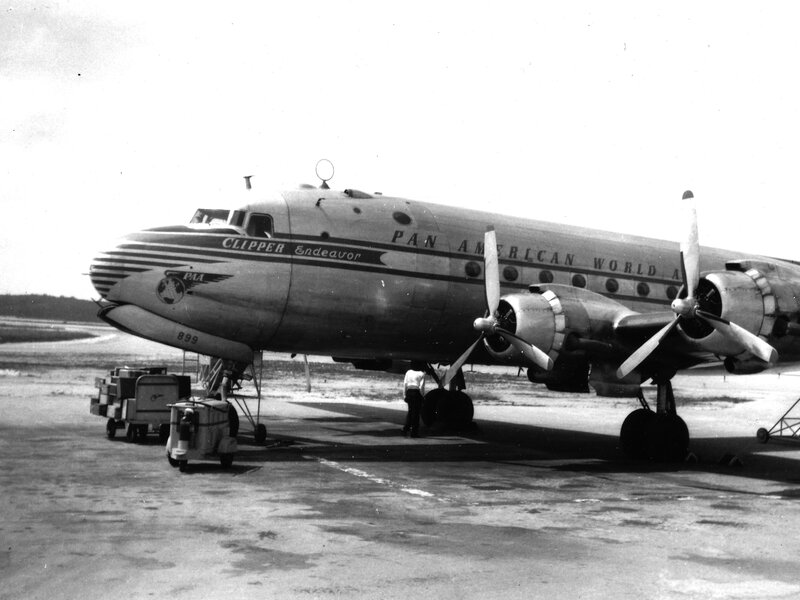
The wreckage of a Pan American Airways passenger plane that disappeared into the Atlantic Ocean after crashing off Puerto Rico in 1952 has been located more than seven decades later, bringing closure to one of the longest unsolved chapters in U.S. aviation history.
The Air/Sea Heritage Foundation (ASHF) announced that the remains of the Clipper Endeavour were discovered on June 2 at a depth of nearly 2,000 feet beneath the Atlantic Ocean. The aircraft was carrying 69 people when it was forced to ditch shortly after takeoff. Although the emergency water landing itself was survivable, 52 people ultimately lost their lives as the aircraft sank within minutes.
The discovery not only resolves a 74-year-old mystery but also highlights an accident that fundamentally changed airline safety procedures still followed today.
What happened to the Pan Am Clipper Endeavour?
On April 28, 1952, Pan American Airways Flight 202, known as the Clipper Endeavour, departed San Juan, Puerto Rico, bound for New York City.
The aircraft carried:
- 64 passengers.
- Five crew members.
Shortly after takeoff, multiple engine failures forced the flight crew to perform an emergency water landing in the Atlantic Ocean.
Investigators later determined that the ditching itself was successful, and everyone initially survived the impact.
However, the aircraft quickly began taking on water and sank in less than three minutes.
Without standardised evacuation procedures or passenger safety briefings, many people were unable to escape.
Fifty-two people died, while 17 survived.
Where was the wreckage found?
According to the Air/Sea Heritage Foundation, the wreckage was located approximately 2,000 feet below the Atlantic Ocean off the coast of Puerto Rico.
Researchers used:
- High-resolution sonar mapping.
- An autonomous underwater vehicle (AUV).
- Historical accident records.
- Archived navigation charts.
The aircraft was found split into two large sections.
Despite spending more than seven decades underwater, investigators said the fuselage remained remarkably well preserved.
Images released by the search team reportedly show:
- The Pan American winged logo.
- The aircraft’s name, “Clipper Endeavor.”
- Large portions of the fuselage are still intact.
How was the aircraft finally located?
The search was led by the Air/Sea Heritage Foundation after years of historical research.
Foundation president Russ Matthews began examining accident records and conducting underwater surveys near San Juan in 2019.
The effort later expanded through collaborations with:
- Discovery Channel’s Expedition Unknown.
- Explorer Josh Gates.
- Marine exploration company Deep Sea Vision.
Researchers also relied on a historic chart created by U.S. Air Force pilots, which helped narrow the search area.
During a recent expedition, an underwater drone identified the wreckage during its first survey mission.
Why is the Clipper Endeavor crash historically important?
Although often overshadowed by other aviation disasters, the Clipper Endeavor accident permanently changed airline safety standards.
Following the tragedy, the Civil Aeronautics Board, the predecessor to today’s Federal Aviation Administration (FAA), introduced mandatory passenger safety briefings before takeoff.
The investigation found that passengers had received:
- No formal safety demonstration.
- Limited evacuation guidance.
- Little coordination during the emergency.
Language barriers and confusion contributed to the chaotic evacuation as the aircraft flooded rapidly.
Today, every commercial airline flight includes safety demonstrations explaining:
- Seat belt use.
- Emergency exits.
- Life vest operation.
- Oxygen masks.
- Evacuation procedures.
These practices trace their origins in part to lessons learned from the Clipper Endeavor disaster.
As Josh Gates noted, “Every time you step onboard an airplane today, you are safer because of what happened to Clipper Endeavor and her passengers.”
Why did the plane sink so quickly?
According to investigators, the emergency landing itself was survivable.
The tragedy unfolded after the aircraft came to rest on the water.
Heavy seas, rapid flooding, and the absence of organized evacuation procedures left many passengers unable to escape before the aircraft submerged.
The plane sank in under three minutes, leaving rescuers with very little time to reach those trapped inside.
Why does the discovery matter today?
Finding the wreckage provides investigators and historians with an opportunity to better document one of the most influential accidents in commercial aviation history.
The discovery also demonstrates how advances in underwater robotics, sonar imaging, and autonomous exploration vehicles are helping solve aviation mysteries that remained unsolved for decades.
For the families of those who lost loved ones, locating the aircraft offers long-awaited answers after 74 years.
TL;DR
- The wreckage of Pan American Airways’ Clipper Endeavor has been found 74 years after it crashed into the Atlantic near Puerto Rico.
- The aircraft was discovered nearly 2,000 feet underwater using sonar technology and an autonomous underwater vehicle.
- The plane carried 69 people in 1952, and 52 died after it sank less than three minutes following a successful emergency water landing.
- Researchers found the aircraft split into two major sections, with the Pan American logo still visible.
- The disaster led directly to mandatory airline preflight safety demonstrations that remain standard on commercial flights today.
- The discovery concludes one of the longest-running searches for a historic U.S. passenger aircraft wreck.