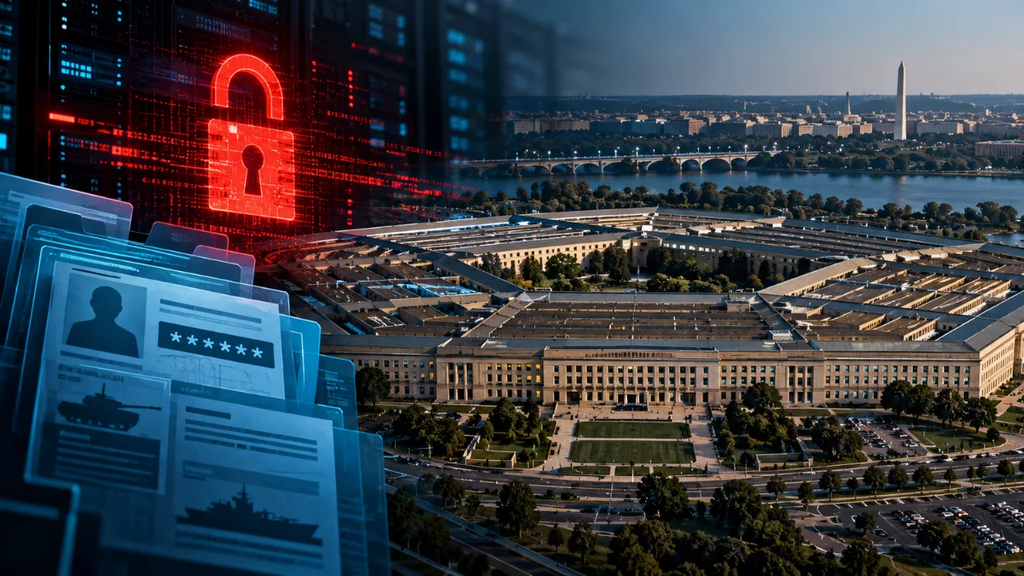
A cybersecurity breach inside the Pentagon’s personnel infrastructure exposed sensitive personal information tied to more than 3 million people after unauthorized users were able to access files for roughly nine months. The affected system belongs to the Defense Manpower Data Center, or DMDC, a major Defense Department repository responsible for personnel and identity information. A defense official said the breach involved 2.76 million living individuals and another 294,000 people who are deceased, putting the total at about 3.05 million. The exposed information included Social Security numbers, names, dates of birth and contact information. In some records, the information also included demographic details and military personnel data such as occupational specialties.
The most troubling feature may not be the number of people involved.
It is the length of time the unauthorized access apparently went undetected.
According to a breach notification reviewed by Military Times, unauthorized users were able to access files on an affected server from October 2025 until July 16, 2026, when DMDC discovered the underlying vulnerability.
What happened inside the Defense Manpower Data Center?
The incident centers on a file-sharing system used by DMDC.
According to the notification sent to affected individuals, DMDC discovered a security vulnerability in the file-sharing system on July 16, 2026. A subsequent analysis indicated that unauthorized users had accessed files containing personally identifiable information between October 2025 and the date the vulnerability was discovered.
DMDC then patched the affected system and restored it, while launching privacy and cybersecurity incident-response procedures.
The Pentagon has described the access as involving a “small number of unauthorized users.”
What remains unclear is exactly who those users were.
No threat actor has been publicly identified, and officials have not disclosed whether the activity was linked to a criminal group, a foreign intelligence service, insiders or another type of attacker.
That uncertainty is particularly significant because the compromised material was not simply a database of names.
Some records contained information about the jobs performed by military and civilian personnel.
More than 3 million people were affected
The Pentagon initially did not publicly provide a final figure for the number of affected individuals.
That changed on September 28, when a U.S. defense official told ABC News that 2.76 million living people and 294,000 deceased individuals were affected.
Combined, that comes to approximately 3.054 million people.
The category of “living individuals” is also broader than simply active-duty troops.
DMDC maintains records involving a wide segment of the Defense Department community, including current and former military personnel, civilian employees, contractors, retirees, veterans and family members. The agency says it maintains more than 60 million DoD records overall.
That means the breach should not be described as three million active-duty service members being hacked.
The affected population can include people with very different relationships to the Defense Department.
What information was exposed?
The breach involved highly sensitive personally identifiable information.
According to the notification letter reviewed by Military Times, the information accessible to unauthorized users included the recipient’s Social Security number along with at least one additional identifier.
Depending on the individual record, that could include a name, date of birth, contact information, sex, race or military personnel information, including occupational specialty.
The presence of occupational information is what gives the incident a potentially broader national-security dimension.
A Social Security number can be valuable to identity thieves.
A Social Security number combined with an individual’s employment history, military specialty and personal details can also make targeted impersonation and social engineering more convincing.
That does not establish that the data was used for espionage or targeting.
Officials have not publicly said that happened.
But the type of information involved creates a reason for security experts to take the breach seriously beyond ordinary consumer identity theft.
The nine-month gap is one of the biggest concerns
The timeline raises a basic cybersecurity question: how long could unauthorized users operate before the Pentagon recognized that something was wrong?
The access reportedly began in October 2025.
DMDC discovered the vulnerability on July 16, 2026.
That means the window stretched for roughly nine months.
Importantly, discovery of the vulnerability does not necessarily mean authorities knew that unauthorized users had been accessing the files throughout that entire period. The timeline emerged after investigators analyzed the system following discovery of the flaw.
In other words, the Pentagon apparently found the security weakness first and then determined that unauthorized access had occurred over the preceding months.
The longer an attacker remains inside a system without detection, the greater the potential opportunity to inspect or copy information.
Officials have not said how many files were actually taken, how frequently they were accessed or whether the attackers extracted the entire contents of any database.
Was the exposed information encrypted?
This point requires some caution.
Military Times reported, based on the breach notification letter it reviewed and confirmation from defense officials, that the affected files contained unencrypted personally identifiable information, including Social Security numbers and military personnel information.
However, some secondary reporting has reproduced different wording suggesting that at least some of the affected data may have been encrypted.
Because publicly available accounts do not fully reconcile those descriptions, it is safer to say that the breach notification reviewed by Military Times described sensitive information in the affected files as unencrypted rather than presenting the encryption issue as completely settled across every file.
What is not disputed is that unauthorized users were able to reach files containing extremely sensitive personal information.
Why military job information matters
A leaked Social Security number presents a familiar identity-theft risk.
Military occupational information introduces another possible layer.
Knowing where a service member or defense employee works, what type of role they perform or what specialty they hold can help create a more detailed profile of that individual.
Such information can potentially be useful in targeted phishing, impersonation or social-engineering attempts.
It could also be valuable to an actor seeking to map personnel associated with particular functions.
Again, there is no public evidence establishing that the perpetrators used the exposed records for intelligence purposes.
The significance comes from the possibility and from the sensitivity of the information, not from a confirmed espionage finding.
Pentagon says there is no evidence of misuse
The department has said it has no indication, at least so far, that the information exposed in the incident has been misused.
That is an important distinction.
A breach can expose information without authorities immediately finding evidence that the data has been exploited.
Misuse can also occur much later.
Unlike a password, a Social Security number, birth date or employment history cannot simply be replaced after every breach. Once exposed, those details can potentially be combined with information from other breaches, public records and commercial databases.
That can make long-term monitoring necessary even when no immediate fraudulent activity is detected.
What is the Pentagon doing for affected people?
The Defense Department is offering affected individuals one year of free credit-monitoring and identity-restoration services through IDX, a private company under contract with the department.
The first notifications were dated September 18, according to the breach letter.
The department has urged affected people to use the monitoring service and remain alert for suspicious financial or identity-related activity.
For individuals whose records contained Social Security numbers and other identifiers, monitoring credit reports can provide an early warning if someone attempts to open accounts or use the information fraudulently.
People should also be cautious with unexpected emails, text messages or telephone calls that appear to know details about their military service or Defense Department employment.
A criminal does not need to possess every detail in a personnel file to make a convincing impersonation attempt.
Sometimes a few accurate pieces of information are enough.
DMDC is far larger than this one affected system
The breach should also be understood in the context of DMDC’s role across the Defense Department.
The center is described as the department’s central source for identifying, authenticating and authorizing personnel during and after their affiliation with the military.
Its broader records include active-duty and reserve service members, civilian personnel, contractors, family members, retirees and veterans. DMDC says its systems contain more than 60 million records.
The Pentagon has not said that all 60 million records were exposed.
The reported figure is approximately 3.05 million people associated with the affected files.
That distinction matters because the headline number can otherwise make it sound as though an entire Pentagon personnel database was compromised.
It was not.
The incident involved a particular information system and files on an affected server.
Who was behind the breach?
That question remains unanswered.
The Pentagon has not publicly identified the unauthorized users or attributed the activity to a known hacking group.
There has also been no public finding that the breach was carried out by a foreign government.
That leaves the motive unresolved.
The possibilities range from financial crime and identity theft to intelligence collection or another purpose, but assigning one without evidence would go beyond what officials have established.
The same applies to the full amount of data accessed.
Officials know the categories of information involved and the population affected, but the public has not been given a complete accounting of what each unauthorized user viewed or copied.
Why the breach matters beyond identity theft
Large government databases are attractive targets because they combine information that is difficult to obtain elsewhere.
In the DMDC case, personal identifiers appear alongside information connected to people’s relationship with the Defense Department.
That combination can create risks that continue after the vulnerable system has been repaired.
A technical patch closes a specific door.
It does not change information that may already have been viewed or copied.
That is why incident response does not end when the vulnerability is fixed. Investigators must also determine what happened before the fix, who had access, what information was exposed and whether any of it was removed from the system.
For the Pentagon, those questions are especially important because its personnel records involve people working across military, civilian and defense-contractor roles.
What happens next?
The immediate task is to determine the full scope of the incident.
That includes identifying the unauthorized users, establishing exactly which files they accessed and determining whether data was downloaded or otherwise removed.
The Defense Department is also expected to examine how a file-sharing vulnerability allowed access for such an extended period and why the activity was not detected earlier.
The incident could ultimately prompt scrutiny of several layers of the Pentagon’s cybersecurity architecture: file permissions, authentication controls, encryption practices, logging, anomaly detection and the monitoring of sensitive data repositories.
The most significant question may be whether the breach was a one-off configuration failure or evidence of a broader weakness in how highly sensitive personnel data is protected.
A breach measured in months, not minutes
Cyberattacks are often described through the moment they are discovered: the alarm sounds, the system is disconnected and the damage is assessed.
This incident is different.
The most striking part of the timeline is the stretch of time before anyone knew a vulnerable pathway was being used.
From October 2025 to July 16, 2026, unauthorized users were able to reach files containing sensitive personal information.
More than 3 million people are now known to have been affected.
The Pentagon has patched the vulnerability and begun notifying those whose information was involved. It says there is currently no evidence of misuse.
But the central questions remain open.
Who accessed the files?
What exactly did they take?
Why did they do it?
And how did a system holding some of the U.S. military community’s most sensitive personnel information remain exposed for so long?
Those answers will determine whether this was primarily a large-scale privacy failure or something with consequences extending much further into national security.