
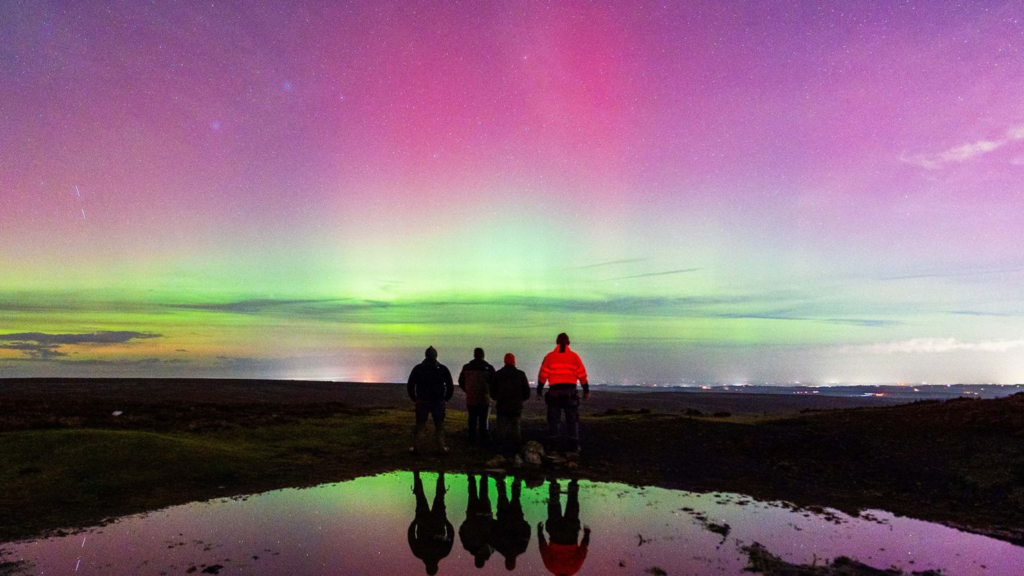
The strongest solar radiation storm in more than two decades hit Earth on January 19, setting off rare space-weather alarms, disrupting high-frequency communications, and lighting up skies far beyond the Arctic Circle.
Classified as an S4-level solar radiation storm, the event has already triggered a G4 geomagnetic storm, one of the most intense disturbances Earth’s magnetic field can experience. For skywatchers, the upside is spectacular: auroras could stretch deep into the continental United States. For scientists and infrastructure operators, the concern is real, and ongoing. Here’s what’s happening, why it matters, and where Americans may see the northern lights.
What is the S4 solar radiation storm hitting Earth?
Solar radiation storms are ranked from S1 (minor) to S5 (extreme). An S4 storm sits just below the top of that scale, making it both rare and consequential.
This storm was detected and confirmed by the Space Weather Prediction Center (SWPC), the U.S. agency that monitors activity from the Sun and its effects on Earth.
Why is this storm unusual
- Rarity: The last comparable radiation storm occurred in October 2003, during the so-called “Halloween solar storms.”
- Intensity: Magnetic energy levels briefly surged to nearly 20 times normal background levels, according to SWPC officials.
- Duration: Unlike short-lived solar flares, this event is expected to last several days, increasing cumulative impacts.
At its core, the storm is driven by powerful Coronal Mass Ejections (CMEs)—huge clouds of magnetized plasma ejected from the Sun at millions of miles per hour.
How does a solar storm trigger auroras?
Auroras occur when charged solar particles collide with gases in Earth’s upper atmosphere. Oxygen produces green and red light, while nitrogen creates blues and purples.
Why does this storm push auroras farther south
- A G4 geomagnetic storm significantly weakens Earth’s magnetic shield.
- This allows solar particles to penetrate lower latitudes.
- The stronger the storm, the farther from the poles auroras become visible.
In practical terms, that means people who’ve never seen the northern lights may get a rare chance—weather permitting.
Where will auroras be visible in the United States?
According to SWPC forecasts, auroras are likely across a wide swath of the U.S., especially during nighttime hours with clear skies.
States with high chances of seeing auroras
- Pacific Northwest: Washington, Oregon, Idaho
- Northern Rockies & Plains: Montana, Wyoming, North Dakota, South Dakota, Nebraska
- Upper Midwest: Minnesota, Wisconsin, Michigan, Iowa
- Great Lakes & Northeast: Illinois, Indiana, Ohio, Pennsylvania, New York, New Jersey, Connecticut, Massachusetts, Vermont, New Hampshire, Maine
- West & Mountain regions: Northern Utah, northern Colorado
- Alaska: Strong, widespread displays expected
How far south could auroras go?
If geomagnetic activity spikes back to G4 levels, forecasters say auroras could be visible as far south as Alabama and parts of California—a rare event by any historical standard.
Viewing tips
- Get away from city lights.
- Look north after sunset, especially between 10 p.m. and 2 a.m. local time.
- Use a phone camera in night mode; auroras often appear brighter on screens than to the naked eye.
Why the strongest solar storm in 20 years matters beyond the sky
Auroras may steal the spotlight, but the real stakes are technological.
Impact on communications and navigation
- High-frequency radio can be completely cut off in polar regions.
- GPS accuracy may degrade temporarily.
- Aviation routes near the poles may need adjustment due to radiation exposure risks.
Risks to satellites and power systems
The electrical currents induced by geomagnetic storms can interfere with satellite electronics, disrupt pipelines and rail signaling systems, and stress power grids, increasing the risk of localized outages.
Robert Steenburgh, a space scientist at SWPC, has warned that CMEs carry their own magnetic fields, which can “wreak havoc” when they interact with Earth’s infrastructure.
Are astronauts and airline passengers at risk?
Astronaut safety
Astronauts aboard the International Space Station are especially vulnerable during radiation storms. SWPC is actively coordinating with NASA to ensure protective measures are in place, including sheltering in shielded modules if radiation spikes.
A similar protocol was used during the 2003 storms, when astronauts reduced exposure by limiting movement during peak radiation periods.
Airline passengers
For most travelers, the risk is minimal. However, flights at high altitudes and on polar routes may see slightly elevated radiation exposure, and airlines may reroute or adjust altitudes as a precaution. Phones, ATMs, and everyday electronics should continue working unless a power outage occurs.
Is this a sign of more extreme solar storms to come?
Scientists say this storm fits into a broader pattern: the Sun is approaching the peak of its 11-year solar cycle, expected around 2025–2026.
What that means
- More frequent solar flares and CMEs
- Increased chances of auroras at lower latitudes
- Higher demand for space-weather forecasting and infrastructure resilience
This event is a reminder that modern society—dependent on satellites, GPS, and global communications—is increasingly exposed to space-weather risks.
TL;DR
- Earth is experiencing the strongest solar radiation storm in over 20 years.
- The storm is rated S4, with a G4 geomagnetic storm already underway.
- Auroras may be visible across much of the northern U.S., and possibly farther south.
- Communications, satellites, and power systems face short-term disruptions.
- Scientists expect more activity as the Sun nears solar maximum.