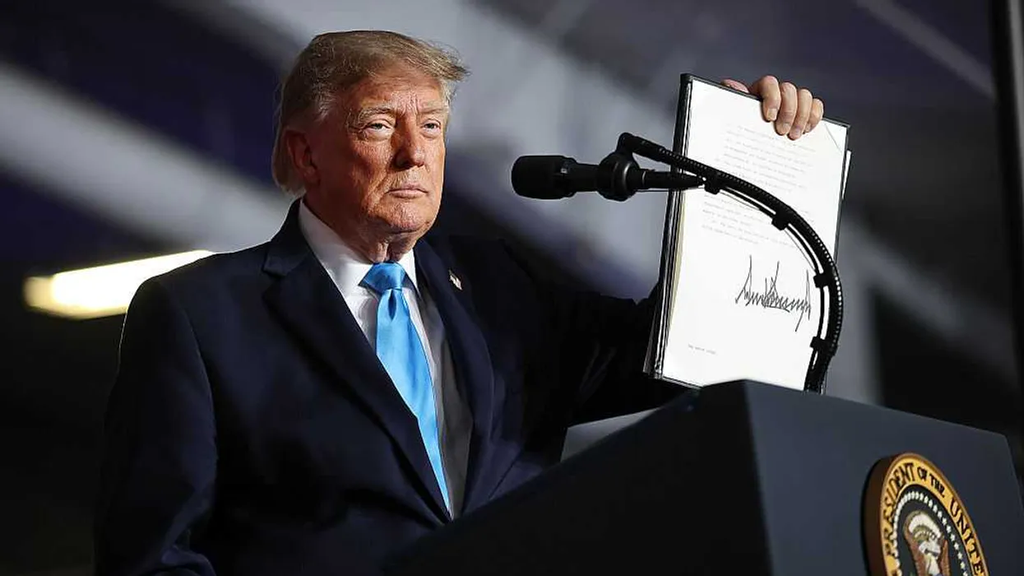
Donald Trump has a new phrase for the media he dislikes, and the internet is already having fun with it. During an appearance at Sparrows Point in Maryland on October 6, the US president said he was moving away from his longtime description of the press as “fake news” and replacing it with “artificial news” or “artificial media.”
Trump explained the wordplay by connecting “artificial” to his recent preference for the phrase “super intelligence” instead of “artificial intelligence.”
“I call them the artificial news,” Trump said. “I took artificial off intelligence. It’s super intelligence. Artificial means fake. So I call them the artificial media.”
The remark quickly circulated online, with critics arguing that Trump was misusing the word “artificial” to make a rhetorical point.
The episode is also the latest example of Trump’s tendency to coin or repurpose terminology, particularly when discussing subjects he has repeatedly criticized, including the media, artificial intelligence and international affairs.
What did Trump mean by “artificial media”?
Trump’s argument rests on a deliberate association between the words “artificial” and “fake.”
His reasoning was that because he prefers “super intelligence” to “artificial intelligence,” he could similarly describe news organizations as “artificial media.”
But the ordinary meaning of “artificial” is not simply “fake.”
Something artificial is generally made or produced by humans rather than occurring naturally. Artificial light, artificial flavoring and artificial materials can be entirely real even though they are manufactured.
That semantic distinction became one of the main points of criticism after Trump’s remarks.
Commentator Alex Cole mocked the president’s explanation, pointing out that artificial light is still light and that the term generally refers to something human-made rather than something necessarily false.
Other social-media users similarly focused on the definition of the word rather than the political argument Trump was trying to make.
The backlash reflects a familiar pattern around Trump’s language: a phrase intended as a political attack can quickly become a debate over the wording itself.
Trump’s latest attack on the media
The phrase is effectively a new version of Trump’s long-running “fake news” attack on journalists and news organizations.
Trump popularized “fake news” as a political insult during his first presidential campaign and continued using it throughout his first term and beyond.
His relationship with the press has remained deeply adversarial during his second presidency.
He has regularly accused news organizations of deliberately misrepresenting his administration, while his critics accuse him of undermining independent journalism by dismissing unfavorable reporting as dishonest.
The “artificial media” phrase does not fundamentally change that argument.
It appears to offer Trump another label for media outlets he considers biased or inaccurate.
Why did Trump bring artificial intelligence into the argument?
The remark was part of a broader linguistic shift Trump has recently promoted around artificial intelligence.
Trump has increasingly used “super intelligence” when talking about advanced AI, arguing that the conventional phrase “artificial intelligence” is less appropriate.
During his Maryland appearance, he explained that he had effectively removed the word “artificial” from “artificial intelligence” and replaced it with “super.”
That distinction has since appeared in discussions involving some major technology executives.
However, “artificial intelligence” remains the standard technical and scientific term used by researchers, companies and governments.
“Superintelligence” has a different meaning in AI discussions. It generally refers to a hypothetical form of intelligence that would substantially surpass human intellectual abilities across many domains.
The two phrases therefore are not simply interchangeable.
Trump’s wordplay has become a recurring feature of his presidency
The “artificial media” episode follows several other attempts by Trump to reshape political or technological terminology.
His administration has embraced alternative names and descriptions in areas ranging from geography to artificial intelligence.
The president has also repeatedly used his own terminology to frame political debates, often turning a complex issue into a short phrase that can be repeated at rallies or in social-media posts.
That strategy has an obvious political advantage.
A memorable phrase can spread far more quickly than a detailed policy explanation.
Whether the phrase remains in common use is another question.
“Fake news” became globally recognizable partly because Trump repeated it for years. “Artificial media” has not yet reached anything close to that level of familiarity.
Critics say Trump is trying to make a slogan out of a definition
The criticism of the latest phrase was not limited to whether people agree with Trump about the media.
Some of the strongest reactions focused on his explanation of the word “artificial.”
The underlying argument was simple: artificial does not automatically mean fraudulent.
A synthetic diamond is artificial, for example, but it is still a physical diamond. Artificial intelligence is artificial because it is created by humans, not because it is inherently fake.
That makes Trump’s linguistic connection between “artificial” and “fake” more rhetorical than definitional.
His political use of the term is nevertheless clear.
By calling the press “artificial media,” Trump is attempting to suggest that news organizations manufacture narratives rather than report reality.
That is essentially the same accusation contained in “fake news,” but with a new vocabulary.
The comments come amid another fight with the media
Trump’s latest terminology also arrives at a particularly tense moment in his relationship with the press.
His administration has faced multiple legal and political disputes with news organizations over White House access.
Reuters reported on October 8 that CNN, MS NOW and Politico were back in federal court seeking a long-term injunction against a White House ban that had revoked their access.
The Trump administration has defended its restrictions by accusing the organizations of publishing “fake news” and arguing that some reporting posed national-security concerns.
A federal judge had already temporarily blocked the ban in September, citing concerns over the government’s treatment of the news organizations.
That broader dispute gives Trump’s “artificial media” remark additional context.
His latest phrase is not simply a joke about vocabulary. It comes amid an ongoing fight over how his administration treats journalists and the degree to which the White House can control access to the president.
Trump has also been under scrutiny over other recent remarks
The Maryland speech came one day after Trump sparked another major controversy over comments about Iran.
At a rally in Nebraska on October 5, Trump said Iran could “take out” Los Angeles or San Diego and described that as a “small price to pay” in the context of protecting the United States and ending the war.
The comments triggered condemnation from California Governor Gavin Newsom and other state and local officials.
The White House later said Trump was not advocating an attack on American cities but was emphasizing the danger that a nuclear-capable Iran could pose if it were not stopped.
The episode added to a week of unusually provocative presidential rhetoric.
Against that backdrop, the “artificial media” comment quickly became another example for critics who say Trump’s public language has become increasingly unpredictable.
Trump has a long history of renaming things
The media phrase is also part of a larger pattern in Trump’s political communication.
Trump has repeatedly attempted to popularize alternative terminology for places, policies and technologies.
One of the most prominent examples came when his administration promoted the name “Gulf of America” for the body of water traditionally known internationally as the Gulf of Mexico.
More recently, Trump has also used alternative language surrounding the Strait of Hormuz and advanced artificial intelligence.
These attempts do not automatically change established terminology.
Names and technical terms generally remain determined by institutions, governments, scientific communities or widespread public usage.
But political leaders can still influence the vocabulary their supporters use.
That is exactly what Trump appears to be attempting with “artificial media.”
Will “artificial media” replace “fake news”?
Probably not immediately.
“Fake news” is already deeply embedded in global political language and is understood even by people who strongly disagree with Trump.
“Artificial media,” by comparison, has to be explained each time it is used.
The phrase also carries an ambiguity that “fake news” does not.
Artificial media could refer to AI-generated journalism, synthetic video, manipulated images or computer-created content. Those are real and increasingly important problems in the modern information ecosystem.
Trump, however, was not using the phrase in that technical sense.
He was applying it to conventional news organizations as part of his continuing criticism of the press.
That could make the phrase difficult to separate from the very AI terminology from which Trump borrowed it.
The irony of the phrase
There is an unavoidable irony in Trump’s choice of words.
“Artificial media” could easily be interpreted as referring to AI-generated news, deepfakes or synthetic content, all of which are genuine concerns for journalists and audiences.
But Trump’s intended target was traditional media organizations.
In effect, he has taken a term that could describe one of the biggest emerging challenges for journalism and repurposed it as another political insult.
That may make the phrase memorable, but it could also give it a meaning very different from what Trump originally intended.
Trump is not the first politician to reshape language
Political language has always involved slogans, labels and deliberate reframing.
Leaders frequently invent shorthand terms to simplify complicated debates or give supporters a common vocabulary.
Trump’s particular strength has been his ability to turn those phrases into recurring political brands.
“Fake news,” “witch hunt,” “deep state” and other expressions have become part of the political vocabulary surrounding his presidency, often spreading far beyond his own speeches.
Whether “artificial media” joins that list will depend largely on whether Trump keeps repeating it and whether supporters adopt it.
For now, the reaction online suggests that the phrase has generated plenty of attention, but attention is not the same as adoption.
A new phrase, same fight
Trump’s attempt to promote “artificial media” is ultimately less about dictionaries than politics.
He wants to frame media organizations he distrusts as manufactured, disconnected from reality and undeserving of public confidence.
Critics, meanwhile, have seized on his explanation of the word to argue that the president is confusing “artificial” with “fake.”
The dispute is unlikely to end with a single speech.
As Trump continues to battle the media, promote alternative terminology and use deliberately provocative language, the White House press fight is likely to produce plenty more slogans.
For now, however, “fake news” still has a head start.