

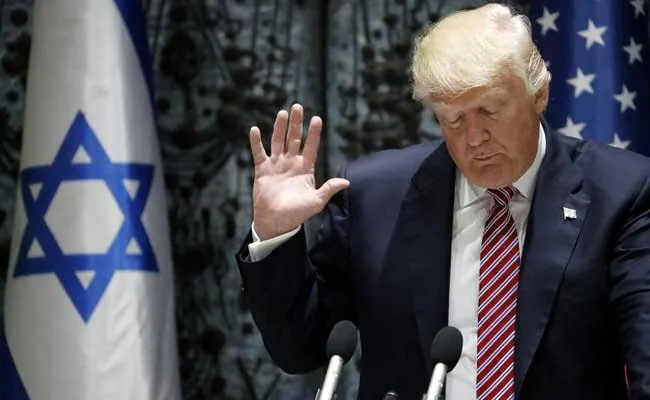
US President’s remarks spark debate over leadership style and decision-making systems
WASHINGTON, D.C. | President Donald Trump has sparked fresh controversy with his recent profanity-laced comment following the breakdown of a ceasefire between Israel and Iran, which he had personally brokered just a day earlier.
“We basically have two countries that have been fighting so long and so hard that they don’t know what the f*** they’re doing,” Trump told reporters on June 24, adding, “I’m not happy with Israel.”
The statement, made without hesitation or apology and followed by Trump walking away visibly angry, raised questions about presidential decorum, diplomacy, and his style of decision-making.
Ceasefire crumbles in 24 hours
Trump’s remarks came after both Iran and Israel violated the ceasefire within 24 hours of its announcement, leading to renewed tensions in the Middle East. Trump’s reaction was not simply frustration—it was an emotional eruption, delivered with stark language uncommon for global statesmen.
His choice of words also contrasts sharply with historical presidential diplomacy. Theodore Roosevelt once advised, “Speak softly and carry a big stick,” a principle promoting quiet strength, far removed from Trump’s blunt and combative tone.
Psychological Insights: The frustration-aggression hypothesis
Trump’s reaction has been linked to a classic psychological theory known as the frustration-aggression hypothesis, developed in the 1930s. The theory suggests that blocked goals lead to frustration, which in turn can lead to aggression.
While modern psychologists now view human behavior as more complex—acknowledging that most people manage frustration through problem-solving or rational thinking—Trump’s reaction has renewed interest in the model.
“Trump’s angry outburst felt primitive, almost textbook in its expression of unchecked frustration,” said Geoff Beattie, a professor of psychology at Edge Hill University.
Kahneman’s Model: Thinking Fast vs Thinking Slow
Beattie draws on Daniel Kahneman’s Nobel-winning research, detailed in his book Thinking, Fast and Slow, to further explain Trump’s behaviour.
Kahneman divides human decision-making into two systems:
- System 1: Fast, automatic, emotional, and intuitive.
- System 2: Slow, effortful, rational, and analytical.
In ideal scenarios, System 2 evaluates and moderates the impulses of System 1. However, Beattie suggests that Trump operates primarily through System 1—reacting emotionally and instinctively rather than deliberating thoroughly.
“His decisions seem to be driven by strong emotions, gut instinct, and a visceral response to events and people,” Beattie wrote.
Leadership by Emotion: Asset or Liability?
Trump’s reliance on quick, emotionally charged decisions has long defined both his business and political careers. While this approach resonates with his base as strong and decisive, critics argue that it results in erratic behavior, poor diplomacy, and impulsive policymaking.
In high-stakes global politics, Beattie cautions, instinct alone is not enough.
“The world at war is a more precarious place, where gut instincts must be tempered by vigilance and deliberation,” he warns.


