
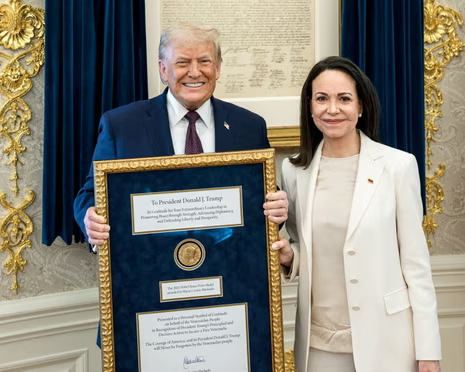
Within hours of a quiet meeting at the White House, a gesture by one of Latin America’s most prominent opposition leaders ignited an unusually complex debate about symbolism, power, and the limits of global honors. United States President Donald Trump has accepted a Nobel Peace Prize medal from Venezuelan opposition leader Maria Corina Machado, a move that is legally permissible, politically charged, and historically unusual.
The episode has raised questions far beyond the ceremonial exchange itself: Can a Nobel medal change hands without changing history? Why would a Venezuelan opposition leader offer her medal to a U.S. president? And what does this moment reveal about U.S.–Venezuela relations at a time of deep regional instability?
This article breaks down what happened, why it matters, and what it does not mean, according to the Nobel Committee itself.
What happened when Donald Trump accepted the Nobel Peace Prize medal?
According to the Associated Press, Trump accepted the Nobel Peace Prize medal offered to him by Maria Corina Machado, calling it a “wonderful gesture of mutual respect.” The former president justified his acceptance by citing Machado’s remarks during their meeting.
“She said… You have ended eight wars, and nobody deserves this prize more than you do in history,” Trump told reporters, framing the moment as recognition of his foreign policy record rather than a formal award.
How the medal was presented
- Machado met Trump privately at the White House on Thursday.
- Following the meeting, she presented her Nobel Peace Prize medal to him.
- The exchange was symbolic; it did not involve the Nobel Committee or alter official records.
This was Machado’s first public appearance in Washington since leaving Venezuela, citing safety concerns amid escalating political repression under President Nicolás Maduro’s government.
Who is Maria Corina Machado, and why does her gesture matter?
Maria Corina Machado is one of Venezuela’s most influential opposition figures and a longtime critic of Nicolás Maduro and the ruling United Socialist Party of Venezuela (PSUV). Her political activism has made her both internationally respected and domestically targeted.
Machado’s stated motivation
After the meeting, Machado described the medal presentation as:
“A recognition for his unique commitment to our (Venezuela’s) freedom.”
In interviews, including comments reported by Al Jazeera, she went further, arguing that Venezuela’s democratic future is closely aligned with U.S. strategic interests.
“As Venezuelans, we are absolutely grateful to President Trump,” she said, emphasizing Washington’s role in applying pressure on the Maduro regime.
Why is this significant
Machado’s gesture is notable for three reasons:
- Symbolism over procedure: The Nobel Peace Prize is typically treated as a personal, non-transferable honor. Offering the medal reframes it as a political statement.
- Appeal to U.S. power: The move underscores how deeply Venezuelan opposition leaders view U.S. policy as pivotal to their cause.
- Messaging to international audiences: The gesture was less about Trump personally and more about signaling alignment with American influence.
Does accepting a Nobel Peace Prize medal change who won the prize?
No, and this point is critical.
The Norwegian Nobel Committee has been unequivocal: the Nobel Peace Prize cannot be shared, transferred, or revoked.
What the Nobel Committee has said
While the committee declined to comment directly on Machado’s gesture, it reiterated its longstanding rules:
- Laureates may do as they please with their medal, diploma, or prize money.
- This includes keeping it, giving it away, selling it, or donating it.
- None of these actions affects the official historical record.
In short, Trump now possesses a Nobel medal, but he is not a Nobel Peace Prize laureate.
Why the distinction matters
The Nobel Prize is as much about institutional credibility as it is about individual achievement. Allowing history to be rewritten by private gestures would undermine that credibility.
Why did this moment attract global attention?
At face value, this was a personal exchange between two political figures. In reality, it touched on multiple fault lines in global politics.
1. The Trump factor
Donald Trump’s relationship with the Nobel Peace Prize has long been contentious. He has repeatedly argued that his diplomatic efforts, particularly in the Middle East, were overlooked by the Nobel Committee.
Machado’s remarks echoed that narrative, reinforcing Trump’s long-standing grievance with the institution.
2. Venezuela’s international struggle
For Venezuela’s opposition, global visibility is a survival strategy. With domestic avenues largely closed, international alliances—especially with the U.S.—carry outsized importance.
3. The power of symbols in politics
Symbols matter because they simplify complex realities:
- To supporters, the medal represents moral validation.
- To critics, it highlights how easily prestigious symbols can be politicized.
- To institutions, it underscores the need for clear boundaries.
How does this affect U.S.–Venezuela relations?
Substantively, it changes very little. Diplomatically, it reinforces existing narratives.
What it reinforces
- Continued U.S. support for Venezuelan opposition figures.
- Machado’s positioning as the international face of anti-Maduro resistance.
- The personalization of foreign policy through individual leaders rather than institutions.
What it does not do
- It does not alter U.S. sanctions policy.
- It does not signal official recognition of Machado as Venezuela’s leader.
- It does not represent a shift in Nobel Committee positions.
For readers tracking U.S. foreign policy, the event is more illustrative than transformative.
Why does the Nobel Peace Prize carry such symbolic weight?
Since its inception, the Nobel Peace Prize has been more than an award—it’s a moral signal. That makes it uniquely vulnerable to reinterpretation.
The paradox of prestige
- The prize derives authority from its exclusivity.
- Yet laureates retain total control over the physical symbols of that authority.
- This creates moments where symbolism outpaces substance.
The Machado–Trump exchange sits squarely within that paradox.
TL;DR: What readers should know
- Donald Trump accepted a Nobel Peace Prize medal from Venezuelan opposition leader Maria Corina Machado.
- The gesture was symbolic and legally allowed.
- It does not make Trump a Nobel Peace Prize laureate.
- The Nobel Committee confirmed that medals can be given away without changing official records.
- Politically, the moment highlights Venezuela’s reliance on U.S. support and the enduring power of global symbols.