
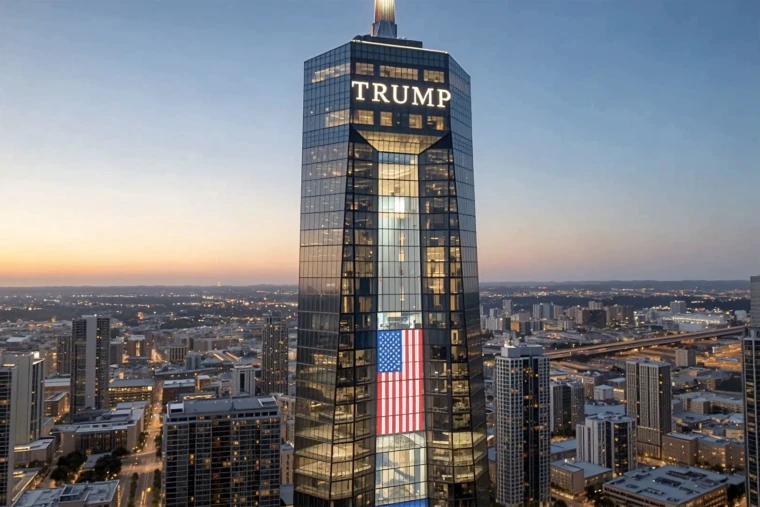
A new proposal tied to Donald Trump is drawing attention, not for policy, but for presentation. AI-generated images of a proposed “Donald J. Trump Presidential Library” in Miami have ignited debate online, raising questions about symbolism, substance, and the blurred line between political legacy and personal branding.
The project, shared on social media by Eric Trump, depicts a towering, gold-accented skyscraper complete with a museum, ballroom, and a statue of the former president. But one detail has dominated the conversation: critics say the “library” appears to lack books.
What Do the Trump Presidential Library Plans Show?
The visuals present an ambitious—and unmistakably branded—concept.
A Monumental Design
According to the renderings, the proposed structure would include:
- A skyscraper with “Trump” emblazoned along its facade
- A spire illuminated in red, white, and blue
- A large ballroom for events
- A museum featuring U.S. aircraft, including a Boeing 747
- Gold escalators and interiors consistent with Trump branding
- A large gold statue depicting Trump in a dramatic pose
The setting: waterfront Miami, emphasizing luxury and visibility.
A Multi-Use Space
The images also suggest the building would function as:
- A lecture venue
- A social event space
- A museum highlighting aspects of Trump’s life and presidency
Why Are Critics Focused on the Lack of Books?
The backlash has centered less on the building itself and more on what it represents.
Social Media Reaction
Users across platforms quickly pointed out:
- The absence of visible bookshelves in the renderings
- A focus on spectacle over scholarship
- The heavy emphasis on personal imagery and branding
Some of the sharper critiques included:
- Calling it a “monument to himself”
- Questioning what kind of books would even be included
- Mocking the concept with jokes about “pop-up picture books”
While many of these comments are partisan or satirical, they reflect a broader concern: whether the project aligns with what a presidential library is traditionally meant to be.
What Is a Presidential Library Supposed to Be?
To understand the criticism, it helps to define the standard.
The Traditional Model
Presidential libraries in the United States typically:
- Archive official records and documents
- Provide public access to historical materials
- Serve as research institutions
- Include museums contextualizing a presidency
They are often managed in partnership with the National Archives and Records Administration (NARA).
Substance Over Spectacle
While many presidential libraries include the following:
- Architectural flair
- Interactive exhibits
- Event spaces
Their core mission remains:
- Preservation of history
- Public education
Is This an Official Project or Just a Concept?
That distinction remains unclear.
What We Know
- The images are AI-generated concept renderings
- They were shared publicly by Eric Trump
- The project is described as being developed by the Trump Organization.
What We Don’t Know
- Whether land has been secured in Miami
- Whether formal approvals or permits exist
- Whether this aligns with official presidential library processes
At this stage, the proposal appears more conceptual than confirmed.
Why the Design Is Stirring Political Reactions
The imagery has triggered responses beyond typical architectural critique.
Comparisons to Global Political Symbols
Gavin Newsom publicly criticized the design, drawing comparisons to:
- Monumental statues in authoritarian regimes
- Personality-driven political symbolism
His comments reflect a broader concern about:
- The personalisation of political legacy
- The optics of self-commemoration
The Role of Branding in Politics
Trump’s brand has always leaned heavily on the following:
- Visual identity
- Luxury aesthetics
- Personal recognition
This proposal extends that approach into the realm of historical preservation.
Why the “Library Without Books” Narrative Matters
Even if exaggerated, the criticism taps into something deeper.
Symbolism vs. Function
A presidential library carries symbolic weight:
- It represents how a presidency is remembered
- It signals priorities—education vs. image
The absence of books in the renderings has become shorthand for a larger critique:
- Is this about history—or legacy branding?
The Power of Visual Communication
In the age of AI-generated content:
- Images, not documents, shape first impressions
- Design choices can overshadow intent
Could the Final Project Look Different?
It’s entirely possible.
Early Concepts Often Evolve
Architectural proposals—especially high-profile ones—typically
- Undergo multiple revisions
- Incorporate stakeholder feedback
- Align more closely with regulatory and institutional requirements
If the project moves forward, it may:
- Include traditional archival elements
- Partner with official institutions
- Adjust its design to reflect broader expectations
What This Says About Politics, Media, and Perception
The story is as much about communication as it is about construction.
The Speed of Narrative Formation
Within hours of the images being posted:
- A dominant narrative (“library without books”) took hold
- Criticism spread across platforms
- Political figures joined the conversation
The Risk of Concept-Driven Announcements
Releasing highly stylized concepts before details are finalized can:
- Invite misinterpretation
- Shift focus from intent to optics
- Amplify criticism
TL;DR
- Donald Trump is linked to a proposed presidential library concept in Miami.
- AI-generated images show a highly branded skyscraper with luxury features.
- Critics have focused on the apparent absence of books in the renderings.
- The project’s official status and details remain unclear.
- The debate highlights broader tensions between legacy-building and public expectations of presidential libraries.