
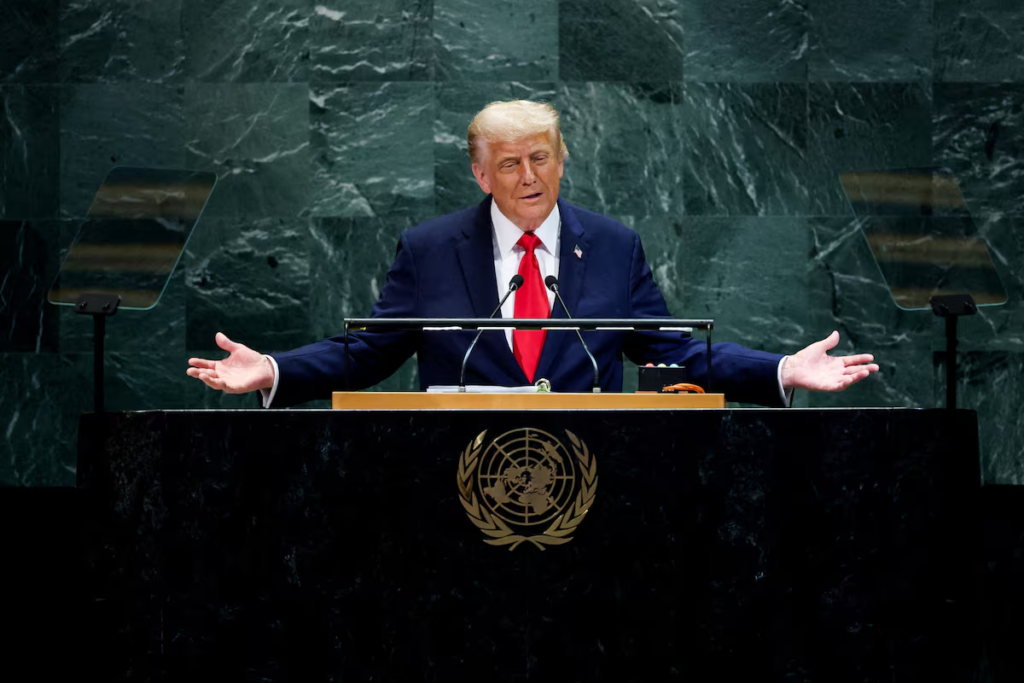
President Donald Trump proposed changing the term “artificial intelligence” to “super intelligence” during his address to the United Nations General Assembly on September 22, arguing that the word “artificial” makes the technology sound less capable than it is.
Trump said US government documents would use the new terminology going forward and suggested that other countries could eventually adopt it as well.
“From this point forward, all of United States documents, and hopefully the world’s, will be changed to use the much more accurate term ‘super’ as opposed to artificial,” Trump said during his UN speech.
He later described the proposed terminology as “super intelligence”, or “SI,” and said the technology’s growth should not be restricted.
What did Trump say about artificial intelligence at the UN?
Trump’s comments were part of a broader discussion about technological development during his address.
Explaining his proposed terminology, Trump argued that the word “artificial” gives the impression that the intelligence is somehow fake or inferior. The Associated Press reported that he said the technology is “not fake” and described it as “amazing”.
The president also said he would not “stifle growth” of the technology, comparing its potential impact with major technological transformations such as the Industrial Revolution.
Trump’s remarks focused primarily on how the technology is described and developed rather than introducing a detailed new AI policy through the speech.
Is the US officially renaming artificial intelligence?
Trump said that US government documents would use “super intelligence” instead of “artificial intelligence” from this point forward.
However, it was not immediately clear whether a formal executive order, regulation or other legal directive had been issued to make such a terminology change across the federal government.
The Associated Press specifically noted that it remained unclear whether an official order had been issued.
That distinction matters because a statement made during a speech is not necessarily the same thing as a legally binding change to federal terminology.
What is ‘superintelligence’?
“Superintelligence” is not an entirely new term.
In technology and academic discussions, it is generally used to describe a hypothetical AI system whose intellectual capabilities would substantially exceed those of humans across a broad range of tasks.
That is different from “artificial intelligence,” which is the much broader term used for technologies that perform tasks associated with human intelligence, including systems that already exist today.
As a result, replacing the two terms would technically change more than the wording. “Artificial intelligence” describes a broad field, while “superintelligence” generally refers to a more advanced and still largely hypothetical level of capability.
Why does Trump prefer the term ‘super intelligence’?
Trump’s argument is essentially about what the name suggests.
He said the word “artificial” makes intelligence “sound fake,” while he considers modern AI capabilities to be increasingly powerful and significant.
The proposed term also fits with Trump’s broader emphasis on the United States maintaining a leading position in advanced technology.
In his remarks, he portrayed AI as a transformational technology whose development should continue rather than be slowed by broad restrictions.
Trump’s comments come amid growing AI debate
The remarks arrive as governments and technology companies continue debating how artificial intelligence should be developed, regulated and deployed.
AI systems are already being used in areas including software development, search, education, financial services, scientific research and content generation.
At the same time, policymakers and researchers remain divided over issues such as AI safety, misinformation, employment disruption, privacy, cybersecurity and the possibility of increasingly autonomous systems.
The terminology debate therefore sits within a much larger argument over what AI should become and how governments should respond to its rapid development.
What does ‘SI’ mean in Trump’s proposal?
Trump suggested “SI” as an abbreviation for “super intelligence.”
The terminology is straightforward, but it could create confusion because “superintelligence” already has a specific meaning in AI research.
Researchers generally use the term to describe intelligence that would surpass human cognitive abilities across essentially all or most important intellectual domains.
That is considerably narrower than the everyday use of “AI,” which covers everything from image-generation tools and recommendation algorithms to large language models and autonomous systems.
Could the terminology change affect AI policy?
Potentially, but the UN speech itself did not spell out a comprehensive policy framework for the proposed terminology.
Whether federal agencies actually change official terminology would depend on formal guidance or directives from the US government.
It would also raise practical questions about existing laws, regulations and international agreements that currently use the term “artificial intelligence.”
Changing a label would therefore be much easier than changing the legal and regulatory architecture built around the technology.
Trump links AI to US technological leadership
Trump’s comments also reflected the increasingly strategic role of AI in competition between major powers.
The United States and China are investing heavily in AI research, computing infrastructure, advanced chips and related technologies.
Trump has repeatedly argued that the US needs to maintain leadership in AI and avoid policies that could give competing countries an advantage.
During the UN speech, he again emphasized the scale of the technology’s potential and compared it with earlier technological revolutions.
What did Trump mean by ‘super intelligence’?
Trump’s use of the term appears to be broader and more rhetorical than the technical definition commonly used by AI researchers.
His proposal was presented as a way of describing what he sees as the extraordinary capabilities and future potential of AI.
In academic discussions, however, superintelligence generally refers to a level of machine intelligence that exceeds human performance across a very wide range of intellectual activities.
That means Trump’s proposed terminology should not automatically be interpreted as a claim that today’s AI systems already qualify as superintelligent.