
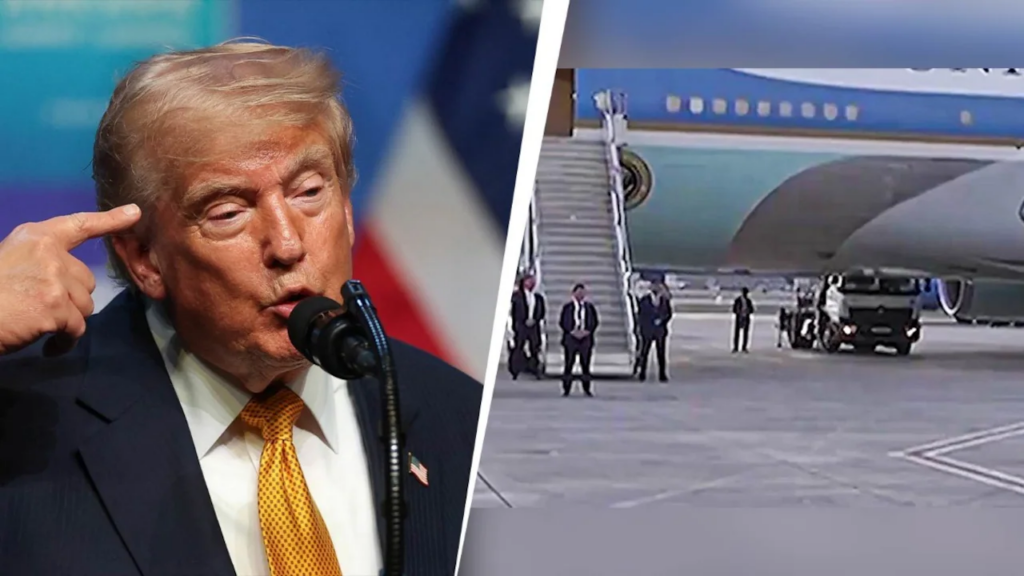
President Donald Trump was secretly moved between aircraft at an airport in Turkey after a reported Iranian threat prompted US security officials to conceal his actual departure route, according to reporting by The Washington Post and The New York Times. Reuters has also reported on the operation.
The unusual operation took place after the NATO summit in Ankara on July 8. Trump was publicly seen boarding an older Air Force One aircraft, while his actual departure reportedly involved a much smaller US Air Force C-32A that flew to Britain.
The most striking detail was how Trump was reportedly moved between the aircraft: an airport catering truck was used to transport him across the airfield, helping conceal his location from journalists and some members of his travelling staff.
Why did Trump secretly change aircraft in Turkey?
The reported aircraft switch was part of a security deception operation triggered by what a US official described to The Washington Post as a credible threat involving Iran.
Turkey shares a border with Iran, and the NATO summit occurred while tensions between Washington and Tehran were extremely high. During the summit itself, Trump said the existing ceasefire with Iran was over and threatened further US military action.
The threat reportedly led US officials to reconsider how Trump would leave Turkey.
Rather than allowing observers to know which aircraft was carrying the president, security officials used multiple aircraft and deliberately created the appearance that Trump was departing on the older Air Force One.
How was Trump moved from Air Force One to the C-32A?
Trump had initially boarded the older Boeing 747 in front of cameras at Ankara’s Esenboğa Airport.
According to The Washington Post’s reporting, he was then secretly moved from that aircraft to the smaller C-32A. An airport catering truck normally used to transport meals and supplies to aircraft was used to move him across the airport.
The C-32A is a military aircraft based on the Boeing 757 and is routinely used for senior US government officials. It is significantly smaller than the presidential 747s commonly associated with Air Force One.
The operation allowed Trump to leave Turkey without making his actual aircraft obvious to people watching the airport.
Why was the old Air Force One used as a decoy?
The older Boeing 747 effectively became a decoy.
Trump had publicly said he would use the older aircraft to fly from Turkey to Britain, reportedly saying he wanted to use it “for old times’ sake.” His new Qatar-donated Boeing 747-8 was sent ahead to Britain. Reuters reported at the time that Trump unexpectedly left Turkey aboard the older aircraft, while the newer plane traveled separately.
The explanation given publicly at the time was that the new aircraft would be available at RAF Mildenhall in Britain for US service members to tour.
The later reporting indicates that the public explanation did not reveal the full security plan.
Did journalists know Trump was no longer on the plane?
Apparently not.
According to The Washington Post, journalists travelling with Trump believed they were aboard the aircraft carrying the president. Some White House staff members were also reportedly unaware that Trump had switched aircraft.
Reporters were reportedly instructed to keep the shades in the press section closed during the flight.
Trump later joked about the unusual instruction when asked why the shades had been kept down, reportedly telling journalists they were “probably on a dangerous flight” before adding, “But if I go, you go?”
The comment took on a different meaning after details of the deception operation emerged.
What aircraft actually carried Trump?
According to the reporting, Trump ultimately travelled aboard a US Air Force C-32A rather than the older Boeing 747.
The C-32A is a modified Boeing 757 used by the US government for high-ranking officials and senior presidential travel missions. Its smaller profile makes it less conspicuous than a presidential 747.
The combination of the C-32A, a decoy 747, and controlled movements across the airport made it much harder for observers to determine where Trump actually was.
This kind of deception is designed to complicate potential surveillance or targeting, especially when a specific aircraft would otherwise be easy to track.
Why was Iran considered a security concern?
The operation came during an unusually tense period in US-Iran relations.
At the NATO summit in Ankara, Trump said the ceasefire with Iran had ended and indicated that additional US military action was possible. Reuters reported that the president threatened further strikes after US forces had conducted attacks against Iran.
Iran also borders Turkey, giving the location particular strategic significance.
The reported threat was therefore occurring against a backdrop of active military confrontation, rather than during an ordinary presidential visit.
The White House has not publicly disclosed the intelligence behind the reported threat, so details about who made the threat, how specific it was and what evidence supported it remain unclear.
Was the Qatar-donated aircraft part of the security concern?
Trump’s Turkey trip was also notable because it marked the first international use of a new Boeing 747-8 donated by Qatar to the United States.
The aircraft had already generated political and security controversy over its unusual status and the cost of modifying it for presidential use.
Trump arrived in Turkey aboard the new aircraft, but it was not used for his immediate return from Ankara.
Instead, the Qatari-donated aircraft travelled ahead to Britain, while the older Air Force One and the C-32A were involved in the departure deception. Reuters reported at the time that the unexpected switch attracted attention because the new aircraft had been the centrepiece of the president’s trip.
Is using a decoy aircraft unusual for a president?
The concept itself is not unprecedented.
Presidential security has historically involved deception, route changes, and efforts to prevent adversaries from knowing the president’s exact movements.
The use of a decoy aircraft can create uncertainty for anyone attempting to monitor or target a presidential flight.
What makes this episode particularly unusual is the reported use of an ordinary airport catering truck to move the president between aircraft.
That detail illustrates how physical logistics can become part of a larger security strategy. A seemingly mundane airport vehicle can attract far less attention than an obvious presidential motorcade or aircraft convoy.
Why were some White House staff members kept unaware?
Operational security is one possible reason.
The more people who know a sensitive movement plan, the greater the risk that information could be unintentionally disclosed.
By limiting knowledge of the actual aircraft to a small group, security officials could reduce the number of people who knew where Trump was travelling.
The Washington Post reported that some staff and journalists believed they were on the presidential aircraft even after Trump had left it.
That suggests the operation relied not just on physical concealment but also on controlling information.
What does the incident reveal about presidential security?
The episode demonstrates how presidential travel can involve several layers of deception and redundancy.
A president’s aircraft is highly visible, relatively easy to identify and potentially track from the ground and through publicly available aviation data. In a heightened threat environment, simply changing the flight plan may not be enough.
A more sophisticated operation can combine:
- A decoy aircraft
- An alternative aircraft
- Controlled airport movements
- Restricted information
- Deceptive public signaling
- Rapid changes in transportation plans
The goal is to make it difficult for anyone outside the security operation to know which aircraft actually contains the president.
Why did the story emerge weeks later?
The security value of such an operation depends partly on secrecy.
Disclosing the details after the event does not necessarily create the same immediate risk as announcing the plan while the president is still traveling.
The Washington Post published its account on August 10, weeks after the July 8 departure. Reuters subsequently reported on the story on August 11, citing the Post and New York Times reports.
The delayed disclosure also explains why some of the information surrounding the departure initially appeared straightforward before the more elaborate details became public.
What remains unknown?
Several important questions have not been answered publicly.
It remains unclear:
- What specific Iranian threat triggered the operation.
- Whether intelligence agencies identified a particular plan or merely a credible general threat.
- How many officials knew about the aircraft switch in advance.
- Whether the operation was planned before Trump arrived in Turkey.
- Whether similar deception measures have been used during other recent presidential trips.
- Whether Iran was actually capable of targeting the specific departure operation.
Those questions may never be answered publicly because they involve intelligence and presidential security procedures.
The bigger significance of Trump’s secret Turkey flight
The reported operation shows just how far presidential security can go when officials believe a threat is credible.
For several hours, the public picture suggested that Trump was traveling aboard the older Air Force One. Behind the scenes, he had reportedly been moved to a different aircraft using a catering vehicle and was already on his way out of Turkey.
The episode was not simply an unusual transportation story. It was a carefully constructed deception designed to make Trump’s actual location harder to determine.
It also illustrates the security challenges created by presidential travel during a military confrontation. When the president is operating close to a country involved in an active conflict, even ordinary movements between an airport and an aircraft can become part of a much larger security calculation.
For now, the precise Iranian threat remains classified. What is clear from the reporting is that Trump’s apparent departure from Turkey was not the departure that actually carried him to safety.