
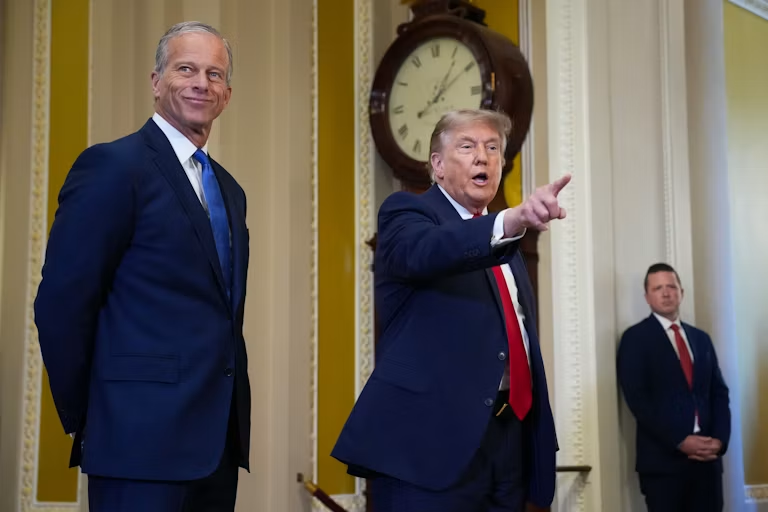
President Donald Trump abruptly shifted a question about renewed violence in the Democratic Republic of Congo to the Ebola outbreak during a White House exchange with an African journalist, producing an unusual moment as the president was pressed on the fate of a U.S.-backed peace agreement.
Hariana Verás, an Angolan journalist and White House correspondent, asked Trump whether he planned to intervene after telling him she had recently visited the DRC and had witnessed what she described as continued killings by forces from Rwanda.
Trump said the United States would act if the peace agreement was violated.
He then asked Verás: “How is Ebola going?”
The exchange quickly moved from the armed conflict in eastern Congo to the country’s separate public-health emergency. Verás responded that Ebola was under control, while adding that the DRC still needed international assistance and that the war remained the bigger problem.
The moment came as fighting and displacement continued in eastern Congo despite the U.S.-backed Washington peace accords between Rwanda and the DRC. At the same time, the DRC was dealing with an Ebola outbreak that had surpassed 8,000 confirmed cases and 3,900 deaths by September 28, according to Congolese health authorities cited by Reuters.
What did Hariana Verás ask Trump?
The question was focused on whether the United States would respond to continued violence in eastern Congo.
Verás told Trump that she had recently returned from the DRC and had personally witnessed what she described as continuing killings of Congolese civilians. She said she had evidence and asked whether the president intended to take action.
Trump responded that if there was a violation of the peace arrangement, the United States would “stop it.”
“We ended the war with Congo and Rwanda, and they both signed it and they both agreed,” Trump said during the Oval Office exchange. He added that he had only recently heard about the alleged violations and would intervene if there was a problem.
Trump was referring to the U.S.-facilitated peace process involving Rwanda and the DRC.
But the record since the agreement was signed shows that the conflict did not simply disappear.
What is the Rwanda-DRC peace agreement?
The peace process culminated in the signing of the Washington Accords for Peace and Prosperity in Washington on December 4, 2025.
The accords incorporated several earlier steps, including a declaration of principles signed in April 2025 and a Washington peace agreement signed on June 27. The December ceremony formally brought those elements together.
The agreement was intended to reduce the fighting in eastern DRC and establish commitments involving security arrangements, armed groups and regional economic integration.
Trump’s administration has repeatedly pointed to the accords as a major diplomatic achievement.
The problem is that implementation has remained incomplete.
U.N. experts said in July 2026 that all major sides in the eastern Congo conflict were violating elements of the peace terms and committing abuses. Their assessment included the Congolese army, the M23 rebel group and Rwanda-backed forces.
Human Rights Watch has separately documented serious violations by M23 and Rwandan forces in eastern Congo, including killings, forced recruitment and other abuses. Rwanda has disputed accusations concerning its role and has argued that other armed groups and actors have contributed to the violence.
That context explains why Verás challenged Trump about whether the United States would do more.
Trump says the U.S. will respond to violations
Trump’s response was consistent with his public description of the Washington agreement.
He said Rwanda and Congo had signed the accord and that the United States would act if its terms were violated.
But the president did not announce a new military or diplomatic measure during the exchange.
He also did not specify which alleged incident Verás was referring to or identify what evidence the United States had received independently.
That distinction matters.
Verás was making a firsthand claim about what she said she had witnessed.
Trump responded to the broader allegation of a possible peace-deal violation.
Neither statement, by itself, establishes responsibility for a particular incident.
The conflict in eastern DRC involves multiple armed actors, including the Congolese military, M23 and other militias. Regional governments have also accused one another of supporting armed groups, making attribution of individual attacks a contentious issue.
Then Trump asked about Ebola
Instead of continuing with the Congo conflict question, Trump turned to the Ebola outbreak.
“How is Ebola going?” he asked.
Verás replied that the outbreak was under control, saying she had spoken with the World Health Organization’s director and had been told the disease was under control.
She nevertheless added that the country still needed help fighting Ebola.
The response effectively moved the exchange onto another major crisis affecting the DRC.
For Trump, the shift also connected the conversation to an issue that has become a major international health concern in Central Africa during 2026.
But current health data show that the outbreak remained significant at the time of the exchange.
Ebola outbreak had passed 8,000 cases
The World Health Organization says the current Ebola outbreak in the DRC was confirmed in May 2026 and involves the Bundibugyo species of the Ebola virus.
The WHO says the outbreak is taking place in a particularly difficult environment marked by insecurity, population movement, limited access to healthcare and other humanitarian pressures.
By September 28, the DRC had reported 8,067 confirmed Ebola cases and 3,901 deaths, according to Reuters, citing the country’s public health institute.
That made the outbreak the largest and deadliest Ebola outbreak recorded in the DRC and the second-deadliest Ebola outbreak globally, behind the 2014-2016 West Africa epidemic.
So while the reporter said she had been told the outbreak was under control, the available epidemiological figures show that the crisis was far from over.
The two statements are not necessarily mutually exclusive. “Under control” can refer to whether containment measures are beginning to work, rather than meaning the outbreak has ended or transmission has stopped.
Why Ebola is such a difficult problem in eastern Congo
The DRC has extensive experience fighting Ebola.
The country has experienced repeated outbreaks over several decades, and its health workers have developed specialized systems for vaccination, testing, contact tracing and treatment.
But the 2026 outbreak presents unusually difficult circumstances.
WHO says it is occurring in a remote and densely populated area while the country is simultaneously dealing with humanitarian needs and insecurity.
People moving between communities and across borders can make surveillance more difficult.
Community mistrust and misinformation can also undermine public-health measures.
The disease itself adds another layer of urgency because the outbreak involves the Bundibugyo species, for which WHO says there is no licensed vaccine or specific treatment currently available, although candidate interventions are being studied.
The U.S. is still funding the Ebola response
The source article claims that cuts to USAID aggravated the Ebola crisis.
That claim requires more qualification.
The United States announced an additional $267 million in funding for the Ebola response on September 23, bringing its total direct commitment to approximately $886 million, according to Reuters. The money is intended to support treatment facilities, diagnostics, medical equipment, and frontline health workers.
That does not mean there have been no disruptions to U.S. foreign assistance or global-health programs during the Trump administration.
But the available evidence does not establish that those broader funding changes directly caused the current Ebola outbreak or are responsible for its scale.
The more defensible description is that the U.S. has simultaneously made significant new commitments to the Ebola response while broader changes to American foreign assistance have generated debate over the long-term capacity of international health programs.
Who is Hariana Verás?
Verás is an Angolan journalist who covers U.S. politics and international affairs from Washington.
During a 2025 White House event, she introduced herself to Trump as the only African reporter accredited at the White House at the time and said she covered the continent as a whole. The American Presidency Project’s transcript preserves that exchange.
She has also been recognized by African and international organizations for her work as a correspondent covering the White House, Pentagon, Senate, and State Department.
Her presence at the White House is significant because she frequently uses her access to raise questions involving African governments and conflicts that receive less attention in the U.S. media.
That background helps explain why her September 2026 question focused specifically on eastern Congo.
Why eastern Congo remains unstable
The DRC’s eastern provinces have experienced conflict for decades.
The region is rich in minerals and has been affected by competing armed groups, ethnic tensions, political disputes and regional involvement.
The M23 rebellion has been central to the latest phase of the crisis.
The Congolese government has accused Rwanda of supporting M23, while Rwanda has repeatedly denied being responsible for the group’s actions in the manner claimed by Kinshasa and has pointed to security threats from armed groups operating from Congolese territory.
The United States has itself taken measures against Rwandan officials and armed-group commanders over the conflict.
In March 2026, the U.S. Treasury sanctioned the Rwanda Defence Force and several Rwandan officials, citing their role in supporting M23 and undermining efforts to stabilize eastern Congo.
The sanctions demonstrate that Washington’s relationship with Kigali has become considerably more complicated than the language surrounding the original peace agreement might suggest.
The peace deal has not ended the war
That is the underlying issue behind Verás’s question.
The Washington Accords created a diplomatic framework.
They did not automatically eliminate the armed groups, territorial disputes and security concerns driving the conflict.
Since the agreements were signed, fighting has continued, and international monitors have documented violations.
The continued violence has also produced a major displacement crisis.
The Guardian reported in September that fighting involving the Congolese army and M23 had continued in several parts of eastern DRC despite the peace accord, forcing civilians to flee their homes.
That helps explain why Trump was confronted with a question about whether a deal he has repeatedly described as ending the conflict is actually holding on the ground.
What did Trump mean when he said “we ended the war”?
Trump has repeatedly characterized the Rwanda-DRC agreement as having ended the conflict.
The White House has similarly listed the DRC-Rwanda accord among the international conflicts Trump says his administration helped resolve.
However, ongoing fighting and U.N. reporting demonstrate that the security situation remains unresolved.
That creates an important distinction between a diplomatic agreement and a fully implemented peace.
A peace accord can establish commitments and mechanisms without immediately ending violence.
Whether the Washington Accords ultimately succeed depends on implementation, compliance by the parties, and the ability of negotiators to deal with armed groups outside the formal agreement.
What the White House exchange revealed
The short exchange brought together three very different issues.
There was the unresolved war in eastern Congo.
There was the U.S.-backed diplomatic agreement that Washington says should bring the conflict to an end.
And there was an Ebola outbreak that has become one of the DRC’s largest public-health emergencies in decades.
Verás wanted to keep the conversation on the first issue.
Trump redirected it briefly toward the third.
The president then ended the exchange by saying he would make sure things worked out.
No new Congo policy was announced during those remarks.
But the exchange highlighted the gap between diplomatic declarations in Washington and conditions on the ground in eastern Congo.
The peace accords remain in place.
The fighting has not fully stopped.
The Ebola outbreak is still active.
And both crises continue to require international attention.