
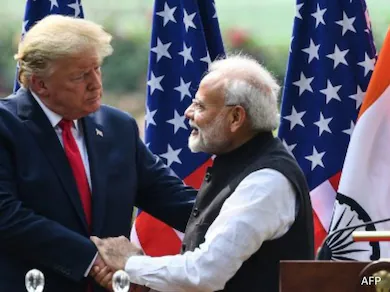
After nearly a year of tariff threats, suspensions, and last-minute brinkmanship, Washington and New Delhi have finally hit pause on a trade fight that was starting to hurt on both sides. On Monday, US President Donald Trump announced a US–India trade deal that sharply lowers tariffs on Indian exports and resets the tone of one of America’s most strategically important economic relationships.
The headline number is hard to miss: tariffs on Indian goods, which had climbed as high as 50%, will now be capped at 18%. The announcement, posted on Trump’s Truth Social platform, followed a phone call with Indian Prime Minister Narendra Modi and immediately drew attention from global markets.
But beyond the relief rally, the deal raises bigger questions. Why did talks drag on for so long? Which sectors stand to gain the most? And how does India’s new tariff position compare with other Asian exporters competing for access to the US market?
What Is the US–India Trade Deal Announced in February 2026?
At its core, the agreement ends months of escalating tariffs that had created uncertainty for exporters, investors, and supply chains.
According to Trump’s statement, the US will:
- Cut reciprocal tariffs on Indian goods to 18%
- Gain improved market access for US exports to India
- Secure commitments from India to lower certain trade barriers
Trump also claimed that India had agreed to halt imports of Russian oil—an assertion New Delhi has not publicly confirmed. Indian officials have so far focused their messaging on trade and manufacturing, not energy policy.
Modi welcomed the tariff reduction as a boost for “Made in India” products, signaling that New Delhi views the deal as a win for domestic exporters and manufacturing ambitions.
Why it matters: For businesses on both sides, the agreement restores a degree of predictability after a year when tariff policy felt more like a moving target than a rulebook.
What Were the Tariff Rates Before the Agreement?
Before the deal, US tariffs on Indian goods reached levels rarely seen between strategic partners.
- Base tariffs: Rose to 26% in April 2025
- Escalation: Increased to 25% again in July 2025
- Penalty tariffs: An additional 25% linked to India’s Russian oil purchases
- Effective peak rate: As high as 50% on many Indian exports
These rates were especially damaging for price-sensitive sectors like textiles, auto components, and consumer goods, where margins are thin and competition from other Asian exporters is intense.
Cutting tariffs to 18% doesn’t erase all friction, but it dramatically lowers the cost barrier Indian firms face when selling into the US market.
How Did US–India Trade Talks Reach This Point?
The path to the agreement was anything but smooth. What began as an ambitious plan to deepen economic ties turned into a drawn-out test of political will.
February 2025: Big Goals, Big Promises
Trump and Modi agreed to aim high—very high. Both leaders talked about more than doubling bilateral trade to $500 billion by 2030, with plans for a multi-sector Bilateral Trade Agreement.
March–April 2025: Talks Begin, Then Stall
Indian Commerce Minister Piyush Goyal held early rounds of talks in Washington. Momentum slowed sharply when Trump imposed a 26% tariff on Indian imports in April, injecting uncertainty into negotiations.
April–June 2025: Framework Takes Shape
Formal talks resumed under India’s chief negotiator, Rajesh Agrawal. Negotiators agreed on a broad framework covering 19 chapters, including:
- Tariffs and market access
- Digital trade
- Regulatory barriers
July–August 2025: Tariff Escalation Peaks
As deadlines loomed, tariffs surged again. By early August, combined duties pushed effective rates to 50%, dramatically raising the stakes for both sides.
September–December 2025: Backchannel Diplomacy
After months of escalation, quiet diplomacy took over. Multiple rounds of talks in India, New York, and Washington narrowed differences and rebuilt trust.
February 2026: The Deal Is Sealed
Following renewed momentum in January, Trump announced the tariff cut on February 2, calling time on one of the most turbulent chapters in recent US–India trade relations.
Which Sectors Are Likely to Benefit From the US–India Trade Deal?
While the agreement doesn’t publish a sector-by-sector tariff schedule yet, several industries are poised to benefit quickly.
Manufacturing and Industrial Goods
Lower tariffs make Indian machinery, auto parts, and industrial components more competitive against suppliers from Vietnam, Thailand, and Mexico.
Textiles and Apparel
This sector was among the hardest hit by the 50% tariff regime. Even a reduction to 18% can significantly improve pricing power in the US retail market.
Pharmaceuticals and Chemicals
India’s generic drug makers and specialty chemical firms could see smoother access, though regulatory approvals will still matter as much as tariffs.
Technology and Digital Services (Indirectly)
While services aren’t directly tariffed, reduced trade friction improves the overall climate for US–India tech partnerships and cross-border investment.
How Does India’s Tariff Rate Compare With Other Asian Countries?
At 18%, India’s new tariff rate is more competitive—but not the lowest—in Asia.
- Vietnam: Often benefits from lower US tariffs due to trade positioning and supply chain shifts
- Bangladesh: Enjoys preferential access for certain textile exports
- China: Faces higher and more volatile tariffs amid ongoing US-China tensions
India now sits in a middle ground: no longer penalized, but still under pressure to keep reforms moving if it wants to attract manufacturers looking to diversify away from China.
This positioning could matter as companies rethink where to place their next factory or supplier contract.
Why Does This Deal Matter Beyond Tariffs?
The US–India trade deal is as much political as it is economic.
For Washington, it signals an effort to stabilize ties with a key Indo-Pacific partner amid broader geopolitical competition. For New Delhi, it reinforces India’s pitch as a reliable manufacturing and investment destination.
At the same time, unresolved issues remain:
- Sector-specific tariff schedules are still unclear
- Market access details haven’t been fully published
- Energy commitments, particularly around Russian oil, remain sensitive
The real test will be whether negotiators can quickly convert this high-level agreement into detailed, enforceable rules.
TL;DR: The Bottom Line on the US–India Trade Deal
- US tariffs on Indian goods drop from as high as 50% to 18%
- The deal ends months of trade uncertainty and escalation
- Manufacturing, textiles, and pharma stand to gain the most
- Key details still need clarification before businesses see full benefits
The agreement marks a reset—not a finish line. Its long-term impact will depend on how quickly both countries move from political announcements to practical execution.