
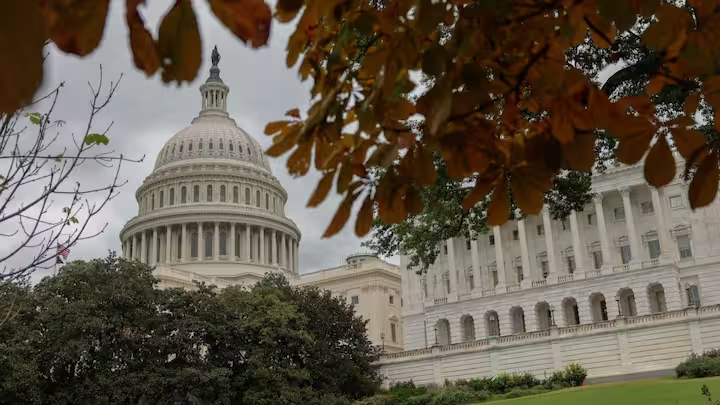
Americans are heading toward one of the most consequential elections of President Donald Trump second term.
The 2026 U.S. midterm elections will take place on Tuesday, November 3, with voters choosing every member of the House of Representatives, a large portion of the Senate and governors across much of the country.
The presidential office itself is not on the ballot. Instead, the election will determine who controls Congress for the final two years of Trump’s current term, while state-level races will shape power in statehouses across the country.
The stakes extend well beyond party control.
Congress controls legislation, federal spending and oversight, while the Senate plays a central role in confirming presidential nominees. Governors and state legislators, meanwhile, influence policies ranging from education and healthcare to taxes, public safety and election administration.
With early voting already underway in some states, the 2026 midterm elections have entered their final stretch. The Federal Election Commission lists November 3 as the next regularly scheduled federal general-election date.
What are the U.S. midterm elections?
Midterm elections are federal general elections held halfway through a president’s four-year term.
Unlike a presidential election, there is no national vote for president. Instead, Americans vote for members of Congress and, depending on their state, governors, state legislators and other offices.
The system is different from parliamentary elections in countries where a government can fall and an early national election can be called. The U.S. Constitution establishes fixed terms for the president, House members and senators.
The 2026 election will produce the 120th Congress, which begins in January 2027.
What is being elected in 2026?
House of Representatives
All 435 voting seats in the House are contested every two years.
House members serve two-year terms, meaning there is a congressional election in every district during every federal election cycle.
To control the chamber after the election, a party generally needs 218 of the 435 voting seats.
As of September 24, the House Clerk listed 218 Republicans, 214 Democrats, one independent and two vacancies.
The independent member, California Rep. Kevin Kiley, switched his affiliation from Republican to independent earlier in 2026 but has continued to caucus with Republicans, making the effective partisan picture somewhat more complicated than the formal labels suggest.
The important point for November is simpler: all 435 seats will be filled through the 2026 election, and control will depend on which party reaches the 218-seat threshold.
Senate
The Senate has 100 members, but senators serve six-year terms. Their elections are staggered so that roughly one-third of the chamber faces voters every two years.
The 2026 regular Senate elections involve the 33 seats in Class II, whose terms expire in January 2027.
Two additional special elections are also being held for Class III seats with unexpired terms: Florida’s seat, previously held by Marco Rubio, and Ohio’s seat, previously held by JD Vance. Ashley Moody was appointed to Florida’s seat, while Jon Husted was appointed in Ohio.
That brings the total number of Senate seats appearing on the 2026 ballot to 35.
As of the current 119th Congress, Republicans hold 53 Senate seats, Democrats hold 45 and two independents caucus with Democrats, producing an effective 53-47 partisan split.
Why does the Senate’s staggered system matter?
The Senate was deliberately divided into three classes so that the entire chamber would not be replaced during a single election.
Class I senators are elected in cycles ending in 2031.
Class II senators, the group voting in 2026, have terms expiring in 2027.
Class III senators have terms expiring in 2029.
The arrangement creates continuity in the Senate. Even during a major election, most senators continue serving because their six-year terms have not yet expired.
It also means that the map of seats up for election differs from one cycle to the next.
In 2026, Republicans have more Class II seats to defend than Democrats, while Florida and Ohio add two Republican-held special elections from another Senate class. That makes the overall Senate map different from simply counting the 33 regular Class II contests.
What is the “midterm penalty”?
American political history shows a recurring pattern in which the party holding the White House loses House seats during midterm elections.
Since 1946, the president’s party has lost House seats in 18 of 20 midterm elections, according to historical data compiled by the American Presidency Project. The two exceptions were 1998 under President Bill Clinton and 2002 under President George W. Bush.
That pattern is sometimes called the “midterm penalty.”
It is not a rule, however.
Economic conditions, presidential approval, candidate quality, major national events, turnout and the number of competitive districts can all affect individual election cycles.
Senate results have also historically been less consistent than House results. The president’s party has sometimes gained Senate seats even when losing House seats.
So the historical pattern is useful context, but it cannot by itself determine what happens in 2026.
What’s at stake in the House?
House control affects the chamber’s entire legislative and oversight structure.
The majority party controls the speakership and committee leadership, influences which bills receive consideration and plays a central role in writing spending legislation.
House committees also have broad investigative authority. A change in party control can therefore alter the focus, scale and direction of congressional oversight of the executive branch.
The current House is especially narrow, making individual districts important.
Reuters reported that roughly 50 of the 435 House contests are receiving serious attention as competitive races. These include districts in Arizona, California, Colorado, Florida, Iowa, Michigan, New Jersey, New York, Ohio, Pennsylvania, Texas, Virginia and Wisconsin.
Why redistricting matters in 2026
The House map is not static.
Nine states are using newly drawn congressional districts for the 2026 election: Alabama, California, Florida, Louisiana, North Carolina, Ohio, Tennessee, Texas and Utah, according to the Associated Press.
The changes followed an unusual wave of mid-decade redistricting, meaning millions of voters are participating in districts that did not exist in their current form during the 2024 election.
Redistricting can change the political composition of individual districts without voters moving.
A district can become geographically larger or smaller, lose one community and gain another, or absorb areas with different voting histories.
As a result, some incumbents face a substantially different electorate from the one that originally elected them.
House races drawing national attention
The competitive House map stretches across several regions.
In Arizona, two districts around Phoenix and Tucson are receiving significant attention.
California is also central to the congressional fight following a Democratic-backed redistricting effort that changed several districts.
Texas has seen its own redistricting battle and remains a major part of the national House contest.
Other races attracting attention include contests in Iowa, Michigan, New Jersey, New York, Ohio, Pennsylvania, Virginia and Wisconsin. Reuters has identified dozens of districts where spending and campaign activity are unusually high for the final weeks of the campaign.
The issues differ from one district to another, but economic concerns, energy prices, immigration, healthcare, trade and the Trump administration’s record are recurring themes in many competitive campaigns.
Why House retirements matter
An incumbent’s decision not to seek another term can transform a congressional race.
Open seats often attract several candidates during the primary process and can remove the electoral advantage that comes from already holding the office.
The 2026 cycle includes numerous House retirements and departures, while redistricting has also prompted some sitting lawmakers to seek different districts or reconsider their party affiliation.
This makes the 2026 House map more fluid than simply examining the current list of incumbents.
What’s at stake in the Senate?
Senate control carries a different set of consequences.
The Senate confirms presidential nominees, including federal judges and Supreme Court justices. It also approves treaties and plays a role in major matters involving national security and executive appointments.
Because senators represent entire states, their campaigns often revolve around statewide issues rather than individual congressional-district concerns.
The current Senate breakdown is 53 Republicans, 45 Democrats and two independents who caucus with Democrats.
A Senate majority requires 51 seats under ordinary circumstances. Because the White House is controlled by Republicans and Vice President JD Vance is the current president of the Senate, the arithmetic for party control cannot be reduced to simply looking at who wins 50 seats.
The Republican-held seats facing voters in 2026 include a mixture of incumbents and open seats.
Senate races to watch
Georgia
Democratic Sen. Jon Ossoff is seeking reelection in Georgia.
The state has become one of the most closely followed statewide political battlegrounds in the country after competitive presidential and Senate elections in recent cycles.
Ossoff is facing Republican challenger Mike Collins. Reuters and the Associated Press have both identified Georgia as one of the races central to the Senate-control debate.
North Carolina
North Carolina has an open Senate seat after Republican Sen. Thom Tillis decided not to seek another term.
Democratic former Gov. Roy Cooper is running against Republican Michael Whatley.
The contest has attracted national attention because it combines an open seat with a state that has repeatedly produced competitive statewide elections.
Michigan
Michigan also has an open Senate seat following Gary Peters’ retirement.
Republican Mike Rogers is running against Democrat Abdul El-Sayed.
The race is unfolding in a state where industrial policy, trade, healthcare and economic issues are particularly prominent in campaign messaging.
Maine
Republican Sen. Susan Collins is running for reelection in Maine.
Democratic challenger Troy Jackson is competing for the seat after the Democratic primary field changed during the campaign cycle.
Maine has long been known for independent-minded statewide voting patterns, making its Senate race closely watched beyond the state itself.
New Hampshire
New Hampshire’s Senate seat is open following Democratic Sen. Jeanne Shaheen’s decision not to seek another term.
Former Republican Sen. John Sununu and Democratic Rep. Chris Pappas won their respective primaries and will meet in November.
Minnesota
Democratic Sen. Tina Smith is also not seeking another term, creating another open Senate contest.
Minnesota’s race is therefore part of the broader group of 2026 contests in which an incumbent departure has changed the political landscape.
Iowa
Republican Sen. Joni Ernst’s retirement opened another seat.
Republican Ashley Hinson and Democrat Josh Turek are competing for the position. The contest has attracted substantial national attention, while issues including agriculture, healthcare and energy costs have become prominent in the campaign.
Kentucky
Senate Minority Leader Mitch McConnell’s retirement has also created an open Republican-held seat in Kentucky.
The race gives voters the opportunity to choose a successor to one of the longest-serving Senate leaders in modern American history.
Texas
Texas is not traditionally associated with competitive statewide Senate elections, but the 2026 contest has attracted national attention.
Republican Attorney General Ken Paxton is running against Democratic state legislator James Talarico.
The race has also been shaped by Paxton’s legal and political battles outside the campaign itself and by substantial national spending.
Alaska and Ohio
Alaska’s race involves Republican Sen. Dan Sullivan and Democratic challenger Mary Peltola, with Alaska’s ranked-choice voting system adding a procedural difference from most other Senate contests.
Ohio features Republican Sen. Jon Husted against former Democratic Sen. Sherrod Brown.
Husted is serving out the Senate term that became vacant after JD Vance became vice president, making the Ohio contest one of the 2026 special elections as well as a closely watched statewide race.
What are the Florida and Ohio special elections?
Two special Senate elections make the 2026 map unusual.
Florida
Marco Rubio resigned his Senate seat after becoming secretary of state.
Florida Gov. Ron DeSantis appointed Ashley Moody to serve the remainder of Rubio’s term temporarily.
The November election will determine who serves the remaining portion of that term. Moody is running as the Republican incumbent appointed to the seat.
Ohio
Ohio’s Class III seat became vacant after JD Vance left the Senate to become vice president.
Gov. Mike DeWine appointed Jon Husted to the seat.
Ohio voters will choose who completes the unexpired term in the 2026 election.
What about governors and state legislatures?
Congress is only part of the 2026 election.
The National Governors Association lists 39 gubernatorial elections this year, covering 36 states and three U.S. territories. Eighteen incumbent governors are seeking reelection, while 21 seats are open because incumbents are term-limited or are not seeking another term.
Governor races are significant because state executives influence budgets, executive agencies, appointments and the implementation of state laws.
In addition, voters will elect members of state legislatures in numerous states.
Those elections can determine who controls state-level lawmaking, including decisions involving taxes, abortion policy, education, healthcare, labor rules, energy and election administration.
Ballot measures will also matter
In several states, voters will decide ballot measures alongside candidates.
The subjects vary by jurisdiction and can include constitutional amendments, taxes, voting procedures, reproductive-rights policy, government spending and other state laws.
That means a voter can face several different decisions on the same ballot.
A state’s candidate races may produce one result while a ballot initiative produces another.
How does turnout work in a midterm?
Midterm turnout is generally lower than presidential-election turnout.
That makes the composition of the electorate especially important.
Older voters have historically participated at higher rates than younger voters, although turnout patterns can change substantially from one election to another.
Campaigns and political organizations therefore spend enormous resources on voter registration, early voting, absentee or mail voting and turnout efforts.
The FEC notes that federal election administration is largely carried out through state systems, meaning procedures and deadlines differ across the country.
Why voting rules differ from state to state
The United States does not operate under a single nationwide voting procedure.
Early voting
Many states offer early in-person voting, but the number of days, eligibility requirements and hours differ.
Mail and absentee voting
States also have different rules governing absentee ballots, ballot requests, identification, signature verification and ballot-return deadlines.
Some states make voting by mail broadly available, while others require voters to meet specific conditions.
Counting and election-night results
An election-night projection is not necessarily the same as a final certified result.
Mail ballots can take additional time to process, and each state has its own procedures for counting, canvassing and certifying results.
That is why major races can remain unresolved after polls close.
What issues are shaping the 2026 midterm elections?
The issues vary from state to state and district to district, but several themes have become prominent nationally.
The economy and cost of living are major concerns, including food, housing, fuel and healthcare costs.
Immigration remains a major political issue.
Energy prices and the economic consequences of international conflicts are also featuring prominently in campaigns.
Healthcare and abortion policy continue to shape several statewide contests, while election administration itself has become a significant issue following disputes over voting rules and federal involvement in state election procedures.
The relative importance of each issue differs by electorate, however, so national campaign themes should not be treated as a complete description of every local race.
Why the 2026 election matters for Trump’s final two years
The election will determine the composition of Congress for the final two years of Trump’s current term.
If the same party controls the White House and both chambers of Congress, the president generally has a clearer path for advancing legislation, although Senate rules, individual senators and other institutional constraints still matter.
If different parties control Congress and the presidency, the legislative process can become more divided.
House control can change the direction of investigations, committee hearings, spending bills and legislation.
Senate control can change the leadership of committees and the fate of presidential nominations.
Even control of a single chamber can therefore substantially alter how Washington operates.
The 2026 midterms also set the stage for 2028
The consequences will extend beyond January 2027.
Governors, senators, House members and other state and national political figures will emerge from the election with greater visibility.
Parties will also examine turnout data, voting patterns and the performance of their candidates in different regions.
But the midterms are not a presidential election, and the issues that drive a congressional or gubernatorial race can differ significantly from those that dominate a presidential campaign.
What the 2026 results will establish immediately is more concrete: who controls Congress, which governors take office and how power is distributed across state legislatures.
What voters are ultimately deciding
The 2026 U.S. midterms are often described simply as a vote on Congress.
They are broader than that.
Every House seat is on the ballot. Thirty-three regular Senate seats and two special Senate elections are being decided. Thirty-nine gubernatorial contests are taking place across states and territories, while state legislative races and ballot measures will add another layer of decisions.
The election will determine who writes federal legislation, oversees the executive branch, confirms judges and other nominees, controls congressional committees and shapes policy in state capitals across the country.
For the White House, it will define the political environment for the final two years of Trump’s second term.
For voters, it is a chance to decide who exercises those powers.