


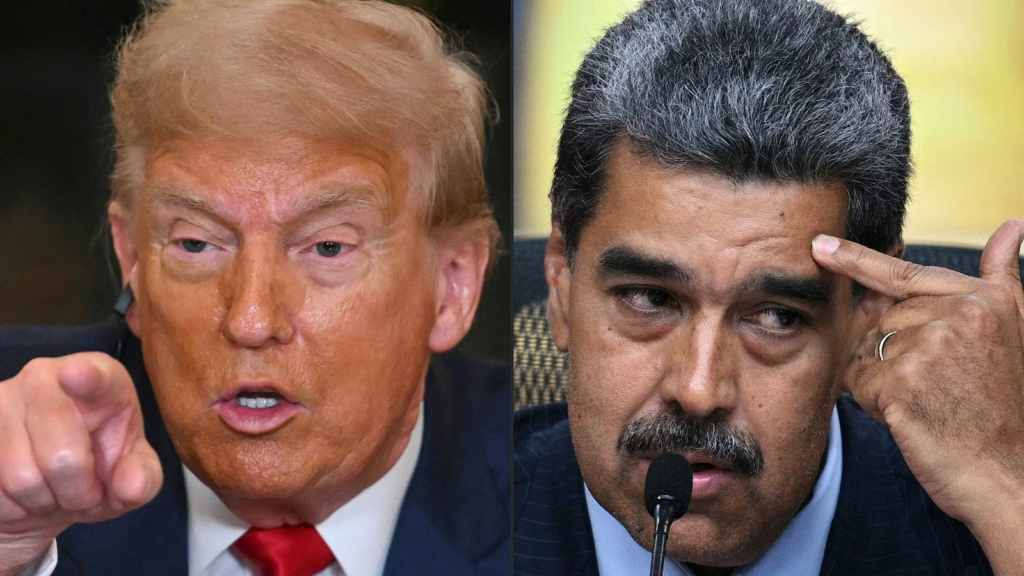
In a dramatic turn that would reshape US–Latin America relations overnight, the US military captured Nicolás Maduro during what Washington described as “large-scale” strikes in Venezuela’s capital, Caracas, on Saturday, January 3. According to reports, President Maduro and his wife, Cilia Flores, were detained by US forces and flown out of the country, ending years of failed attempts to arrest a leader long accused by US authorities of narco-terrorism.
If confirmed in full, the operation would mark one of the most consequential unilateral US actions in the Western Hemisphere in decades—both for its military audacity and its political fallout.
This article explains what reportedly happened, why Maduro had been a US target for years, how his formidable security was breached, and why this moment matters far beyond Venezuela’s borders.
What happened in Caracas during the US operation?
On Saturday, US forces carried out what officials described as coordinated, large-scale strikes in Caracas, culminating in the capture of Nicolás Maduro and Cilia Flores. The operation was reportedly executed by Delta Force, the US Army’s elite counterterrorism unit, after years of intelligence gathering and operational planning.
US President Donald Trump confirmed the capture, emphasizing the scale of preparation behind the mission.
“A lot of good planning and a lot of great, great troops and great people,” Trump said, as quoted by The New York Times.
Key reported details of the operation
- Location: Caracas, Venezuela’s heavily guarded capital
- Targets: President Nicolás Maduro and First Lady Cilia Flores
- Unit involved: Delta Force (US Army)
- Outcome: Both individuals were captured and flown out of Venezuela
- US confirmation: Public acknowledgement by President Trump
Why has the US sought Nicolás Maduro’s arrest for years?
The reported capture did not come out of the blue. US authorities have pursued Maduro for nearly a decade, framing him not just as an authoritarian leader but as a criminal figure operating at the intersection of state power and transnational crime.
US accusations against Maduro
Maduro has been accused in US courts of:
- Narco-terrorism
- Drug trafficking conspiracies
- Collusion with armed groups linked to cocaine routes into the US
In 2020, US prosecutors formally charged him, placing a bounty on his capture. That reward was later doubled to $50 million in 2025 under the Trump administration, signaling Washington’s continued prioritization of the case.
Why was Maduro considered nearly impossible to capture?
For years, analysts described Nicolás Maduro as one of the most heavily guarded leaders in the world. His survival was not accidental; it was the product of layered, militarized security designed specifically to counter assassination and capture attempts.
How Maduro’s security apparatus worked
Presidential Honour Guard (Inner Ring)
- Elite unit tasked with close personal protection
- Secured Miraflores Palace, official residences, and public appearances
- Reported directly to the presidency, bypassing standard police chains
SEBIN: Venezuela’s Intelligence Shield
The Bolivarian National Intelligence Service (SEBIN) played a central role in:
- Counter-intelligence operations
- Surveillance and threat monitoring
- Disrupting assassination plots and political threats
SEBIN has long been feared domestically for its reach and secrecy.
Military Perimeter Control
- Bolivarian National Guard (GNB) and National Bolivarian Armed Forces (FANB) controlled outer security rings
- Secured airspace, routes, and public venues
- Escorted motorcades and protected strategic infrastructure
Cuban advisers behind the scenes
Maduro also relied on Cuban security and intelligence advisers, a legacy of the Hugo Chávez era. While Caracas has never officially detailed their role, these advisers are widely believed to assist with:
- Counter-espionage
- Protective intelligence analysis
- Security protocol design
How did Delta Force reportedly succeed where others failed?
Delta Force specializes in high-value capture missions under extreme risk. According to US officials, Maduro’s arrest was the result of years of intelligence penetration and inter-agency coordination, rather than a sudden tactical opportunity.
Factors that may have enabled the capture
- Long-term intelligence mapping of Maduro’s movements
- Pattern-of-life analysis despite frequent route changes
- Coordination across military and intelligence agencies
- Exploiting a narrow operational window in Caracas
After surviving a 2018 drone attack, Maduro drastically tightened security, adding counter-drone systems, restricting airspace, and reducing public exposure. That history makes Saturday’s reported success even more striking.
Why does the capture of Nicolás Maduro matter geopolitically?
If fully substantiated, the US military capture of Nicolás Maduro would reverberate far beyond Caracas.
Regional implications
- Latin America: Raises fears of precedent-setting US intervention
- Allied governments: Forces regional leaders to recalibrate relations with Washington
- Venezuela: Creates uncertainty around governance, military loyalty, and internal stability
Global consequences
- Russia, China, Iran are likely to condemn the operation as a violation of sovereignty
- International law debates: Questions over jurisdiction, extradition, and use of force
- US foreign policy: Signals a more aggressive posture toward adversarial leaders
What happens next for Venezuela?
The immediate future remains unclear. Key questions include:
- Who controls the Venezuelan government apparatus now?
- How will the military and intelligence services respond?
- Will Maduro face trial in the United States, and on what timeline?
Markets, regional governments, and international bodies will be watching closely for signs of instability or retaliation.
Why this moment is different from past US-Venezuela clashes
Washington has previously relied on sanctions, diplomatic pressure, and indictments to isolate Maduro. A direct military capture, if confirmed, represents a sharp escalation.
It also underscores a broader message: the US is willing to act decisively when legal and intelligence efforts stall, even against deeply entrenched leaders.
That message will not be lost on other governments facing US indictments.
TL;DR
- The US military reportedly captured Nicolás Maduro in Caracas on January 3.
- The operation was carried out by Delta Force after years of planning.
- Maduro had been a US target since 2020, with a $50 million bounty by 2025.
- His capture breaks through one of the world’s most sophisticated personal security systems.
- The geopolitical fallout could reshape US relations across Latin America and beyond.