
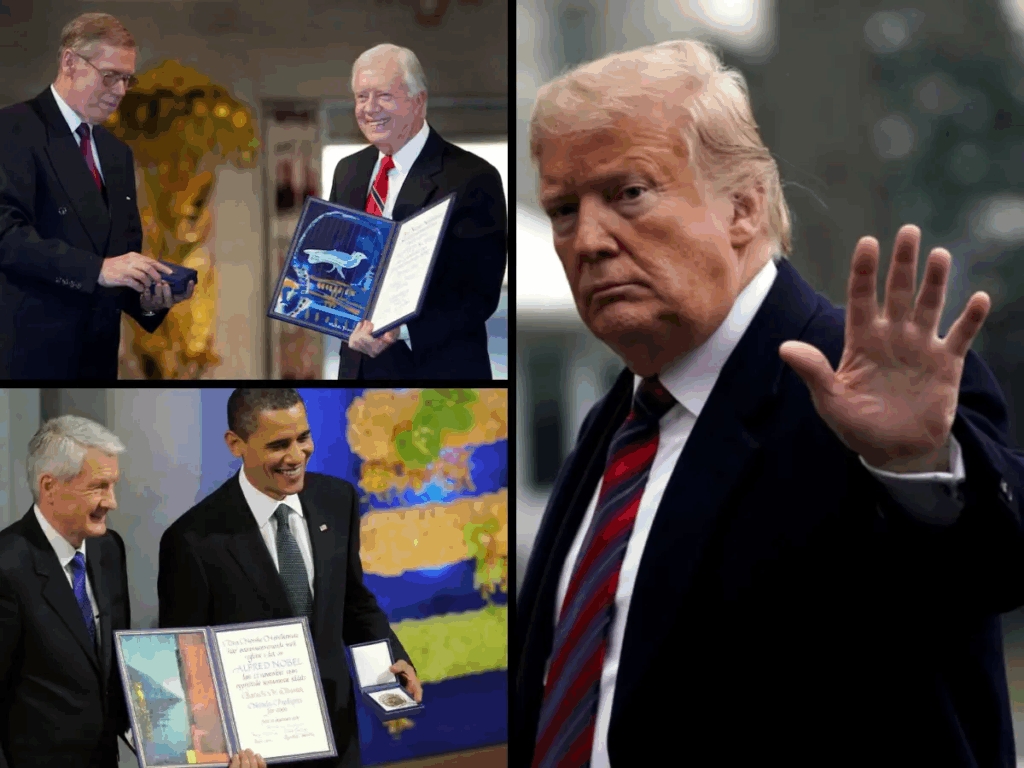
Why does Donald Trump crave the Nobel Peace Prize?
Donald Trump’s fixation with the Nobel Peace Prize has been no secret. Since 2018, he’s received multiple nominations — six in total — for his role in international diplomacy. Most recently, Republican Congressman Buddy Carter nominated Trump for brokering a ceasefire between Israel and Iran. Earlier, Pakistan put his name forward for facilitating a de-escalation between India and Pakistan.
Yet, despite these nods, the prize has eluded him. That puts him in contrast with a small and elite group of American leaders — four US presidents and one vice president, who have won the Nobel Peace Prize. Here’s a look at who they are and why they received the honor.
Which US presidents have won the Nobel Peace Prize?
1. Theodore Roosevelt (1906)
For: Mediating the end of the Russo-Japanese War
Theodore Roosevelt was the first sitting US president to be awarded the Nobel Peace Prize. He earned the honor for his successful diplomacy in ending the Russo-Japanese War (1904–1905), which concluded with the Treaty of Portsmouth. His efforts marked a significant turning point in early 20th-century global diplomacy and showcased America’s emerging role as a peace broker.
Roosevelt personally hosted Japanese and Russian diplomats in the US, actively navigating the truce behind closed doors.
2. Woodrow Wilson (1919)
For: Founding the League of Nations
As the 28th President of the United States, Woodrow Wilson received the Peace Prize for leading the charge to end World War I and helping create the League of Nations, the precursor to the modern-day United Nations. Though the US never officially joined the League, Wilson’s vision of international cooperation and collective security earned him the prize.
Wilson had already completed his second term by the time he was awarded the honor.
3. Jimmy Carter (2002)
For: Promoting peace, democracy, and development
Though long out of office, former President Jimmy Carter was recognized by the Nobel Committee for his decades of diplomacy and humanitarian work. From mediating international conflicts to promoting human rights, economic equality, and global development, Carter’s post-presidency career arguably became more influential than his White House tenure.
Quote from the Nobel Committee: He received the prize for his “untiring effort to find peaceful solutions to international conflicts.”
4. Barack Obama (2009)
For: Strengthening global diplomacy
In a controversial and much-discussed decision, the Nobel Committee awarded the 2009 Peace Prize to President Barack Obama just months into his first term. He was recognized for his “extraordinary efforts to strengthen international diplomacy and cooperation between peoples.”
Critics said it was premature, but supporters pointed to his early initiatives on nuclear disarmament, diplomatic outreach, and efforts to reboot America’s global image after years of war.
Key contributions highlighted:
- Reducing nuclear weapons proliferation
- Promoting climate diplomacy
- Engaging adversarial nations like Iran and Cuba
Which US vice president received the Nobel Peace Prize?
Al Gore (2007)
For: Environmental activism and climate change awareness
Former Vice President Al Gore shared the 2007 Nobel Peace Prize with the Intergovernmental Panel on Climate Change (IPCC). His award recognized years of advocacy around global warming, especially through his work in the documentary “An Inconvenient Truth” and his efforts to mobilize global climate policy.
The Nobel citation stated: They were honored “for their efforts to build up and disseminate greater knowledge about man-made climate change.”
So, where does Trump stand?
Despite his ongoing efforts at global diplomacy, including high-profile summits with North Korean leader Kim Jong-un, the Abraham Accords between Israel and Arab states, and ceasefire negotiations, Donald Trump has not yet received the Nobel Peace Prize.
Why hasn’t he won?
- The Nobel Committee prioritizes long-term impact and verified peace outcomes, not just negotiation attempts.
- His diplomatic moves, while headline-making, have often lacked follow-through or sustainable results.
- The politicization of nominations (especially by partisan actors) hasn’t helped his credibility with the committee.
Does Trump still have a chance?
Yes, Nobel nominations can be made posthumously or after leaders leave office. If Trump’s diplomatic interventions prove lasting and impactful over time, future committees could still consider him.
However, with his frequent criticisms of past recipients (including Obama) and his confrontational approach to international relations, Trump’s relationship with the Nobel community remains tenuous.