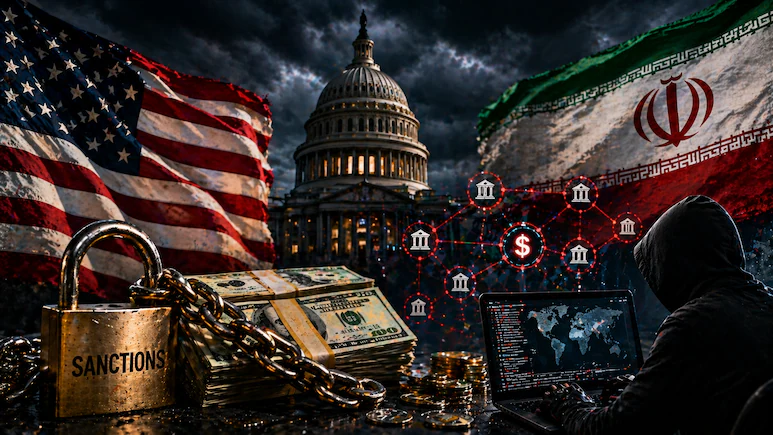
The latest round of US sanctions on Iran-linked entities signals a sharper escalation in Washington’s effort to choke off Tehran’s military supply chains. Announced by the US Treasury Department, the move targets 10 individuals and companies, some based in China and Hong Kong, accused of helping Iran procure materials for drones and ballistic missiles.
At first glance, this looks like another routine sanctions package. It isn’t. The timing, scope, and warnings of secondary penalties suggest a broader strategy with implications far beyond Iran—touching global energy flows, shipping security, and even Chinese financial networks.
What Are the Latest US Sanctions on Iran?
The US Treasury’s latest action focuses on disrupting procurement networks that support Iran’s military production—particularly its increasingly sophisticated drone and missile programs.
Who has been targeted?
The sanctions list includes companies and intermediaries spread across multiple jurisdictions:
- China-based Yushita Shanghai International Trade Co Ltd
- Hong Kong-based HK Hesin Industry Co Ltd
- Belarus-based Armory Alliance LLC
- Dubai-based Elite Energy FZCO
These entities are accused of acting as middlemen—facilitating payments, sourcing materials, or arranging logistics for Iran’s defense sector.
What are they accused of doing?
According to US officials, these firms helped Iran:
- Acquire components for Shahed drones
- Source raw materials for ballistic missile programs
- Move money through international channels to bypass restrictions
Iran’s drone program has become a central pillar of its military strategy—and a key export tool to allies and proxy groups.
How Do These Sanctions Work?
Sanctions aren’t just symbolic, they are designed to isolate entities from the global financial system.
Primary sanctions
These directly block US-based transactions and freeze any assets under US jurisdiction.
Secondary sanctions (the bigger threat)
The Treasury also issued a warning: foreign companies, even non-US ones, could face penalties if they continue doing business with sanctioned entities.
This includes:
- Banks facilitating transactions
- Airlines moving goods or personnel
- Energy firms tied to Iran’s oil trade
One key focus is China’s so-called “teapot” refineries—independent operators that have historically purchased discounted Iranian oil.
Secondary sanctions extend US influence globally, forcing foreign firms to choose between access to the US financial system or doing business with Iran.
Why Is the US Targeting Iran Now?
Timing is everything—and this move comes amid heightened geopolitical tensions in the Middle East.
Escalation in the Strait of Hormuz
Iran’s recent actions in the Strait of Hormuz, a critical chokepoint between Iran and Oman, have rattled global markets.
- Roughly 20% of global oil and LNG flows through this route
- Shipping activity has slowed dramatically
- Energy prices have surged as a result
Strategic objective
The US aims to weaken Iran’s ability to:
- Threaten commercial shipping
- Supply allied militias
- Expand its military-industrial capacity
Brett Erickson of Obsidian Risk Advisors summed it up: the goal is to limit Iran’s ability to project power regionally, particularly against shipping lanes and US allies.
Are These Sanctions Enough to Slow Iran?
Here’s where the story gets more complicated.
Iran’s production capacity is massive
Iran is not a minor player—it has scaled its defense manufacturing significantly.
- Estimated ability to produce up to 10,000 drones per month
- A well-established network of suppliers and intermediaries
- Experience operating under decades of sanctions
The “adaptation problem”
Experts argue these sanctions are too narrowly focused.
Iran has historically adapted by:
- Shifting suppliers across jurisdictions
- Using shell companies
- Leveraging informal financial networks
What’s missing?
Notably, the US has not yet targeted:
- Major Chinese banks supporting Iran-linked transactions
- Core financial infrastructure sustaining Iran’s economy
These sanctions may slow Iran, but they’re unlikely to stop it outright.
What Does This Mean for Global Energy Markets?
The ripple effects extend far beyond defense policy.
Oil prices and supply risks
Disruptions in the Strait of Hormuz can:
- Spike global oil prices
- Increase volatility in energy markets
- Strain supply chains for LNG-dependent countries
Shipping and insurance costs
With rising tensions:
- Shipping routes become riskier
- Insurance premiums surge
- Some carriers may avoid the region altogether
This creates a feedback loop—higher costs lead to higher consumer prices worldwide.
Why China Is a Key Piece of the Puzzle
A striking aspect of these sanctions is the inclusion of Chinese and Hong Kong-based entities.
China’s role
China remains one of Iran’s most important economic partners:
- Major buyer of Iranian oil
- Supplier of industrial goods
- Host to intermediaries facilitating trade
The geopolitical balancing act
By targeting Chinese-linked firms—but not major banks—the US is walking a fine line:
- Applying pressure without triggering full-scale economic conflict
- Sending a warning rather than escalating immediately
Future sanctions could expand to larger financial institutions if current measures fall short.
What Happens Next?
The next phase depends on how both Iran and global players respond.
Possible scenarios
- Expanded sanctions: Targeting broader financial networks
- Retaliation: Iran escalating activity in the Strait of Hormuz
- Workarounds: New procurement routes emerging quickly
What to watch
- Changes in oil shipping patterns
- Chinese financial sector involvement
- New entities appearing in future sanctions lists
TL;DR: Key Takeaways
- The US sanctioned 10 entities for helping Iran’s military procurement
- The focus is on drones and missile supply chains
- Secondary sanctions could impact global companies, especially in China
- Iran’s large production capacity limits the immediate impact
- Energy markets are already feeling the pressure due to Strait of Hormuz tensions