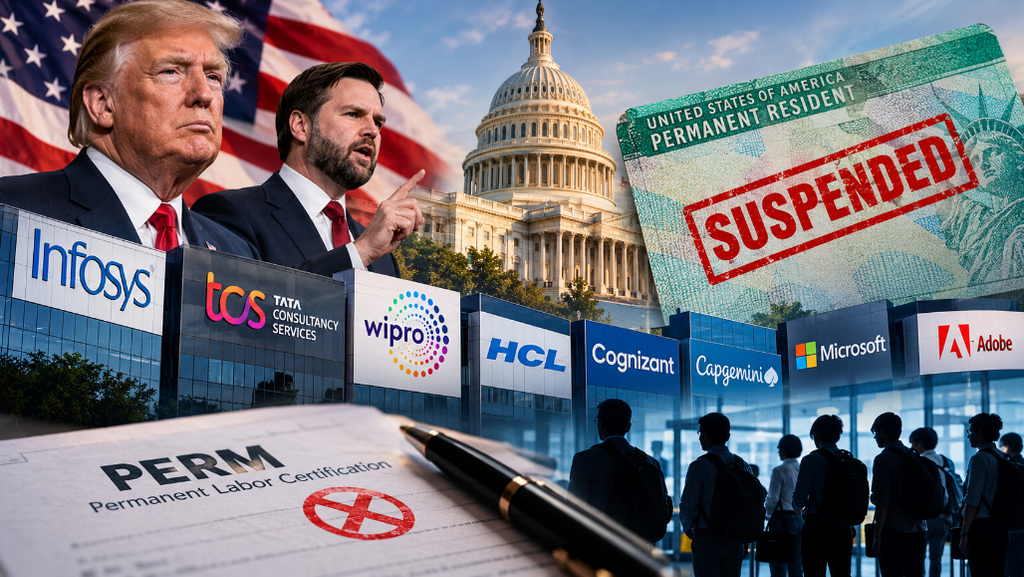
The Trump administration has suspended several major technology and IT services companies from a US programme used to sponsor foreign workers for permanent residency, escalating its crackdown on the H-1B system and employment-based immigration. The companies affected by PERM include Microsoft, Adobe, Cognizant, Infosys, Tata Consultancy Services (TCS), Wipro, HCL Technologies and Capgemini.
US Vice President JD Vance and Labor Secretary Keith Sonderling announced the action on October 8, accusing major companies of abusing the foreign-worker system and disadvantaging American employees.
The measure targets the Permanent Labour Certification, or PERM, programme. PERM is a key stage in the employment-based green card process for many foreign workers.
It is important to note that the administration has not cancelled the H-1B visas of workers employed by these companies.
Instead, the Department of Labour said it would stop accepting new or processing pending PERM labour-certification applications involving the affected companies.
The move could have major consequences for foreign workers, including thousands of Indian technology professionals who rely on employer sponsorship as they seek permanent residency in the United States.
What exactly has the US suspended?
The action concerns PERM, formerly known as the Permanent Labour Certification Program.
Under the program, an employer generally must demonstrate to the Department of Labor that there are not sufficient US workers who are able, willing, qualified and available to take a particular permanent job and that hiring the foreign worker will not adversely affect the wages and working conditions of similarly employed American workers.
Once the labor certification is approved, the employer can generally move to the next stages of an employment-based green card case, including filing an immigrant petition with US Citizenship and Immigration Services.
The Labor Department said it would suspend both new and pending PERM applications involving the named companies.
That means the immediate impact is on the permanent-residency process, not the underlying H-1B status of workers already employed by these firms.
Why is Microsoft being singled out?
Vance made Microsoft the centrepiece of the announcement.
He said an ongoing federal investigation had prompted the decision to suspend Microsoft’s participation in PERM.
“Our message to Microsoft is: You’re a great American company, but you’ve got to hire great American workers,” Vance said.
He accused Microsoft of laying off thousands of American employees while relying heavily on H-1B workers.
Vance claimed Microsoft laid off about 6,000 US workers last year while benefiting from approximately 6,300 H-1B visas and nearly 3,000 green cards.
He further argued that the company had replaced laid-off American workers with foreign employees.
Those figures and the administration’s interpretation of Microsoft’s workforce decisions are claims made by government officials. They should not be treated as an independent finding that Microsoft unlawfully replaced American workers with H-1B employees.
Microsoft had not immediately responded to requests for comment at the time of the announcement.
Which other companies are affected?
Labor Secretary Keith Sonderling said the action extends well beyond Microsoft.
The companies named by the administration include:
Cognizant
Infosys
Tata Consultancy Services
Wipro
HCL Technologies
Capgemini
Adobe
Together with Microsoft, the companies represent some of the biggest employers and technology-service providers with substantial US operations.
Several are also among the largest users of employment-based immigration programs, making the suspension particularly significant for foreign technology workers.
The administration argues that some employers have relied excessively on foreign labor while American workers have faced layoffs and wage pressure.
The companies themselves have not been found guilty of wrongdoing merely because the Labor Department suspended their PERM participation.
The stated allegations remain subject to investigation and any applicable legal proceedings.
What is PERM and why does it matter for H-1B workers?
PERM is not an H-1B visa.
H-1B is a temporary, nonimmigrant work classification that allows eligible US employers to employ foreign professionals in specialty occupations.
PERM belongs to the permanent immigration system.
For many H-1B employees, however, the two systems are connected because an employer may sponsor an H-1B worker for an employment-based green card. PERM is often an early and important part of that process.
The Labor Department’s role is to certify that the permanent hiring of a foreign worker meets the labor-market requirements.
Only after that process can the employer generally proceed with the immigrant petition and subsequent green card stages.
As a result, a suspension of PERM can create significant uncertainty for foreign employees who are already working in the United States on temporary visas and were expecting their employers to advance their permanent-residency cases.
Does this mean H-1B workers are losing their visas?
No.
The announcement does not say that the H-1B visas of employees at Microsoft, Infosys, TCS, Wipro or the other affected companies have been canceled.
The immediate restriction is on PERM labor certifications.
An H-1B worker can therefore remain in H-1B status if that status is otherwise valid and properly maintained.
The bigger problem arises for workers whose long-term immigration strategy depends on employer-sponsored permanent residency.
Delays in the green card process can become particularly consequential for employees who are approaching the maximum period generally available in H-1B status.
That does not mean every affected employee will immediately lose legal status. The consequences depend on the worker’s individual immigration history, priority date, current visa status and stage in the green card process.
Why are Indian IT workers especially concerned?
Indian professionals make up a large share of the H-1B workforce, particularly in technology and IT services.
Companies such as TCS, Infosys, Wipro, HCL and Cognizant have historically employed large numbers of Indian technology professionals in the United States.
Many workers enter the US on temporary employment visas and later depend on employer sponsorship for permanent residency.
The suspension could therefore have a disproportionate effect on Indian employees whose employers are affected and whose PERM cases have not yet been completed.
The problem is particularly sensitive because employment-based green card queues for Indian nationals can already be extremely long.
A pause in the PERM process could make the wait even more difficult for some employees.
What does the administration say the companies did wrong?
The Trump administration has framed the crackdown around alleged misuse of immigration programs and the displacement of American workers.
Sonderling said the companies had used foreign labor in ways the administration believes harmed American workers.
He also claimed that the companies targeted by the action had collectively requested permanent residency for almost 3 million foreign workers since 2009.
According to Sonderling, the firms had also received more than 230,000 H-1B visa approvals and more than 100,000 permanent labor certifications over that period.
The administration characterized those numbers as evidence of a system that has been used on a massive scale.
But the volume of applications or approvals does not itself prove fraud or illegal conduct.
PERM exists precisely to allow US employers to hire foreign workers permanently when they meet the program’s requirements. Whether individual applications involved fraud, improper recruitment or other violations is a separate legal question.
Why does the Labor Department say PERM exists?
The US Department of Labor describes PERM as a labor-market protection mechanism.
Before most employers can sponsor a foreign worker for permanent employment, they must establish that there are not enough US workers who are able, willing, qualified and available for the particular job and that employment of the foreign worker will not adversely affect the wages and working conditions of similarly employed US workers.
Employers must generally obtain a prevailing wage determination and conduct the required recruitment before filing the PERM application.
The process is designed to ensure that foreign hiring for permanent jobs does not undercut American workers.
That is why the administration is using PERM as a pressure point in its broader immigration crackdown.
Are these companies being accused of fraud?
Government officials have used strong language, including allegations of fraud and abuse.
But a suspension from the PERM program should not automatically be described as a final finding that every affected company committed fraud.
The administration says several of the companies are under active federal investigation.
Sonderling specifically linked Microsoft’s suspension to an ongoing investigation and said Microsoft and Adobe were being suspended because of multiple active federal investigations.
The companies therefore face a regulatory action amid ongoing scrutiny, rather than a final judicial determination of criminal wrongdoing.
That distinction is particularly important for employees whose immigration cases could be affected despite having no involvement in any alleged misconduct.
What about Harvard, Yale and Stanford?
The Labor Department announced a separate investigation involving nine US universities.
The institutions named include Harvard University, Yale University and Stanford University.
Labor Department Inspector General Anthony D’Esposito said subpoenas had already been issued.
The administration is investigating whether some universities may have used international students in ways that suppressed wages or otherwise harmed American workers.
Officials also said they would examine whether foreign influence, improper financial relationships or visa abuse could be compromising federally funded research.
The university investigations are separate from the suspension of the technology companies’ PERM participation, although both actions form part of the administration’s broader campaign around foreign labor and immigration programs.
Why is the Trump administration taking this action now?
The move is part of a much broader effort to reduce what the administration describes as abuse of temporary and permanent foreign-worker programs.
The Trump administration has repeatedly argued that US immigration policy should prioritize American workers and prevent employers from using foreign labor to reduce labor costs.
H-1B has become a central target of that debate.
Supporters of tighter restrictions say companies should first seek American workers for jobs and should not use visa programs to replace domestic employees.
Critics argue that highly skilled foreign professionals fill genuine shortages and that technology companies depend on international talent for engineering, research and specialized technical work.
That debate is now moving beyond the H-1B visa itself and into the permanent-residency system.
Could the suspension delay green cards?
Yes.
For affected workers whose cases depend on PERM, the suspension can prevent the next stage of the employment-based immigration process from moving forward.
The Labor Department has said no new or pending PERM labor-certification applications involving the affected companies will be processed.
That could create delays for workers who have already spent years navigating the US immigration system.
However, the exact effect will vary.
A worker with an already approved PERM certification may be in a different position from someone whose employer has only started the recruitment process or whose application remains pending.
Likewise, a worker who already has an approved I-140 or who is waiting for adjustment of status may face different consequences.
Immigration attorneys will therefore need to examine each employee’s case individually rather than treating the suspension as a blanket cancellation of all green card applications.
Could this affect workers outside the US?
Potentially, depending on the stage of their employment-based immigration case.
Workers who are still abroad and expected to immigrate through employer sponsorship could also face delays if their cases depend on a PERM filing that cannot proceed.
But again, the suspension does not mean every existing immigration petition has been canceled.
The effect depends on where the particular case sits in the immigration process.
The policy could reshape the US tech industry’s hiring model
The immediate impact is on immigration paperwork, but the longer-term consequences could extend to corporate hiring strategies.
Large technology and outsourcing firms have built business models around global workforces.
Restrictions on H-1B hiring and now PERM sponsorship could encourage companies to recruit more workers already authorized to work permanently in the United States, expand domestic training programs or shift additional work overseas.
The administration’s preferred outcome is clear: companies should hire and retain more American workers.
Whether the policy actually produces more US jobs without creating new shortages in specialized fields remains an open question.
What happens next?
For workers, the most important development will be how the Labor Department implements the suspension and how long it remains in place.
The companies could face prolonged investigations, administrative challenges or changes in the department’s position as the cases develop.
For foreign employees, the crucial question will be whether their individual PERM or green card cases are new, pending or already past the labor-certification stage.
The announcement therefore represents a major escalation, but it is not the same as shutting down the H-1B program or canceling the green cards of existing workers.
Instead, the Trump administration has targeted a key bridge between temporary employment and permanent residency.
For thousands of foreign professionals, that bridge has suddenly become much harder to cross.