
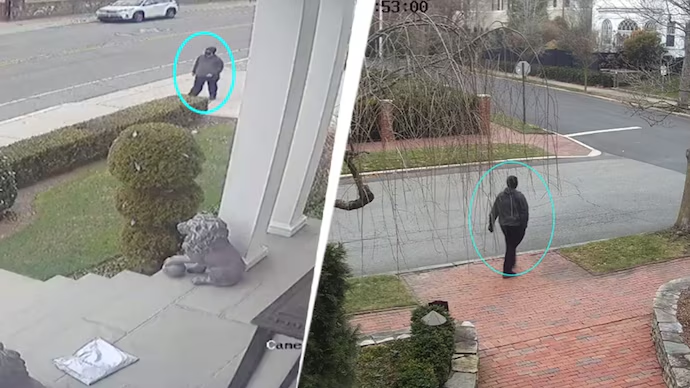
The Brown University shooting has entered a critical new phase after the FBI released a video timeline that appears to show the suspected gunman moving through nearby streets for nearly an hour before the attack. The footage, paired with a clearer image of the suspect, has intensified one central question: was the shooter surveying the campus in advance?
Two students were killed, and nine others were injured in the shooting, which unfolded near Brown’s engineering building. While investigators say the case is progressing, the new material has shifted public attention from what happened to why and how this attack was carried out.
What follows is a clear breakdown of what the FBI video shows, why investigators believe it matters, and what remains unknown as the manhunt continues.
What does the new FBI video show in the Brown University shooting?
The FBI’s newly released video stitches together surveillance clips captured across Providence on the afternoon of the shooting. According to authorities, the footage shows a single person of interest walking through multiple streets near Brown University for roughly an hour, beginning shortly after 2 p.m.
Where the suspect was seen
Investigators say the person appears repeatedly on sidewalks within a few blocks of the engineering building where the shooting occurred. The path captured on video suggests deliberate movement rather than random wandering.
Key details highlighted by law enforcement include:
- The suspect remained in the same general area for an extended period.
- The locations captured align closely with pedestrian routes around campus.
- The movement pattern ended shortly before the shooting began.
Why the footage stands out
In each clip, the suspect’s face is either masked or turned away from the camera. Even so, authorities were able to enhance portions of the footage to provide a slightly clearer look at the individual’s build and posture.
The FBI describes the suspect as stocky and approximately 5 feet 8 inches tall. Clothing appears dark and nondescript, offering few distinguishing features.
Did the shooter recce the Brown University campus?
The question of reconnaissance, often shortened to “recce,” has become central to how investigators and security experts interpret the video.
What “recce” means in an active shooter investigation
In law enforcement terms, reconnaissance refers to actions taken before an attack to learn the layout of a location, identify entrances and exits, and observe foot traffic patterns and timing.
Not all attackers conduct formal reconnaissance, but when they do, it often shows up as repeated presence near a target area before the incident.
Why are investigators asking this question?
The FBI has not confirmed that the suspect was conducting surveillance. However, the length of time captured on video and the proximity to the eventual crime scene raise legitimate investigative questions.
Factors fueling the recce theory include:
- The sustained presence near campus rather than a quick pass-through.
- Movement along multiple adjacent streets.
- Timing that places the suspect in position well before the shooting.
Security analysts caution that extended pre-attack movement can suggest planning, but it can also reflect unrelated activity. Investigators are careful not to conclude without corroborating evidence.
Why the FBI released the video now
The decision to release the footage publicly came after a significant development: a previously detained person of interest was released without charges. That reset the investigation and expanded the search.
Reigniting the manhunt
By sharing the timeline and images, the FBI is asking the public to help fill in the gaps. Officials believe someone may recognize the suspect’s clothing, gait, or movements—even if the face is unclear.
The agency has announced a reward of up to $50,000 for information leading to the identification, arrest, and conviction of the shooter.
How public tips are shaping the case
Police say they have received roughly 200 tips so far. Many involve home security cameras, doorbell footage, or business surveillance systems in the East Side of Providence.
Investigators are urging residents to review footage from Saturday afternoon, look for anyone matching the general description, and report even brief or unclear sightings.
What remains unknown about the Brown University shooting
Despite new visuals, some of the most important questions remain unanswered.
Motive is still unclear
Rhode Island Attorney General Peter Neronha has cautioned against speculation, particularly around ethnicity, politics, or culture. He has emphasized that prematurely assigning motive can distort public understanding and complicate an active investigation.
At this stage:
- No manifesto or statement has been publicly linked to the shooter.
- Authorities have not confirmed whether the attack was targeted or random.
- There is no official indication of ideological or personal motives.
Identity and connections
Authorities have not named a suspect. While online speculation has circulated about various claims, law enforcement has not endorsed those claims.
Investigators are examining whether the suspect had any prior connection to Brown University, if the individual traveled specifically to Providence for the attack, and whether anyone assisted before or after the shooting.
How campus shootings are investigated in the digital age
The Brown University shooting highlights how modern investigations rely heavily on digital breadcrumbs.
Surveillance saturation cuts both ways
Urban campuses are covered by university-owned security cameras, city traffic and street cameras, and private doorbell and business systems.
While this increases the chance of capturing suspects, it also creates massive volumes of data. Investigators must carefully sequence footage to reconstruct timelines without missing critical details.
Why can clearer images take time?
Enhanced video does not guarantee instant clarity. Factors like lighting, camera angle, frame rate, and motion blur limit what technology can realistically reveal.
This is why faces may remain obscured even after enhancement, body language and movement patterns become key identifiers, and public recognition often matters as much as technical analysis.
Why this case matters beyond Brown University
The implications of this investigation extend well past Providence.
Campus security under scrutiny again
Universities across the U.S. are watching closely, particularly around perimeter monitoring in open campuses, coordination between campus police and federal agencies, and how quickly suspicious pre-incident behavior can be flagged.
The balance between transparency and caution
By releasing partial footage, the FBI is walking a fine line. Too little information can stall tips, while too much can fuel misinformation.
This case illustrates how law enforcement increasingly depends on public cooperation while also asking the public to resist speculation.
TL;DR
- The FBI released a new video timeline in the Brown University shooting, showing a person of interest near campus for about an hour before the attack.
- The footage has raised questions about whether the shooter conducted reconnaissance.
- Two students were killed and nine were injured; no suspect has been identified.
- Authorities are offering a $50,000 reward and urging the public to review security footage.
- Motive remains unknown, and officials caution against speculation.