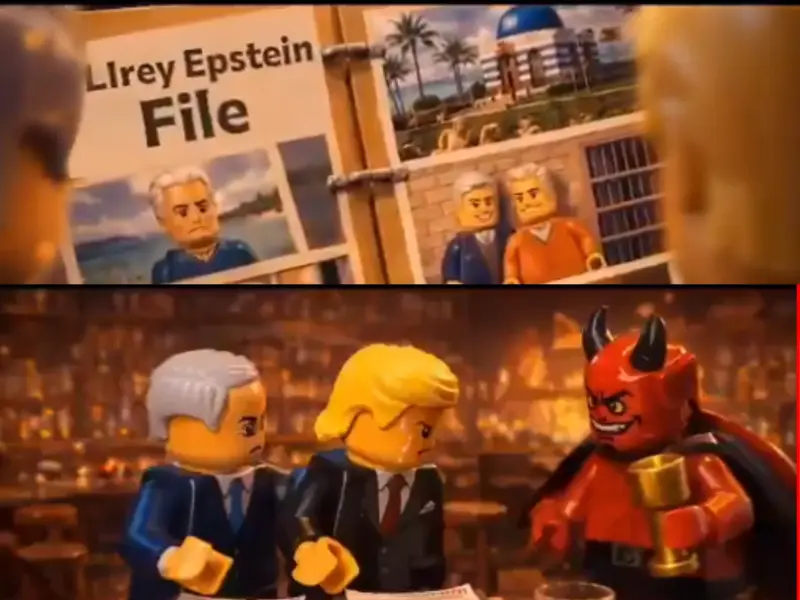
A LEGO-style animated video circulating on social media is drawing attention for its provocative claim that US President Donald Trump launched the war with Iran to distract from the Epstein files.
The video, reportedly linked to Iranian-affiliated media outlets, uses a visual style similar to the popular LEGO Movie franchise. Through animation and symbolic storytelling, it portrays the conflict as a deliberate distraction from political scandal while highlighting civilian casualties from alleged US-Israeli strikes.
The clip has spread widely online, becoming one of the latest examples of digital propaganda tied to the ongoing conflict between the United States and Iran.
What does the LEGO-style video show?
The animated clip opens with a fictional scene showing Donald Trump alongside Israeli Prime Minister Benjamin Netanyahu reviewing documents labeled “Epstein Files.”
In the video’s narrative, Trump appears angry after reading the files and launches a missile toward Iran. The scene is meant to suggest that the US president initiated the conflict to divert attention from the Jeffrey Epstein scandal.
The animation then shifts to scenes depicting large-scale military strikes on Iranian territory.
According to the storyline presented in the video, US-Israeli attacks hit a school in the Iranian city of Minab.
The video claims the strikes killed 168 students and staff at Shajarah Tayyebeh Elementary School on the first day of the conflict.
No independent verification of this claim has been publicly confirmed, and the video presents the events through a clearly political narrative.
How the video portrays the war’s escalation
After depicting the alleged school strike, the animation moves into scenes of retaliation by Iran.
In the clip, missiles are shown striking British military bases in Cyprus. Other scenes portray fighter jets crashing, civilians running through city streets, and explosions in major urban areas.
One segment shows a missile hitting the Burj Al Arab hotel in Dubai, symbolizing the regional spread of the conflict.
The video also includes a sequence in which an Iranian military commander appears to plan missile strikes on Tel Aviv while launch crews prepare rockets.
Why propaganda videos are common during wars
Animated videos and cinematic storytelling have become increasingly common tools of wartime propaganda.
Governments and affiliated media groups often produce such content to shape public perception both domestically and internationally.
Digital propaganda can serve several purposes:
- Reinforce national narratives about the conflict
- Influence global public opinion
- Undermine the credibility of rival governments
- Generate viral social media engagement
In recent years, animated formats have proven particularly effective online because they are easy to share and can present complex narratives in simplified visual form.
The use of a LEGO-like aesthetic may also help the video stand out on social media feeds, increasing the likelihood that users will watch and share it.
Similar propaganda videos in past Iran conflicts
This is not the first time stylized animated videos have been used during confrontations involving Iran.
Similar clips circulated during previous periods of tension between Iran and Western countries.
These included:
- Videos released after US strikes on Iranian nuclear facilities last year
- Animated content during a brief 12-day conflict between Iran and Israel
- Social media clips portraying regional retaliation scenarios
Such content often blends real geopolitical events with fictional or exaggerated elements designed to support a particular narrative.
What is the current status of the US–Iran war?
The broader conflict referenced in the video began on February 28 following a major missile attack on a compound linked to Iran’s leadership.
According to reports, the strike hit the palace compound associated with Iran’s Supreme Leader Ayatollah Ali Khamenei. Iranian sources claimed the attack killed him, though details remain disputed and information has been tightly controlled.
Since then, the conflict between the United States and Iran has escalated with missile exchanges and military activity across parts of the Middle East.
US officials have suggested the fighting could end soon.
Donald Trump initially estimated the conflict might last four to five weeks but more recently said the war was “almost over.”
Iranian officials, however, have projected a far longer timeline.
Tehran has claimed it possesses enough weapons and resources to continue the conflict for up to a decade.
Trump, in contrast, has argued that Iran’s military arsenal is nearly exhausted.
Why misinformation spreads quickly during conflicts
Experts say wartime environments often create ideal conditions for misinformation and propaganda to spread.
Several factors contribute to this:
- Limited access to verified information from conflict zones
- Competing narratives from governments and military forces
- Rapid sharing of content on platforms such as X, TikTok, and Telegram
Visual storytelling formats like animation can amplify these effects because viewers may interpret dramatic imagery as factual reporting.
Researchers studying information warfare warn that distinguishing between verified reports and propaganda becomes increasingly difficult during active conflicts.
TL;DR
- A LEGO-style animated video linked to Iranian-affiliated media is circulating online.
- The video claims Donald Trump started the war with Iran to distract from the Epstein files.
- It depicts US-Israeli strikes on an Iranian school and shows Iran retaliating across the region.
- The animation appears to be part of a broader digital propaganda effort tied to the ongoing US–Iran conflict.
- Officials from both sides continue to give conflicting assessments about how long the war will last.