
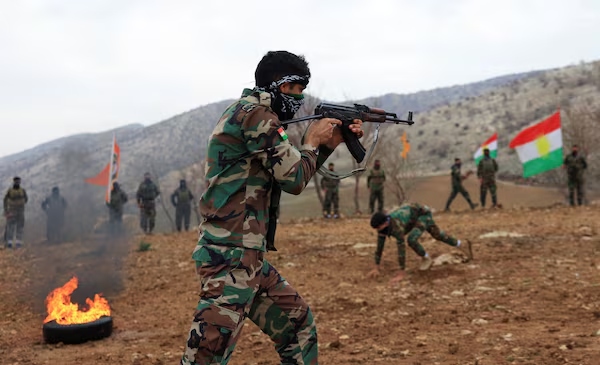
U.S. President Donald Trump has signalled support for a potential offensive by Iranian Kurdish fighters as the conflict between the United States, Israel, and Iran escalates. In an interview with Reuters, Trump said he would welcome Kurdish involvement in the war against Tehran, describing the idea as “wonderful,” though he stopped short of confirming whether the U.S. would provide air support.
The comments have renewed global attention on the Kurds, one of the largest ethnic groups in the world without a nation-state. Kurdish communities live across several Middle Eastern countries, including Iran, where Kurdish militant groups have long clashed with the government in Tehran.
Here’s what to know about the Kurds, their history, and why they could become a factor in the evolving conflict with Iran.
Who Are the Kurds?
The Kurds are an ethnic group native to the mountainous regions of the Middle East. Today, Kurdish populations are primarily spread across:
- Turkey
- Iran
- Iraq
- Syria
- Smaller communities in Armenia and the diaspora worldwide
Estimates place the Kurdish population between 30 million and 40 million people, making them one of the largest stateless ethnic groups in the world.
Most Kurds speak Kurdish languages belonging to the Iranian branch of the Indo-European language family, and many practice Sunni Islam, though there is religious diversity within Kurdish communities.
Despite their large population and shared cultural identity, the Kurds have never achieved a fully recognized independent state.
How the Kurds Became a Stateless Nation
The modern Kurdish political question largely emerged after the collapse of World War I and the breakup of the Ottoman Empire.
Following the war, Western powers briefly proposed the creation of a Kurdish state. But geopolitical changes—including the success of the Turkish independence movement—derailed the plan.
The result: Kurdish lands are divided
Instead of forming a country, the Kurdish territories were divided among newly established states:
- Turkey
- Iran
- Iraq
- Syria
The borders left Kurdish communities scattered across multiple countries, often under governments that viewed Kurdish nationalism as a threat.
Over the next century, Kurdish movements seeking autonomy, cultural rights, or independence faced varying degrees of repression across the region.
Kurdish History Inside Iran
Kurds make up a significant minority in Iran.
According to UK government estimates, Kurdish communities account for approximately 8%-17% of Iran’s population. Most live in western provinces along the border with Iraq.
The Republic of Mahabad
One of the most important moments in Kurdish history in Iran came in 1946, when Kurdish leaders briefly established the Republic of Mahabad.
The Soviet-backed state lasted less than a year before Iranian forces under the Shah dismantled it.
Although short-lived, Mahabad remains a powerful symbol of Kurdish aspirations for self-rule.
Armed resistance and political activism
In the decades since, several Iranian Kurdish groups have fought or organised politically against the government in Tehran. Many of these groups operate from bases near the Iran–Iraq border.
The Kurdish regions have also been a focal point of protest movements in recent years.
The Mahsa Amini Protests and Kurdish Regions
Kurdish areas in Iran gained global attention during the 2022 nationwide protests triggered by the death of Mahsa Amini, a 22-year-old Iranian Kurdish woman who died in custody after being detained by Iran’s morality police.
Her death sparked widespread demonstrations against the Iranian government.
Many of the largest protests occurred in Kurdish-majority cities, which have historically had tense relations with Tehran.
The Kurdish regions again saw unrest during anti-government protests in late 2025, reinforcing their role as a political flashpoint.
Why Donald Trump Wants Kurdish Fighters in the Iran War
Trump’s comments come amid reports that U.S. intelligence agencies are exploring ways to support Kurdish opposition groups inside Iran.
Sources familiar with the plan told CNN that the Central Intelligence Agency may be working to arm Iranian Kurdish fighters in hopes of triggering a broader uprising.
The strategic goal
The idea behind supporting Kurdish forces is not necessarily that they would defeat Iran’s military directly.
Instead, analysts say the strategy could:
- Force Iranian forces to divert troops to border regions
- Stretch the country’s military resources across multiple fronts
- Encourage other ethnic groups inside Iran to launch parallel uprisings
If successful, the approach could weaken Tehran’s ability to focus on external conflicts.
Why Iraqi Kurdistan Is Critical to the Plan
Any attempt to support Iranian Kurdish fighters would likely depend on logistics through Iraqi Kurdistan, the semi-autonomous Kurdish region in northern Iraq.
Weapons and fighters would likely need to move through Kurdish-controlled territory before entering Iran.
However, officials in the Kurdistan Regional Government have denied involvement in any such plan, calling reports about a coordinated operation “completely unfounded.”
Their reluctance reflects the region’s delicate political position between major powers.
Iran’s Response: Strikes on Kurdish Targets
Iran has already begun targeting Kurdish groups in response to rising tensions.
According to reports cited by Al Jazeera, Iranian missiles struck Sulaymaniyah in Iraqi Kurdistan during recent military operations.
Tehran has long accused Kurdish militant groups of operating across the border to destabilise the country.
These strikes suggest Iran is preparing to confront any potential Kurdish uprising before it escalates.
The Turkey Problem: A Major Obstacle
One of the biggest complications for U.S. support of Kurdish fighters is Turkey.
Ankara has spent decades fighting the Kurdistan Workers’ Party (PKK), which it considers a terrorist organization.
The PKK announced a ceasefire in March 2025, but tensions remain high.
Any U.S. cooperation with Kurdish militias could strain relations with Turkey, a key NATO ally.
For Ankara, increased Kurdish military activity anywhere in the region is viewed as a direct security threat.
Why Kurdish Groups Are Wary of U.S. Support
History has made Kurdish leaders cautious about relying on foreign powers.
The United States has previously supported Kurdish forces in conflicts in Iraq and Syria, particularly during the fight against ISIS.
But in several cases, U.S. backing has been scaled back or withdrawn after political shifts, leaving Kurdish allies vulnerable.
Because of that history, some Kurdish groups remain sceptical about becoming deeply involved in another U.S.-backed conflict.
Could Kurdish Fighters Actually Change the War?
Analysts say Kurdish militias could realistically capture and hold territory in Kurdish-majority areas inside Iran.
But most experts doubt they could advance far beyond the border regions without significant outside support.
Still, even a limited insurgency could:
- Tie down Iranian troops
- Create internal instability
- Increase pressure on the Iranian government during wartime
Whether such a strategy would produce lasting change—or simply widen the conflict—remains uncertain.
TL;DR
- Donald Trump has expressed support for Iranian Kurdish fighters joining the war against Tehran.
- The Kurds are a stateless ethnic group of 30–40 million people spread across Turkey, Iran, Iraq, and Syria.
- Kurdish regions in Iran have a history of unrest and political activism.
- U.S. intelligence is reportedly considering support for Kurdish militias to pressure Iran from within.
- Major obstacles include Turkey’s opposition, Kurdish scepticism toward U.S. support, and the risk of wider regional escalation.