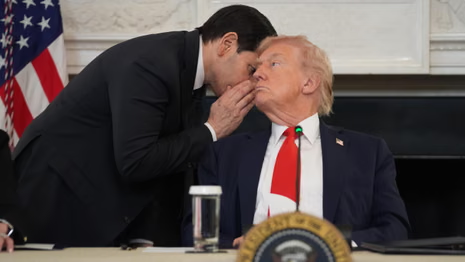
The handwritten note that started it all
When a photo emerged from the White House showing Secretary of State Marco Rubio passing a handwritten note to President Donald Trump, it immediately set off speculation online. The moment, captured during an October 8 roundtable on Antifa, revealed a rare glimpse into how major policy announcements may originate behind closed doors.
The note, written on White House stationery, read, “You need to approve a Truth Social post soon so you can announce the deal first.” It referred to a pending Middle East peace agreement, urging Trump to announce before anyone else could.
Minutes later, Donald Trump addressed the room: “I was just given a note by the Secretary of State saying that we’re very close to a deal on the Middle East, and they’re gonna need me pretty quickly.” Within hours, a carefully worded Truth Social post followed, declaring that Israel and Hamas had agreed to the first phase of a peace plan.
What the Rubio note reveals about Donald Trump’s online communication
This small exchange sheds light on a larger pattern: Donald Trump’s Truth Social feed, often seen as spontaneous or impulsive, is more strategic than many realize. Behind the late-night rants and fiery one-liners, there’s a structured system that blends personal voice with political coordination.
The Rubio note suggests that Trump’s posts aren’t always off-the-cuff reactions but sometimes part of real-time diplomatic choreography. Timing, language, and tone are often designed to frame breaking developments before official statements reach mainstream media.
Who actually crafts Trump’s Truth Social messages?
Though Trump’s posts are written in his recognizable voice — capital letters, repetition, and flair — several insiders reportedly assist in drafting key updates.
- Natalie Harp, a former Office of the President staffer, has been reported to manage or schedule Trump’s posts during sensitive hours, ensuring alignment with official messaging.
- Stephen Miller, now White House Deputy Chief of Staff, is said to help refine posts related to policy or immigration, ensuring consistency with administration goals.
- Meredith McIver, who ghostwrote several Trump Organization books, has long been credited for polishing Trump’s rhetoric for public release.
The collaborative approach allows the team to maintain Trump’s distinct tone while ensuring factual accuracy and timing — especially on issues of national or international significance.
The strategy behind “authentic chaos”
Trump’s digital persona thrives on unpredictability, yet his communications are often as calculated as a campaign rollout. Political strategists have long argued that Trump uses his online presence not merely as a platform but as a stage.
By controlling timing and tone, the administration can dominate the news cycle, forcing both allies and critics to respond on its terms. The Rubio note highlights this mechanism in action: a rapid pivot from private diplomacy to a public declaration framed entirely within Trump’s narrative.
Why this approach works
- Speed and control: Truth Social gives Donald Trump direct access to millions, bypassing traditional media filters.
- Message uniformity: With staff support, posts stay consistent with broader policy goals.
- Narrative dominance: Announcing developments first lets the White House frame global events before other governments or networks do.
Behind-the-scenes coordination in the Trump administration
The Rubio episode underscores how tightly integrated the president’s communications team is with foreign policy moves. Jared Kushner and real estate developer Steve Witkoff were reportedly consulted before the Middle East post went live, indicating a blend of diplomatic and personal networks influencing timing.
This coordination mirrors earlier White House dynamics, where communications staffers, advisors, and family members helped craft tweets and statements. In Trump’s second term, the structure appears more formalized, blending spontaneity with strategic approval.
Why it matters
The incident highlights the blurred line between diplomacy and digital performance. Donald Trump’s Truth Social presence is not just a window into his thoughts; it’s a lever of political and geopolitical power.
In an age where a single post can move markets or shift diplomatic tone, understanding who writes and approves these messages becomes essential to decoding American foreign policy.
The Rubio note also raises broader questions: how much of presidential communication is authentic expression, and how much is deliberate narrative construction?
The evolution of presidential communication
From Franklin Roosevelt’s radio “fireside chats” to Barack Obama’s use of YouTube and Twitter, presidents have always adapted to new media. Trump’s Truth Social represents the next phase — an era where leaders communicate directly, instantly, and often without intermediaries.
However, as this latest episode shows, even the most direct communication still involves strategy, structure, and a team of writers ensuring that “authentic” moments land exactly as intended.
TL;DR
A leaked photo showing Marco Rubio handing Donald Trump a handwritten note during a White House event has revealed the calculated nature of Trump’s Truth Social activity. While his posts may appear spontaneous, insiders confirm that key messages — particularly those on diplomacy — are coordinated and crafted by a close circle of aides and former staffers. The incident underscores how Trump’s online communication doubles as both messaging and diplomacy in real time.