
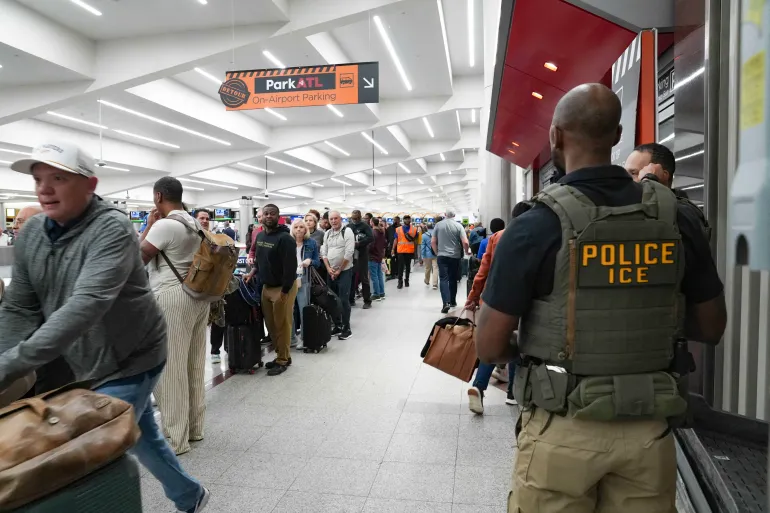
The Trump administration’s decision to deploy Immigration and Customs Enforcement (ICE) agents to major U.S. airports isn’t about immigration enforcement—it’s about keeping airport security functioning during a prolonged government shutdown.
With the Department of Homeland Security (DHS) partially shut down for weeks, the move reflects a stopgap response to a growing operational problem inside the nation’s busiest airports.
What Triggered the Deployment of ICE Agents?
The immediate cause is a staffing crisis at the Transportation Security Administration (TSA), which is responsible for screening passengers and securing airport checkpoints.
TSA Workforce Strained by Shutdown
- The DHS shutdown has entered its fifth week, leaving many TSA workers unpaid
- Absenteeism has surged, with over 9% of TSA staff missing shifts
- At some major airports (Houston, New York, Atlanta), more than one-third of workers were absent
This has led to:
- Long security lines
- Flight delays and missed connections
- Increased pressure on remaining TSA staff
TSA is a critical frontline security agency. Even small staffing disruptions can cascade into nationwide travel delays and security concerns.
What Will ICE Agents Actually Do at Airports?
Despite initial concerns, ICE agents are not replacing TSA officers. Their role is limited and supportive.
Assigned Responsibilities
ICE personnel are expected to:
- Help manage passenger queues and crowd control
- Check IDs at certain checkpoints
- Monitor exit lanes to prevent unauthorized entry
- Assist with general airport flow and logistics
What They Will NOT Do
- Operate X-ray machines
- Conduct full security screenings
- Replace trained TSA officers
Tom Homan, overseeing the initiative, made it clear: ICE agents are not trained for technical screening tasks and will not take on those responsibilities.
The distinction is crucial. Airport security screening requires specialized training—this move is about easing bottlenecks, not redefining security roles.
How Widespread Is the Deployment?
The rollout is starting with a limited footprint but could expand.
Initial Plan
- Deployment begins at around 14 airports
- Focus on high-traffic hubs experiencing the worst staffing shortages
- Scope may increase depending on conditions
Local authorities, such as Atlanta’s mayor, have confirmed that ICE agents will operate under TSA supervision, not independently.
Why Is the DHS Shutdown Affecting Airports So Severely?
Airport security is uniquely vulnerable during a government shutdown.
TSA’s Essential Worker Status
- TSA officers are classified as essential workers
- They must continue working without pay during shutdowns
- Over time, financial strain leads to higher absenteeism
The Ripple Effect
- Fewer staff → longer lines
- Longer lines → passenger frustration
- Operational stress → increased security risks
Unlike many federal functions, airport security cannot pause. That makes staffing shortages particularly disruptive.
What’s the Political Context Behind the Shutdown?
The root cause of the crisis lies in a political standoff in Washington.
Key Points of Dispute
- Republicans want continued funding without major changes
- Democrats are pushing for reforms to immigration enforcement policies
- Funding bills have stalled, triggering the shutdown
Signs of Possible Compromise
- Democratic leadership has indicated willingness to prioritize TSA pay
- Negotiations are ongoing, but no resolution has been finalized
How Are Unions and Politicians Reacting?
The decision to deploy ICE agents has drawn mixed—and often critical—responses.
Union Opposition
The American Federation of Government Employees (AFGE) argues:
- The focus should be on paying TSA workers, not supplementing them
- TSA officers are trained professionals who shouldn’t be indirectly replaced
Union leadership emphasized that workers continue to show up despite financial hardship.
Political Reactions
- Some Republicans have called the move a “bad idea”, citing potential risks
- Others in the administration argue it will reduce chaobs at airports
Transportation officials maintain that the goal is to stabilize travel conditions, not alter security protocols.
The debate reflects a broader question—should operational fixes come before resolving underlying political issues?
Does This Raise Security Concerns?
The deployment walks a fine line between operational support and perceived risk.
Potential Concerns
- ICE agents lack specialized TSA training
- Public confusion about roles could arise
- Overreliance on stopgap measures may mask deeper issues
Mitigating Factors
- ICE agents are not handling screening technology
- They operate under TSA supervision
- Their tasks are limited to support functions
Security experts often stress that even small deviations in protocol can have outsized consequences—making clarity of roles essential.
What Happens Next?
The future of this policy depends largely on how long the shutdown continues.
Short-Term Outlook
- ICE deployment may expand if absenteeism worsens
- Airport delays could persist without staffing recovery
Long-Term Scenarios
- Shutdown ends: TSA staffing stabilizes, ICE role winds down
- Shutdown continues: More agencies may be pulled in to assist
- Policy shift: Greater investment in contingency staffing plans
TL;DR
- ICE agents are being deployed to airports due to TSA staffing shortages during a DHS shutdown
- They will assist with logistics—not perform security screenings
- The move is a temporary fix to manage long lines and delays
- Unions and some politicians oppose the plan, arguing workers should be paid instead
- The situation hinges on resolving the broader political standoff in Washington