
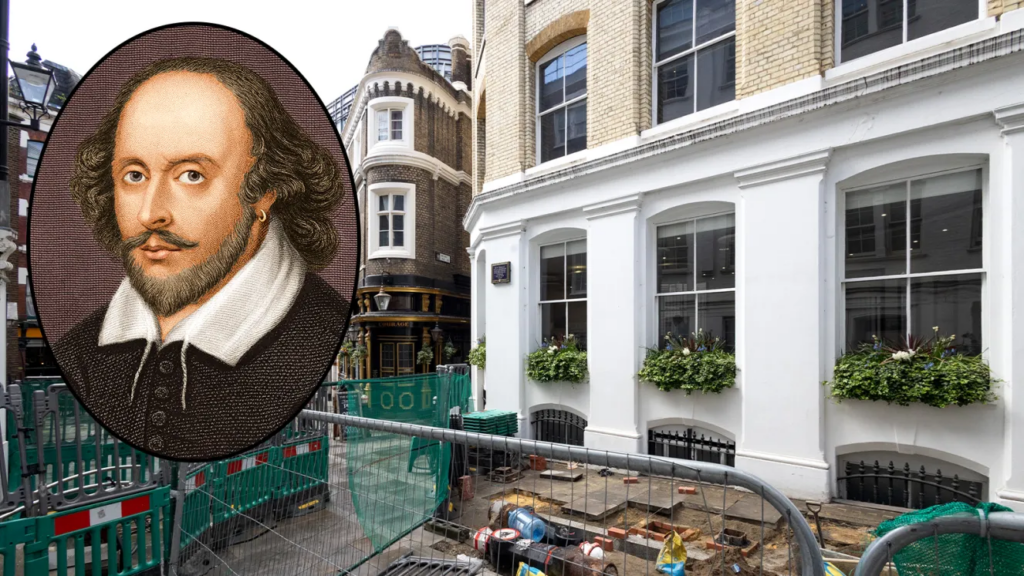
A recent archival breakthrough in London has, for the first time, identified the exact location and layout of William Shakespeare’s long-debated city residence. The discovery adds fresh detail to the playwright’s life in his final years—and challenges the long-held idea that he retreated from London after 1613.
Uncovered by Lucy Munro at the London Archives, the findings offer something historians have lacked for centuries: a concrete picture of where Shakespeare lived, how his home was structured, and what that says about his life at the height of his career.
Where Exactly Was Shakespeare’s London Home?
The newly identified property sits in the historic Blackfriars district—an area already associated with Shakespeare but never precisely mapped in terms of his residence.
A closer look at the location
- Near the former Blackfriars Gatehouse
- Within walking distance of the Globe Theatre
- Close to local landmarks like the Sign of the Cock Tavern
This wasn’t just a convenient address, it placed Shakespeare at the center of London’s theatrical and social life.
Why it matters:
Previous assumptions placed his home somewhere “near” Blackfriars. Now, historians can pinpoint its exact footprint, transforming vague geography into a tangible reality.
What Did Shakespeare’s House Look Like?
One of the most compelling aspects of the discovery is the detailed layout of the home.
Key architectural features
- An L-shaped structure
- Part of the house extended over the gatehouse
- Large enough to be divided into two separate residences
Munro describes it as “not huge, but relatively substantial”—suggesting a comfortable, middle-to-upper-class urban home.
What this tells us
This wasn’t a modest lodging or temporary stay. It was:
- A significant property investment
- A functional living space, possibly shared or rented
- Evidence of Shakespeare’s financial stability and social standing
What Does This Reveal About Shakespeare’s Later Years?
The timing of the purchase—1613—is crucial.
That same year, the Globe Theatre famously burned down during a performance. For years, many scholars believed this marked the beginning of Shakespeare’s withdrawal from London life.
The new evidence suggests otherwise
- Shakespeare bought property in London the same year
- He remained deeply connected to the theater scene
- He continued writing and collaborating
Notably, he worked with John Fletcher on The Two Noble Kinsmen after the Globe fire.
Takeaway:
Rather than retiring, Shakespeare appears to have stayed professionally active—and physically present—in London.
Was the Property an Investment or a Statement?
Another long-standing theory suggests Shakespeare bought the Blackfriars property purely as an investment.
Munro’s findings complicate that narrative.
Why this may not have been just about money
- Blackfriars was a prestigious but evolving neighbourhood
- There were cheaper investment opportunities elsewhere
- Its proximity to the theatre district suggests intentional placement
Munro argues that the location—less than a five-minute walk from the Globe—points to continued engagement with his work.
The social context of Blackfriars
At the time:
- The area housed gentry and elite residents
- It was becoming increasingly socially mixed
- It sat at the intersection of commerce, culture, and performance
This blend made it an ideal location for someone like Shakespeare—both a businessman and an artist.
How Does This Change Our Understanding of Shakespeare?
For generations, Shakespeare has often been portrayed as a solitary genius who withdrew to Stratford-upon-Avon later in life.
This discovery paints a very different picture.
A more dynamic portrait emerges
Shakespeare was:
- A collaborator, not an isolated writer
- A shareholder in theaters, not just a playwright
- A property owner in London, actively managing his affairs
As Will Tosh put it, the findings offer a “dazzling new sense of Shakespeare the London writer.”
Why this matters today
Understanding where and how Shakespeare lived helps us:
- Contextualize his late works
- Better grasp the economics of early modern theater
- Humanize a figure often treated as mythic
Why Archival Discoveries Like This Still Matter
It’s easy to assume that everything about Shakespeare has already been uncovered. This discovery proves otherwise.
What made this possible?
- Careful examination of historical property records
- Cross-referencing maps, legal documents, and local archives
- A focus on micro-histories—the overlooked details of daily life
The broader impact
Findings like this:
- Refine historical narratives
- Challenge outdated assumptions
- Open new avenues for research
TL;DR
- Shakespeare’s exact London home location has been identified for the first time
- The house was L-shaped, substantial, and partly built over a gatehouse
- It was located in Blackfriars, near the Globe Theatre
- The discovery challenges the idea that Shakespeare retired in 1613
- It reveals a more active, engaged, and business-savvy figure