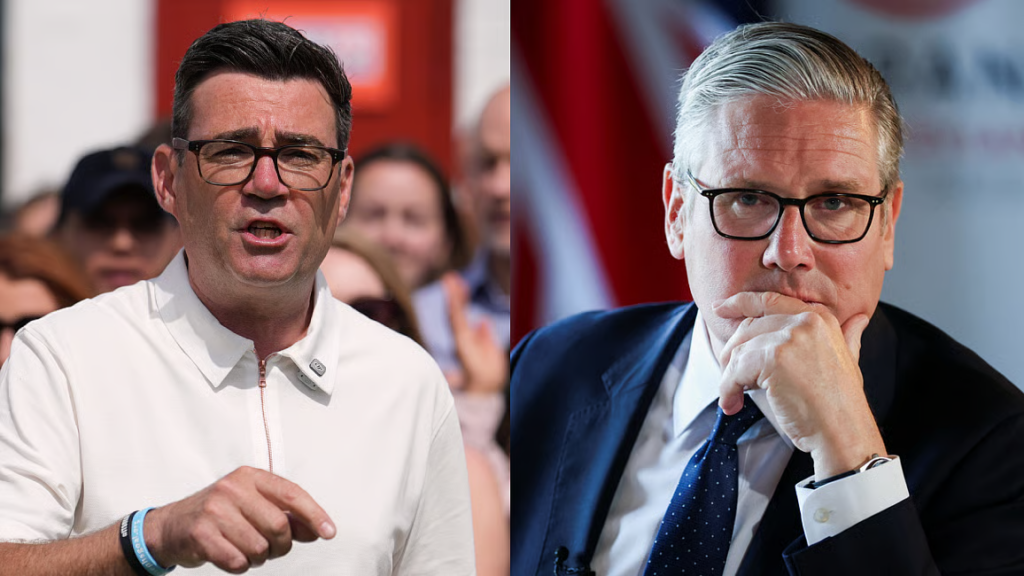
Andy Burnham has emerged as the leading contender to become the United Kingdom’s next prime minister following reports that Prime Minister Keir Starmer has resigned after mounting pressure from within the Labour Party. Burnham’s return to Parliament through the Makerfield by-election has reignited speculation about his national leadership ambitions and positioned him as the frontrunner to lead both Labour and the country.
Known as the “King of the North,” Burnham has built his political reputation by championing regional devolution, public transport reforms, and policies aimed at reducing inequality outside London. His popularity in northern England, coupled with years of ministerial experience, has made him one of Labour’s most recognizable figures.
If he succeeds Starmer, Burnham would complete one of the most remarkable political comebacks in recent British politics.
Who is Andy Burnham?
Andy Burnham is a senior Labour politician with more than two decades of experience in British politics.
Born in Merseyside in 1970, Burnham entered Parliament in 2001 as the Member of Parliament for Leigh. During the Labour governments led by Tony Blair and Gordon Brown, he held several Cabinet positions, including Secretary of State for Health, Secretary of State for Culture, Media and Sport, and Chief Secretary to the Treasury.
His experience across multiple departments established him as one of Labour’s most senior political figures before he shifted his focus to regional government.
Why is Andy Burnham called the ‘King of the North’?
Burnham earned the nickname because of his strong advocacy for northern England.
After becoming the first elected Mayor of Greater Manchester in 2017, he consistently argued that regions outside London deserved greater political powers, increased investment, and more control over transport, housing, and public services.
His willingness to challenge successive governments in Westminster over funding and regional inequality strengthened his reputation as the political voice of northern England.
Supporters view him as a champion of local communities, while critics argue his approach occasionally brought him into conflict with the national Labour leadership.
What did Andy Burnham achieve as Greater Manchester mayor?
Burnham served three terms as Metro Mayor after winning elections in 2017, 2021, and 2024.
His tenure focused on expanding local control over essential public services.
Bringing buses back under public control
One of Burnham’s most significant reforms was franchising Greater Manchester’s bus network, ending decades of fully deregulated private operation and giving local authorities greater oversight of routes, fares, and service quality.
The move was widely viewed as one of the biggest transport reforms outside London.
Tackling homelessness
Burnham also launched the “A Bed Every Night” initiative, providing emergency accommodation for people experiencing homelessness.
He donated a significant portion of his mayoral salary to homelessness charities and made housing insecurity one of his administration’s central priorities.
Regional devolution
Throughout his time as mayor, Burnham campaigned for additional powers to be transferred from Westminster to local governments, arguing that cities should have greater authority over transportation, policing, health services, and economic development.
Why did Burnham return to Parliament?
According to reports, Burnham resigned as Greater Manchester mayor to contest the Makerfield by-election after serving nearly a decade in regional government.
Because the positions of Metro Mayor and Member of Parliament cannot be held simultaneously, returning to Westminster required him to leave City Hall.
His reported victory in Makerfield marked his return to the House of Commons after almost nine years away from national politics.
The result immediately fueled speculation that he could challenge for Labour’s leadership.
Why is Burnham considered the favorite to become prime minister?
Several factors have strengthened Burnham’s political standing.
Strong electoral appeal
Burnham has consistently performed well in elections, particularly across northern England, where Labour has faced increasing competition in recent years.
Executive experience
Unlike many MPs, Burnham has extensive experience managing a major metropolitan authority, overseeing transport, policing, housing, and regional economic policy.
Broad popularity
His emphasis on public services and regional investment has earned support beyond Labour’s traditional voter base.
Leadership experience
Having previously served in senior Cabinet positions and led one of England’s largest city regions, Burnham is widely viewed as an experienced administrator capable of leading a national government.
Why did Keir Starmer reportedly resign?
Reports indicate that Keir Starmer faced increasing pressure from Labour MPs following declining public support and internal dissatisfaction with the party’s direction.
According to the reports, Burnham’s strong by-election performance intensified calls for a leadership change, with several senior Labour figures encouraging Starmer to step aside.
Starmer reportedly announced that he would resign as Labour leader while pledging his full support to his successor.
What challenges would Burnham face as prime minister?
If Burnham becomes Britain’s next prime minister, he would inherit several pressing issues.
These include:
- Economic growth and inflation.
- Public service funding.
- NHS reform.
- Housing affordability.
- Immigration policy.
- Relations with Europe.
- Regional economic inequality.
Many of the priorities Burnham pursued as mayor, particularly transport reform and devolution, could become part of a broader national agenda.
Why Andy Burnham matters
Andy Burnham has spent much of his political career arguing that Britain’s economic and political system is too heavily centered on London.
Whether serving as a Cabinet minister or Greater Manchester’s mayor, he has consistently advocated greater investment in regional communities and stronger public services.
If he becomes prime minister, his leadership could represent a significant shift toward regional governance and local decision-making.
His rise would also mark an unusual political journey from Westminster to city government and back again, making him one of the few modern British politicians to build national leadership credentials through local executive office.
TL;DR
- Andy Burnham is being tipped as the next UK prime minister following reports of Keir Starmer’s resignation.
- Burnham recently returned to Parliament after winning the Makerfield by-election.
- He previously served as Greater Manchester’s Metro Mayor for three terms.
- Burnham earned the nickname “King of the North” for championing northern England and greater regional powers.
- Before becoming mayor, he served in several senior Cabinet positions under Labour governments.