
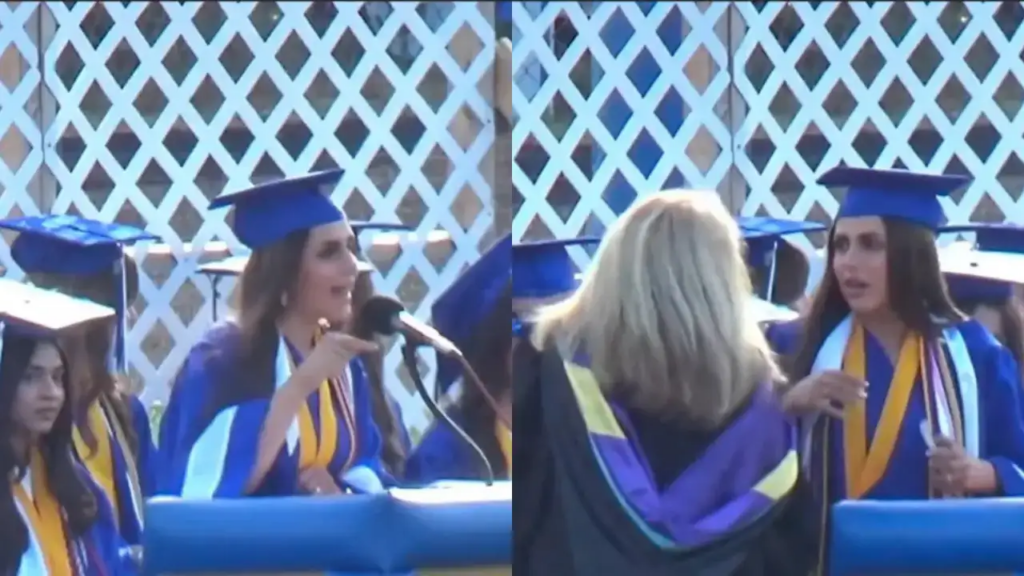
A high school graduation speech in North Carolina has sparked a national debate over free expression, student rights, and the limits of school-approved messaging. At the center of the controversy is Leen Hijaz, the valedictorian of Clayton High School, whose commencement address was interrupted after she deviated from a version of the speech that had reportedly been approved by school administrators.
Video of the incident quickly spread across social media, turning Hijaz into a national figure in an ongoing conversation about student speech at school-sponsored events. Meta Title: Who Is Leen Hijaz? Valedictorian Speech Controversy Explained
Who is Leen Hijaz?
Leen Hijaz is the 2026 valedictorian of Clayton High School in Johnston County, North Carolina.
As valedictorian, she was selected to deliver a graduation address during the school’s commencement ceremony, a role traditionally reserved for the student with the highest academic achievements in the graduating class.
Before the ceremony, school officials reportedly reviewed and approved a written version of her speech, a common practice at many public schools across the United States.
However, events took an unexpected turn when Hijaz departed from that approved text during her remarks.
What did Leen Hijaz say in her graduation speech?
Near the conclusion of her speech, Hijaz spoke about the importance of using one’s voice to advocate for people facing hardship around the world.
Addressing fellow graduates and attendees, she said that many people globally are struggling to be heard and encouraged students to recognize the value of free expression.
She then referenced several ongoing humanitarian crises and conflicts, including:
- Palestine
- Sudan
- Democratic Republic of the Congo
- Afghanistan
Hijaz also mentioned families affected by immigration enforcement actions in the United States.
According to reports, she told the audience:
“These are not distant issues. They are happening right now as I speak.”
The comments received applause and cheers from portions of the audience.
Why was her speech interrupted?
Moments after making the remarks, Clayton High School Principal Melissa Moore Hubbard approached the podium and appeared to stop the speech before Hijaz could continue.
The interruption became the defining moment of the ceremony and quickly attracted attention online after videos circulated across multiple social media platforms.
School district’s explanation
Following the incident, school officials stated that Hijaz had departed from the version of the speech that administrators had approved before graduation.
According to a statement from Johnston County Public Schools, officials intervened to keep the ceremony aligned with its intended purpose.
The district said the decision was not aimed at silencing the student but at ensuring that a school-sponsored event remained consistent with previously approved content.
School administrators argued that commencement ceremonies are structured events with guidelines that participants are expected to follow.
Why has the incident gone viral?
The controversy touches on several issues that frequently generate public debate:
Student free speech
Supporters of Hijaz argue that graduation speeches should allow students to express meaningful viewpoints, especially when discussing humanitarian concerns and social issues.
Critics of the school’s response say interrupting the valedictorian created the appearance of censorship and may have amplified attention to the speech.
School authority
Others argue that schools have the right to enforce rules governing official events.
Because commencement ceremonies are school-sponsored programs rather than open public forums, administrators often maintain authority over what is presented on stage.
This legal distinction has been central to many past disputes involving student speech.
Social media amplification
The incident might have remained a local story had it not been captured on video.
Within hours, clips of the interruption spread across X, TikTok, Instagram, and other platforms, generating millions of views and sparking debate among educators, parents, activists, and political commentators.
The rapid circulation transformed a local graduation ceremony into a national conversation.
Advocacy groups weigh in
The controversy has also attracted attention from civil rights organizations.
Council on American-Islamic Relations publicly praised Hijaz for speaking about humanitarian issues and urged school officials not to impose disciplinary measures.
The organization framed the incident as an issue involving freedom of expression and civic engagement among young people.
As of publication, school officials have not announced any disciplinary action related to the speech.
The broader debate over graduation speeches
The dispute reflects a recurring question facing schools across the United States:
How much freedom should students have when delivering speeches at school-sponsored events?
Courts have generally recognized that public schools may place certain limits on speech during official ceremonies, particularly when the speech could be interpreted as carrying the school’s endorsement.
At the same time, graduation speeches have often served as platforms for students to discuss social justice, politics, public policy, and current events.
The tension between institutional oversight and individual expression continues to generate legal and cultural debate.
What happens next?
For now, Leen Hijaz has become an unexpected national figure.
The viral moment has sparked discussions about:
- Student speech rights
- School censorship claims
- Humanitarian advocacy
- The role of graduation ceremonies
- Social media’s influence on public controversies
Whether the story leads to policy changes or further action from school officials remains unclear. What is certain is that a few unscripted moments at a North Carolina graduation ceremony have become part of a much larger national conversation.
Why this story matters
The controversy surrounding Leen Hijaz illustrates how local school events can rapidly become national flashpoints in the social media era. It also highlights competing views about education, civic engagement, and free expression. As schools continue to navigate politically and socially sensitive topics, incidents like this are likely to remain at the center of debates over who gets to speak, what can be said, and where the boundaries should be drawn.
TL;DR
Leen Hijaz, valedictorian of Clayton High School in North Carolina, became the focus of national attention after school officials interrupted her graduation speech when she referenced global humanitarian crises and immigration enforcement issues. The school district says she departed from an approved version of the speech, while supporters argue the interruption raises concerns about student free speech.