
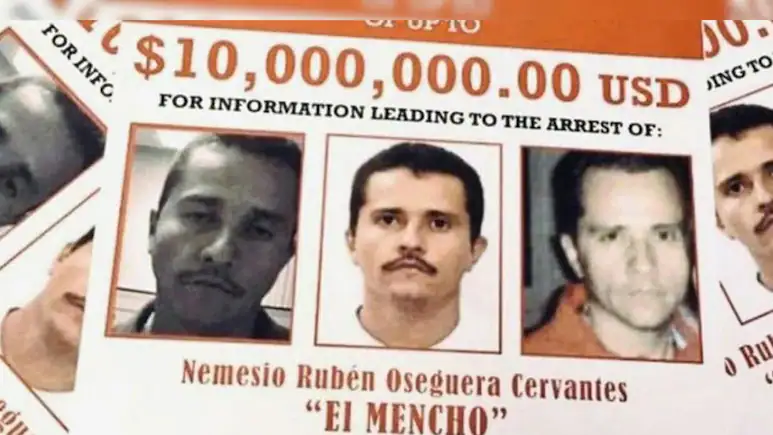
Mexico’s most wanted fugitive, El Mencho, is dead. The killing of Nemesio Ruben Oseguera Cervantes—leader of the Jalisco New Generation Cartel—marks the end of one of the most violent chapters in Mexico’s modern drug war.
For years, El Mencho stood at the center of a criminal empire accused of flooding the United States with fentanyl, assassinating officials, and turning entire cities into battlegrounds. U.S. authorities had placed a $15 million bounty on him. Mexican forces had tried—and failed—multiple times to capture him.
Now, after a military operation in Jalisco, that pursuit is over. The consequences are just beginning.
Who Was El Mencho?
El Mencho was born in 1966 in rural Michoacán, a region long shaped by both agriculture and organized crime. Avocado orchards and opium poppy fields have coexisted there for decades, reflecting the economic tensions that feed the drug trade.
Before becoming one of the world’s most feared crime bosses, Oseguera:
- Migrated to the United States in his youth.
- Became involved in heroin trafficking, according to U.S. prosecutors.
- Served prison time in the U.S. and was deported to Mexico.
- Joined local police upon returning home.
- Later defected to organized crime.
That trajectory—from cop to cartel assassin to kingpin—helped shape his reputation. Unlike some cartel leaders who emerged directly from smuggling families, El Mencho learned both sides of the law enforcement divide.
From Milenio Cartel to CJNG Founder
Oseguera initially joined the Milenio Cartel, which operated under the shadow of the Sinaloa Cartel. After internal power struggles, he broke away and founded the CJNG.
His strategy combined:
- Sinaloa-style international trafficking networks.
- The paramilitary brutality associated with the Los Zetas.
- Aggressive expansion into fuel theft, extortion, kidnapping, and human trafficking.
Within a decade, CJNG evolved from a regional player into a global trafficking force rivaling its former allies.
Why Was El Mencho So Important to U.S. Authorities?
The El Mencho story is inseparable from fentanyl.
The CJNG became a major supplier of synthetic opioids entering the United States. Fentanyl—cheap to produce, easy to transport, and extraordinarily potent—has been linked to hundreds of thousands of overdose deaths in the U.S. over the past decade.
The U.S. government labeled CJNG one of the most dangerous criminal organizations in the world. Authorities accused it of:
- Manufacturing fentanyl using precursor chemicals sourced internationally.
- Running methamphetamine super-labs.
- Smuggling drugs through established border corridors.
- Laundering profits through front businesses and shell companies.
The $15 million reward reflected how central El Mencho had become to the fentanyl crisis.
How Did the Final Operation Unfold?
Mexican defense officials said El Mencho was wounded during a military operation in Tapalpa, Jalisco, roughly two hours from Guadalajara. He died while being transported to Mexico City.
The government described the operation as its most significant effort yet to demonstrate seriousness in tackling cartel power. The timing carries geopolitical weight, especially amid U.S.-Mexico pressure over border security and drug flows.
The Cartel’s Violent Response
CJNG reacted swiftly.
- Vehicles were set ablaze across nearly a dozen states.
- Roads were blocked.
- Schools closed in several areas.
- Guadalajara effectively shut down as residents sheltered indoors.
The message was unmistakable: removing the boss would not instantly dismantle the machine.
How Did El Mencho Evade Capture for So Long?
For years, El Mencho slipped through operations that captured or killed other major figures, including Joaquin Guzman.
Unlike Guzmán, who cultivated media myth and notoriety, El Mencho preferred relative obscurity. Few confirmed photos exist. He rarely gave interviews. His voice surfaced mainly through leaked audio threats circulated online.
Political Protection and Local Influence
Experts have long argued that CJNG expanded not only through fear but through patronage.
Analysts such as Edgardo Buscaglia of Columbia University have said the cartel invested heavily in political influence. That included alleged campaign financing and bribery—claims that would require sourcing from court documents or investigative reporting.
“Hearts and Minds” Strategy
During the COVID-19 pandemic, videos circulated showing CJNG-branded food packages distributed in struggling communities. The optics mattered.
In regions where the state presence was weak, CJNG positioned itself as an alternative authority—one that provided aid, even as it enforced control through violence.
What Made CJNG Different?
CJNG distinguished itself through spectacle and force.
Militarized Tactics
In 2015, cartel gunmen shot down a Mexican military helicopter with a rocket-propelled grenade during a failed attempt to capture El Mencho. The incident stunned the country and underscored CJNG’s access to heavy weaponry.
During a six-week period that same year, the group reportedly killed two dozen police officers in western Mexico.
High-Profile Assassination Attempts
In 2020, an assassination attempt targeted Mexico City’s then-police chief, Omar Garcia Harfuch. Two bodyguards were killed. Authorities blamed CJNG.
Harfuch later rose to become Mexico’s security chief and played a role in the operation against El Mencho—closing a violent loop years in the making.
Does El Mencho’s Death Weaken CJNG?
History suggests cartel decapitations rarely end the violence.
When Guzmán was captured, the Sinaloa Cartel fractured into competing factions. Power vacuums often trigger internal wars, splinter groups, and even more bloodshed.
Three key questions now loom:
- Succession: Who takes control? CJNG has senior lieutenants, but clear leadership lines are murky.
- Fragmentation: Will the cartel split into rival cells?
- Territorial wars: Will competitors move into CJNG-controlled regions?
Security analysts often warn that removing a top leader can create short-term chaos before any long-term stabilization—if stabilization comes at all.
A comparison chart here—“Cartel Leader Removed vs. Violence Trends”—would help illustrate the pattern.
Why This Matters Beyond Mexico
El Mencho’s rise reflected deeper structural forces:
- U.S. drug demand.
- Weak institutions in parts of Mexico.
- Globalized chemical supply chains.
- Corruption at local and national levels.
His death may satisfy a symbolic milestone, but the fentanyl trade is decentralized. Labs can relocate. Leadership can regenerate. Demand remains constant.
For U.S. readers, this story connects directly to:
- Border policy debates.
- The opioid crisis.
- Discussions about labeling cartels as terrorist organizations.
- U.S.-Mexico diplomatic relations.
TL;DR
- El Mencho, leader of the CJNG, has died after a Mexican military operation.
- He built one of the world’s most violent and powerful cartels.
- CJNG played a central role in fentanyl trafficking into the U.S.
- His death may destabilize—but not necessarily dismantle—the organization.
- The broader drug war dynamics remain unchanged.
What Comes Next?
The killing of El Mencho closes one chapter but leaves the larger story unresolved.
Cartels are ecosystems, not one-man operations. Removing the head doesn’t automatically dismantle the network. Financial pipelines, political connections, and trafficking routes often survive leadership losses.
Whether this moment becomes a turning point—or simply another spike in a long war—will depend on what follows:
- Sustained institutional reform.
- Financial disruption of cartel money flows.
- International cooperation on precursor chemicals.
- Addressing demand in the United States.
Without those elements, El Mencho’s bloody legacy may outlive him.